“If they mean to have a war, let it begin here.” Captain Parker

On April 19, 1775, the first armed conflict of the American Revolutionary War took place on the village green in Lexington, Massachusetts. I picture the tension in those early morning hours, Paul Revere, William Dawes, and Samuel Prescott had alerted the local militia, and two of my 5th great-grandfathers, Joseph Simonds and Joel Viles, stood among the seventy-seven men of Captain John Parker’s Company facing 800 British soldiers.
As the standoff unfolded, a shot suddenly rang out, its origin remains a mystery, and the British troops opened fire. Eight colonists were killed, and several others wounded, marking the beginning of open revolution. I feel immense pride knowing that my ancestors were there, part of that “shot heard round the world.”
Joshua Simonds (6th g-grandfather) was present at Lexington Green and had gone into the meetinghouse for gunpowder with Caleb Harrington and Joseph Comee. Comee was killed and Harrington was wounded as they attempted to leave the house. Simonds stayed to safeguard the gunpowder.
“When the British came up in front of the meeting-house, Joshua Simonds was in the upper gallery, an open cask of powder standing near him, and he afterward told me, that he cocked his gun and placed the muzzle of it close to the cask of powder, and determined to “touch it off,” in case the troops had come into the gallery.” Deposition of Ebenezer Munroe on 2 April 1825.
Read More about the Depositions: In the aftermath of the Battles of Lexington and Concord, the Massachusetts Provincial Congress ordered depositions to be taken from eyewitnesses. The Congress was trying to prove the British fired first at Lexington. Deposition #7 was given by Nathaniel Mullikin, Philip Russell, and others, who testified the British fired first at the Battle of Lexington. Source: American History Central
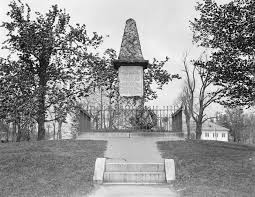
Lexington‘s Revolutionary War Monument
Funded by the Commonwealth of Massachusetts, following a 1797 petition to the General Court by Joseph Simonds to,”preserve to posterity a record of the first effort made by the people of America for the establishment of their freedom and independence,”
Erected on July 4, 1799, Lexington‘s Revolutionary War Monument is the oldest war memorial in the United States. Featuring a granite obelisk set on a simple pedestal, it marks the approximate location of the line of the Lexington militia that stretched across the town common to confront the British Regulars on April 19, 1775.
Source: Monuments – Freedom Way
Read more about Lexington: (246th Anniversary) The Shot Heard Round Buckman Tavern
Copyright © 2026. All Rights Reserved by David R. French

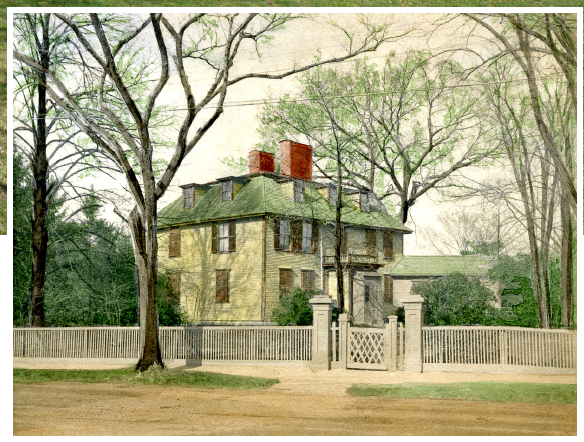 The Buckman Tavern is most renowned for its role in the events of April 19, 1775. However, the site is important in other ways. It has been a notable presence in Lexington since it became a tavern in 1713, shortly after it was built. As a “Public House of Entertainment,” the Tavern was faithfully tended by