The Brothers French

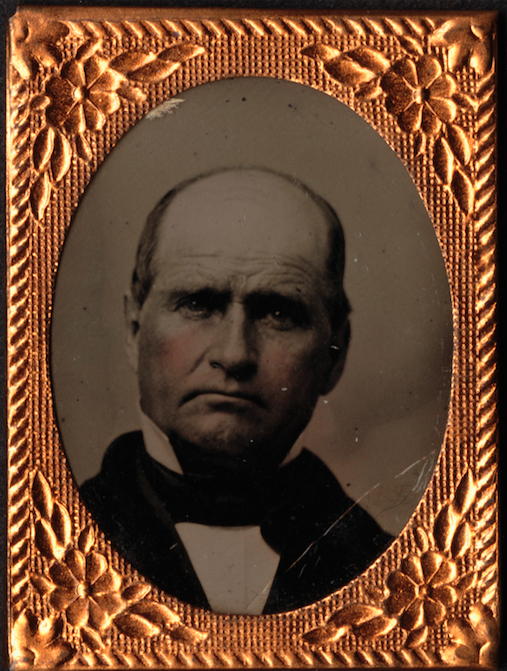
The following provides brief biographical sketches of Josiah and Amos French, the brothers of my 3rd great paternal grandfather Abram French (Photo left). I have to admit a little familial pride, these French boys were an amazing, enterprising lot! I have written several posts about Abram: Leading Citizen – Abram French, Priceless – Abram French, and Which Abram Are You.

Mr. Amos French belonged to the class of men who made their way into the world unaided, and without encouragement of any kind. He was in every respect a self-made man and the success which he secured in his years later was the fruit of his own persevering effort and stern self-denial.

( the History of Lowell”)

(Edited excerpt from the History of Lowell) Mr. Amos B. French was born in Billerica, July 3, 1812, and died in Lowell, March 23, 1890. Mr. French was descended from a family whose members were among the early colonial settlers. His common ancestor in this country was Lieutenant William French, who arrived here in 1635, and was elected the first Representative of the town of Billerica in 1663-64. Amos received his early education in the country schools of his native place, and came to Lowell at the age of 11 years to engage in business. At different times he was employed by the manufacturing companies of Lowell, and in 1835 was the keeper of a restaurant. He afterwards engaged in the crockery business with Mr. Puffer, under the firm name of French & Puffer, in which business he continued for twenty-seven years.

Amos served the city as member of the Board of Aldermen in 1870-71. At the time of his death he was a Director of the First National Bank, a Director of the Lowell Mutual Fire Insurance Company, and a Trustee of the Lowell Institution for Savings.

I recently came across a much more detailed story about the life of Amos, he had a very interesting and, some might say, sweet career. Amos B. French – The story is contained in a book entitled, Twirling Jennies: A History of Social Dance in the City of Spindles by Ruth Evans”

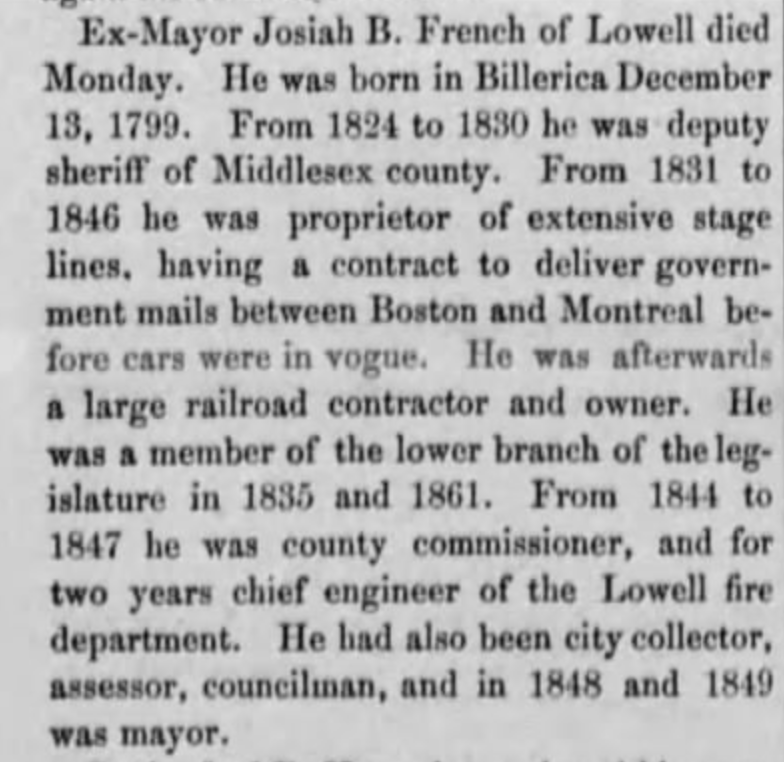
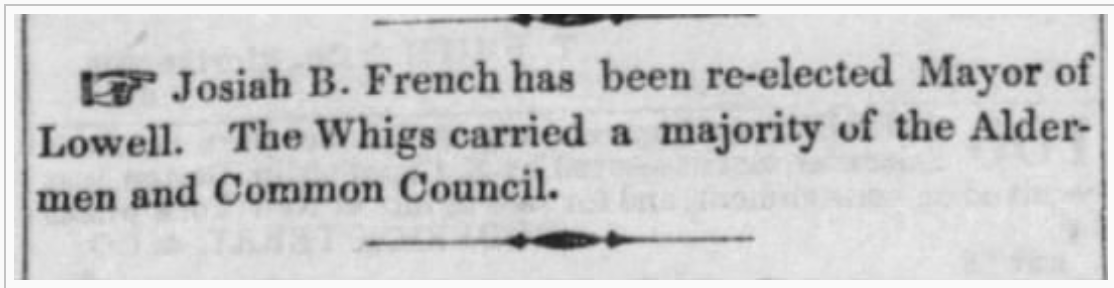
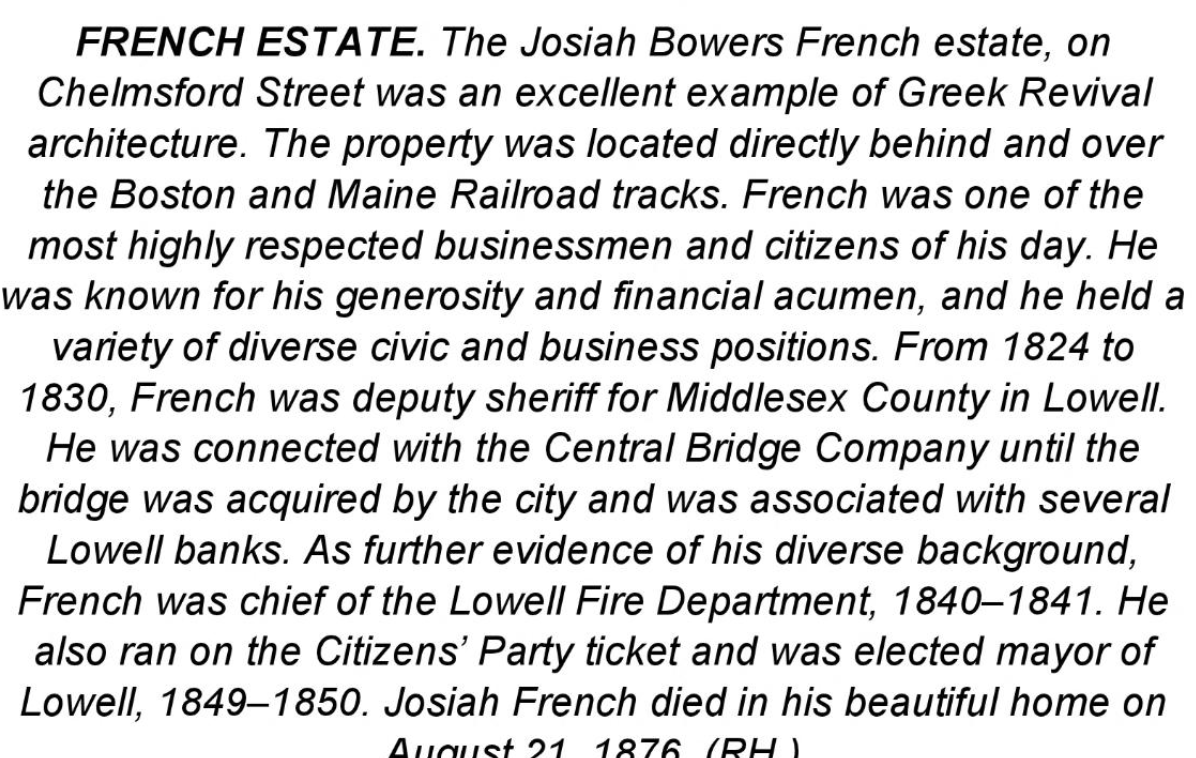
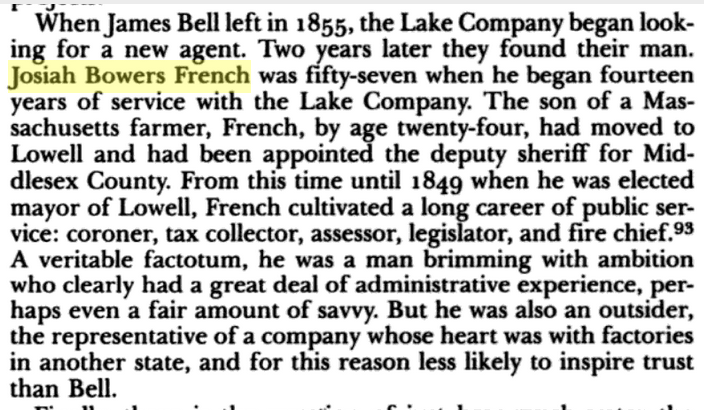
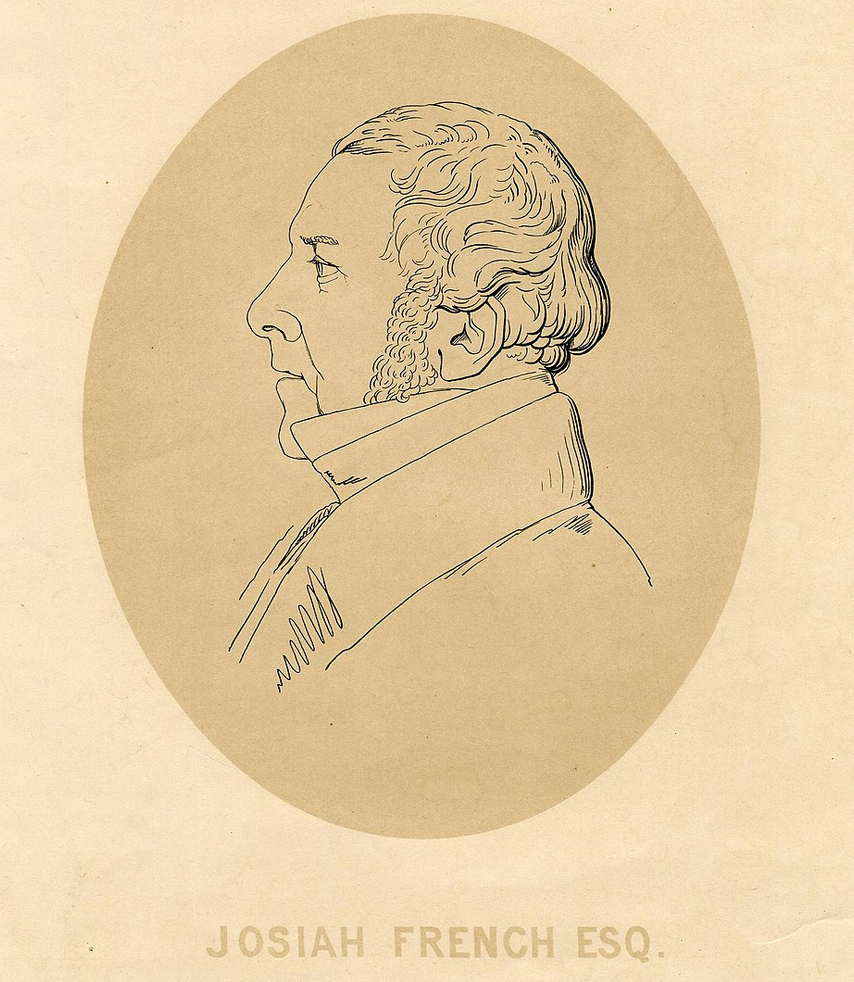
“(Josiah) French was one of the most highly respected businessmen and citizens of his day. He was known for his generosity and financial acumen.”

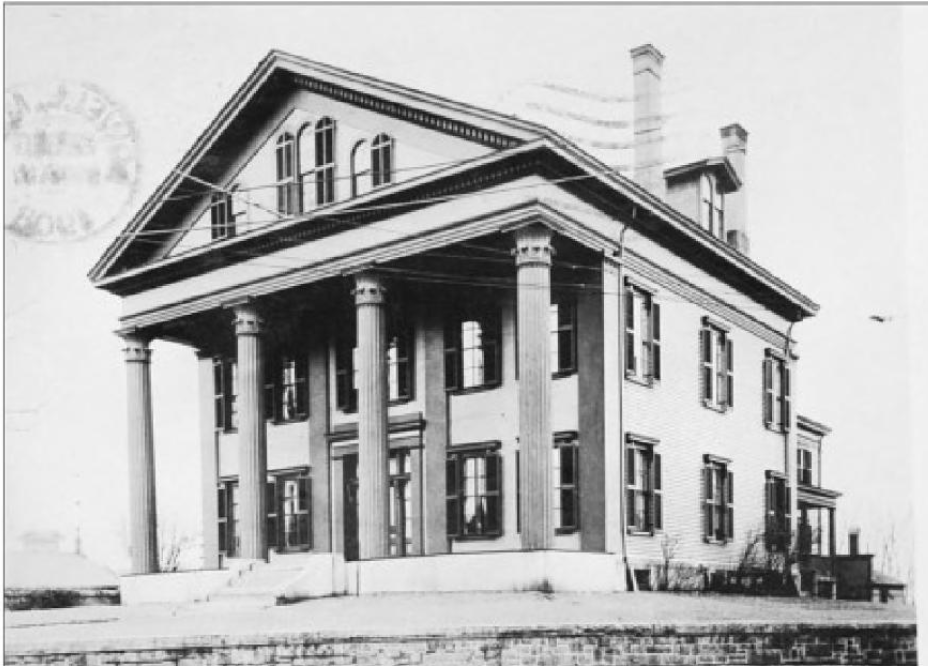
French Estate
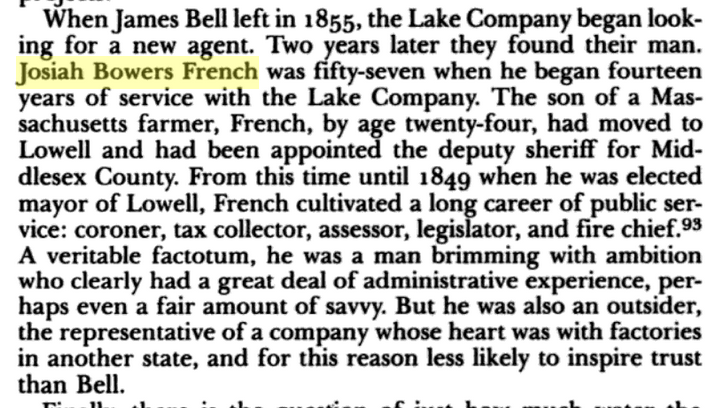
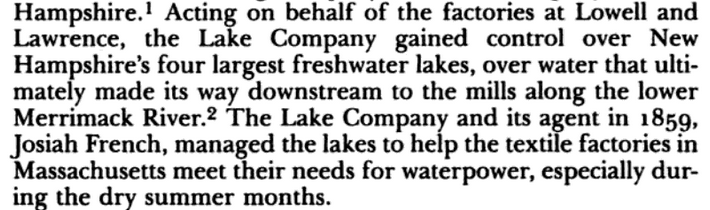
Nature Incorporated: Industrialization and the Waters of New England, 1992

The Winnipesaukee Water War and the 1859 Fight for NH Property Rights (Article posted by the New England Historical Society) Great article about this long running New England water war – “On Sept 28, 1859, James Worster led 50 angry farmers, mill operators, loggers and laborers in a vain effort to destroy a 250-foot dam that controlled the outflow of Lake Winnipesaukee. The dam regulated how much water flowed into the Merrimack River and powered the cotton cards, the spinning frames and the power looms of the enormous textile mills in Lowell and Lawrence, Mass. It was just one battle in the Winnipesaukee water war that had gone on for years.”

…. “When the men showed up, the sheriff arrived and sent them away. Undeterred, they came back in the afternoon and began removing the planking. The Lake Company’s agent, Josiah French, and his assistant tried to stop them. In the course of the struggle, French’s assistant struck one of the men on the hand with an iron bar. Some of them tried to push French off the dam. The dam attackers left again, only to return around nightfall with a larger crowd. Worster arrived with the 50 men wielding axes and iron bars. They came from as far away as Concord. And they brought with them a law enforcement officer who arrested French and his assistant for assault and battery.” …. “French was then sued for assault because he’d clubbed a rioter’s hand with an iron bar. A jury acquitted him.”

Comments, edits and suggestions are welcome!

Copyright © 2022. All Rights Reserved by David R. French


Leading Citizen – Abram French

(Story from History of Lowell, Mass., content edited)

Among the men who were prominently identified with the early history of Lowell, few are more entitled to be held in respectful remembrance than Mr. Abram French.  Mr. French was the fifth in a family of eleven children.  He was born in Billerica, Mass., Dec. 13, 1803, and died at Lowell, April 11, 1879. 

Abram was descended from Lieut. William French, who was born in England in 1604.  He married in England, came to New England aboard the “Defense” in 1635, and died Nov. 20, 1681.  From this ancestor the line of descent runs as follows:

  • Jacob French was born January 16, 1639-40, married Mary Champney, Sept. 20, 1665, and died May 20, 1713.
  • William French was born July, 1668, married Sarah Danforth, May 22, 1695, and died Sept. 30, 1723.
  • Ebenezer French was born August 5, 1707, married Elizabeth Hill, Aug. 27, 1729, and died Dec. 31, 1791.     
  • Jesse French was born April 6, 1739, and married Abigail Jaquith, April 14, 1761.
  • Luther French was born in Fitchburg, MA on September 25, 1767, married Sarah Bowers, Aug. 28, 1796, and died in Lowell, March 15, 1846.

Mr. (Abram) French received his education in the public schools of his native town, and went out of school assisted his father in the work of the farm.  At the age of 17, he went to Lexington, Mass., where he was employed in a general country store for a few years, after which he went into the dry goods business in East Lexington for himself.  In 1835, he came to Lowell and was identified with business interests here for the greater part of his life.

Mr. French, in early manhood was a stanch Democrat, became a member of the Free Soil Party during the struggle between the north and south, and attended the Free Soil Convention at Buffalo in 1848.  On the formation of the Republican Party he joined that party and remained a Republican till his death.

During the anti-slavery agitation he was active in the movement in Lowell, and was strongly in favor of abolition, and so deep was the impression of those trying times that his sympathy for the colored race remained always true and steadfast.  Though taking an active interest in public affairs, he never sought office.  He was a member of the Common Council in 1852 and 1853, and afterward of the School Board for a number of years.  He early joined the Free Masons, and was a member of Pilgrim Commandery of Knights Templar.  He filled various positions of trust and was a Trustee of the City Institution for Savings, and a Director of the Lowell Mutual Fire Insurance Company for many years.

In religious belief he was a Unitarian from boyhood, and was a constant attendant at the Church of the First Unitarian Society of Lowell.  Mr. French was twice married; first, on July 21, 1831, to Elizabeth Simonds, of Lexington, Mass., and second, on Nov. 20, 1855, to Alice Dean of Providence, R.I.  By his first wife he had: Charles A., born April 18, 1832; who married Elizabeth M. Holbrook, of Boston; Elizabeth, born July 7, 1834, who married Charles Darrow, of Boston; James O., born Jan. 5, 1838, who died in childhood; George W., born March 8, 1840, who married Jennie S. Hall, of Boston; and Horace E., born Feb. 24, 1843, who married Laura M. Foster, of Medford. By his second wife he had: Alice, born Sept. 3, 1856, who married Frederic P. Spalding, of Lowell; Gertrude, born Nov. 29, 1857; and Anna, born Sept. 20, 1859, both of whom died in childhood.

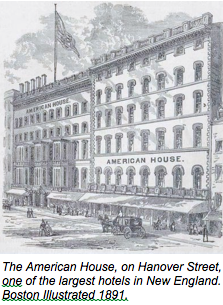
For many years he was a merchant tailor, occupying a building on Central Street, which he purchased from the Middlesex Mills Company in 1841.  During his ownership the Appleton Bank was one of his tenants, several prominent professional men occupied offices in the building, and Mr. French’s store was a rendezvous for many men who afterwards rose to distinction in the Democratic Party.  In 1849, he sold the building to the Appleton Bank, intending to remain as a tenant, but a long delay in rebuilding caused him to change his plans, and later he went into the retail clothing business, under the American House Hotel, from which he retired in 1868.

Additional Posts about Abram:

Priceless – Abram French

Which Abram Are You?


Bodurtha – Tragic Drowning

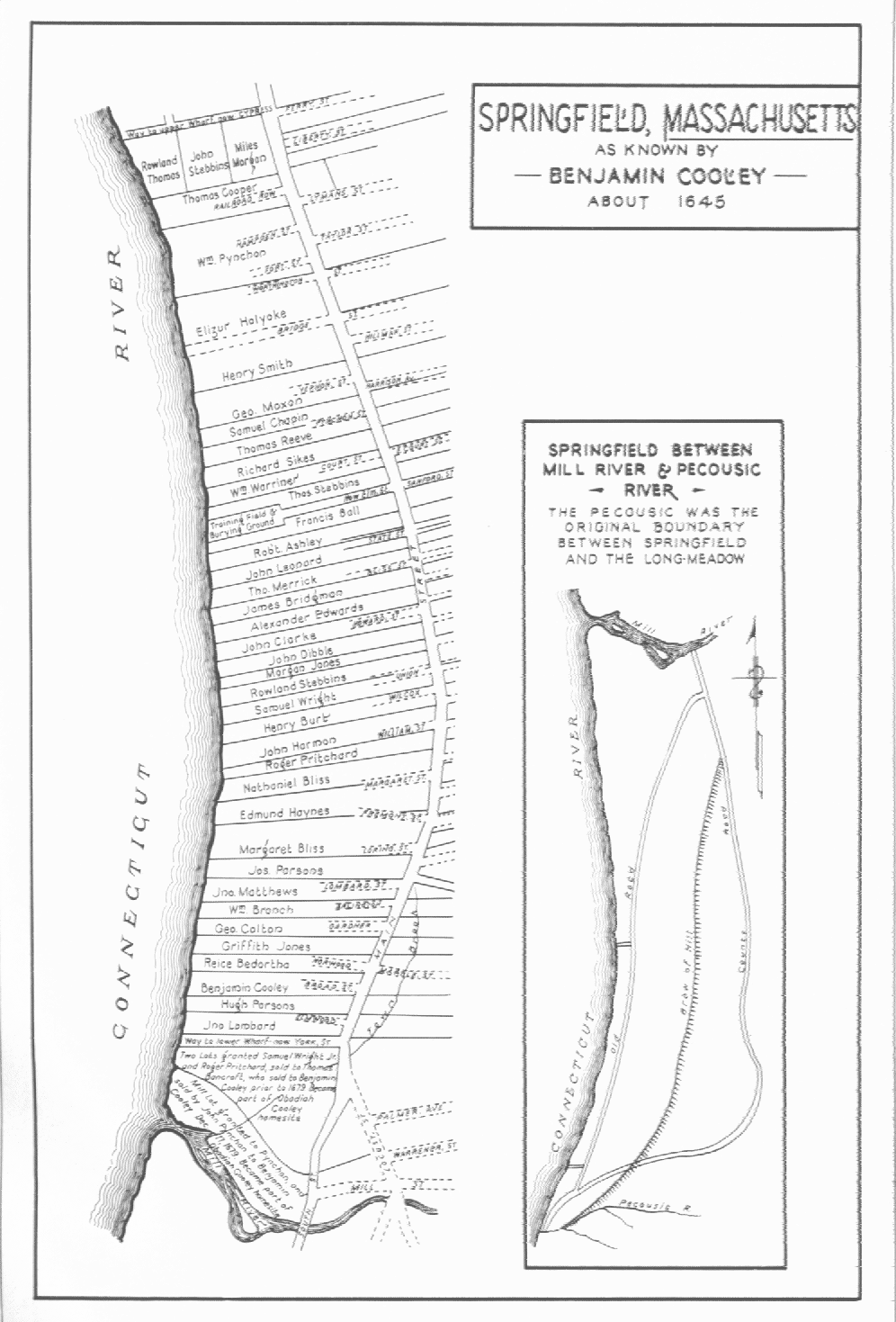
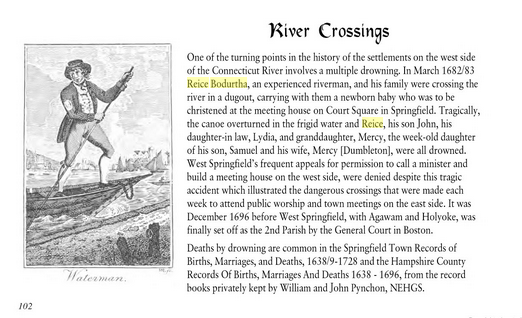
Reice Bodurtha, my 8th paternal great-grandfather, was born in 1621 in Wales and married Blanche Lewis in 1646 in Springfield, Massachusetts. Together, they had four children (John (died at birth), John, Joseph, Samuel) during their marriage. In 1645, he was granted a house lot, wet meadow and woodland by the Plantation of Agawam (Springfield Colony). The house lot extended from “Ye streete fence to Ye great river.”  The map (at left) illustrates the location of the Bodurtha house lot.

Sadly, Ye great river – the Connecticut River, was the place where Reice and his family suffered a tragedy. The event is described is in Stories Carved in Stone: Agawam, Massachusetts (Rusty Clark, 2005).

Which, Witch?

In 1652, Hugh Parsons, of Springfield, Massachusetts, was convicted before William Pynchon on formal charges of witchcraft. One of his formal accusers (along with his wife and most of the town) was Blanche Bodurtha, my 8th great-grandmother.

Witch-Hunting in Seventeenth-Century New England: A Documentary History 1638

Before Salem: Witch Hunting in the Connecticut River Valley, 1647–1663

© David R. French and French in Name Only, 2019. Unauthorized use and/or duplication of this material without express and written permission from this blog’s author and/or owner is strictly prohibited. Excerpts and links may be used, provided that full and clear credit is given to David French and French in Name Only with appropriate and specific direction to the original content.


Captain Jonathan, Gentleman

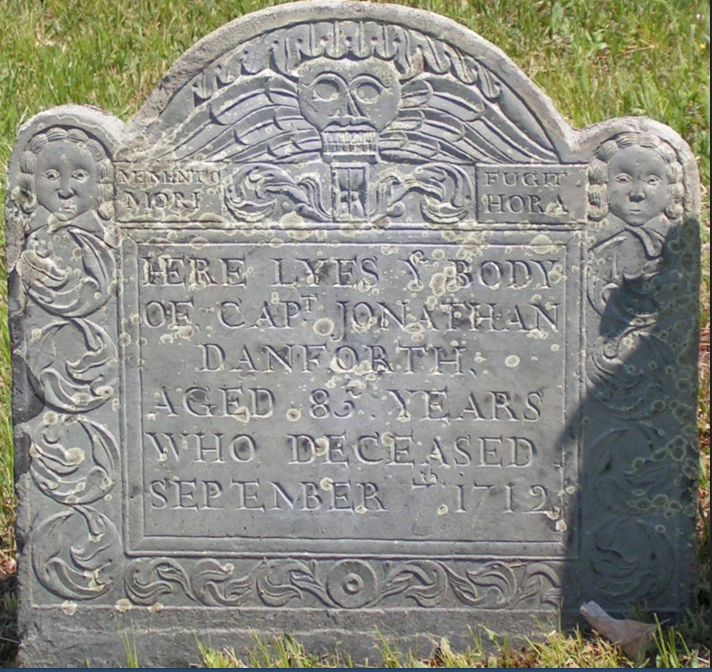
The following story is about Jonathan Danforth, my 8th great paternal grandfather.  Jonathan was born on February 28, 1627 in Framlingham, England and died at the age of 85 on September 7, 1712 in Billerica, Massachusetts.  By all historical accounts, he was a respected community leader and a gifted surveyor. In the inventory of his estate, he is referred to as “Captain Jonathan, Gentleman.”

Part two touches on Jonathan’s involvement and response to conflicts between  Native Americans and colonists.  Part three provides a brief story about Jonathan’s brother, Thomas Danforth, who played a role in the Salem witch trials.

Part One – Early New England Colonist, Gifted Surveyor, Community Leader

When
Jonathan was five years old, he came to America with his father,
Nicholas Danforth, brothers Thomas and Samuel and his three sisters,
Anna, Lydia, and Elizabeth. Jonathan’s mother had died a week before he
was a year old.

The Danforth family sailed on the Griffin, departing England on August 1,1634 arriving in Boston on September 18. The Griffin weighed 300 tons and carried about one hundred passengers and cattle for the colonies plantations. It is believed that he spent his youth in New-Towne (later Cambridge) living with his father until his death in 1638 and then lived with an elder, married sister. At the age of twenty, he left Cambridge and was a founding father of Billerica, Massachusetts. He married Elizabeth Poulter in Boston on November 22, 1654 and together they had eleven children.  Elizabeth died on October 7, 1689. Their daughter, Sarah (1676-1747), married William French (my 7th great-grandfather).

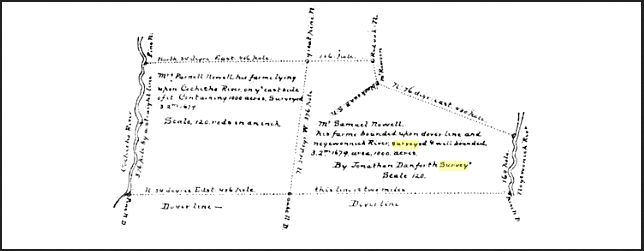
Jonathan was a noted land surveyor and his descriptions of this service fill some 200 pages in the first volume of Land Grants. He held many public offices: deputy for the town, town clerk, selectman and he also represented the town at the General Court in 1684/5.

“He rode the circuit, chain’d great towns and farm, To good behavior, and by well marked stations, He fixed their bounds for many generations.  His art ne’er failed him, though the loadstone faile.  When oft by mines and streams it was assailed.  All this is charming, but there’s something higher.  Gave him the lustre which we most admire.” Poem by his nephew, the Rev. John Danforth of Dorchester.

Part Two – King Philip’s War and the Fate of Indian Children

It
was also an especially bloody war—the bloodiest, in terms of the
percentage of the population killed, in American history. The figures
are inexact, but out of a total New England population of 80,000,
counting both Indians and English colonists, some 9,000 were killed—more
than 10 percent. Two-thirds of the dead were Indians, many of whom died
of starvation. Indians attacked 52 of New England’s 90 towns, pillaging
25 of those and burning 17 to the ground. The English sold thousands of
captured Indians into slavery in the West Indies. New England’s tribes
would never fully recover.
Blood and Betrayal: King Philip’s War

Starting
in 1646, colonists began to establish “praying towns” in an effort to
convert New England tribes to Christianity.  By the year 1675, there
were an estimated 1,100 Praying Indians in Massachusetts located in fourteen Praying Towns.
These towns were situated so as to serve as an outlying wall of defense
for the colony. Wamesit, a praying town, was located within five miles
of Billerica.

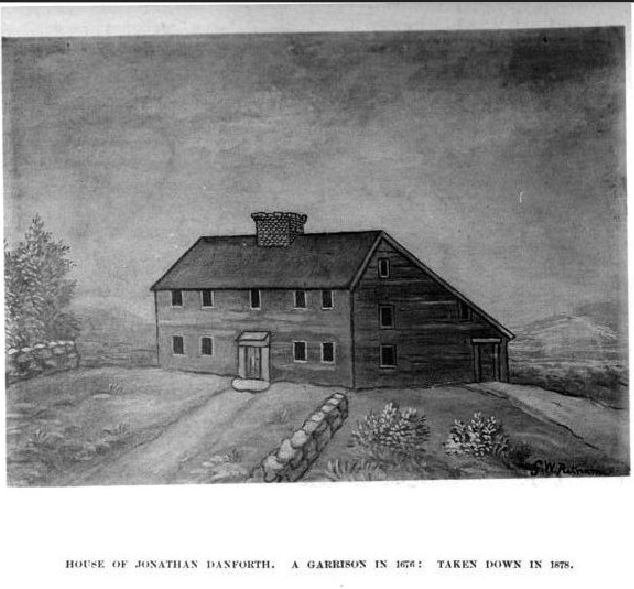
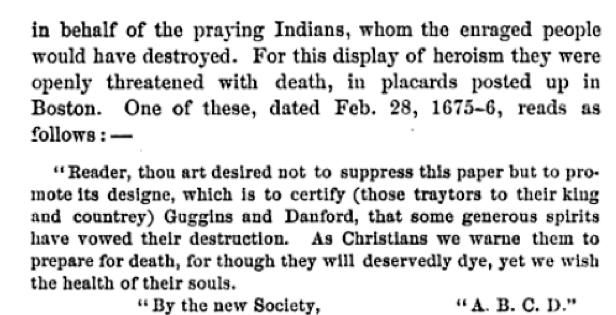
Jonathan Danforth served during King Philip’s War under Major Daniel Gookin. The town of Billerica had twelve garrison houses, each was providing a defensive space for four to seven families. The homes of Jonathan Danforth and Jacob French’s (8 great grandfather) house both served in this capacity.  During the war, Daniel Gookin, Jonathan and Thomas Danforth were protective of their neighbors, the Praying Indians, resulting in threats on their lives for interceding….

Following
the war, some Indian children where placed into servitude in the homes
of local residents where they “were to be provided religious education
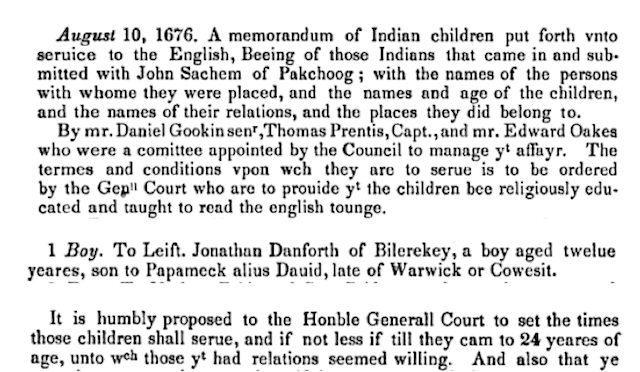
and taught to read the english tounge.”  According to published
accounts, “a boy of twelve, son to Papa Meck, alias Dauid, late of
Warwick or Cowesit, Rhode Island, was apportioned or bound out to
Jonathan Danforth.” The boy, later known as John Warrick died on January
15, 1686 at Billerica.

The following extract from the New England Historical and Genealogical Register, 1854 (Indian Children Put to Service) provides a listing of the children, the names and status of their parents and to whom they were been placed.

Part III – Thomas Danforth – Judge not lest ye be judged

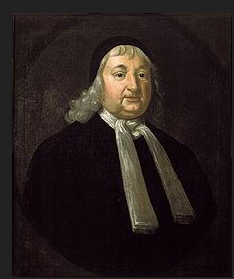
Jonathan’s brother Thomas Danforth (portrait) was the first treasurer for Harvard College and elected president of the province of Maine, then independent of the colony of Massachusetts.  One published account observed, “Perhaps the most intriguing characteristic of Thomas Danforth was his willingness to stand up for his convictions despite opposition.”  Considered a progressive advocate for colonists’ rights, he also was persecuted for his decent treatment of the Praying Indians during King Philip’s War.

Deputy
Governor Thomas Danforth traveled to Salem in the early months of 1692
as part of a preliminary inquiry into the matter of witchcraft being
practiced.  He was not appointed to serve as one of nine judges name to
the Court of Oyer and Terminer (hear and determine) established for the Salem witch trials
and was vocal in his distaste for the manner the witchcraft proceedings
were conducted.  As a demonstration of his sympathy for those swept up
in the hysteria, he provided sanctuary on his own property (Danforth
Plantation) for Salem families seeking asylum, including Sarah Cloyes
and her husband and children. (Check out this great post – Witch Caves & Salem End Road)

Additional Sources:

History
of Framingham, Early Known as Danforth’s Farms 1640-1880; with a
Genealogical Register by Temple, Josiah Howard; published Framingham
1887.

The Danforth Family in America – Fifth Meeting; published Boston 1886

© David R. French and French in Name Only, 2019. Unauthorized use and/or duplication of this material without express and written permission from this blog’s author and/or owner is strictly prohibited.


Ben and Jerry

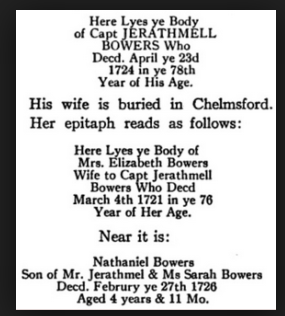
Benanuel and Jerathmeel Bowers (Ben and Jerry)

Warning:
this story contains references to fornication, moonshine, corporal
punishment and jail. (Good, now that I have your attention – Read on!)

My 7th paternal great-grandfather, Jerathmeel Bowers, was born in Cambridge, Massachusetts in 1650 to George and Elizabeth (Worthington) Bowers.  When Jerathmeel was six his father died and six months later his mother Elizabeth married Henry Bowtell.

The
next mention of Jerathmeel in 1670 states that he “proved an
outrageously insolent servant and was convicted of premarital
fornication. (with Elizabeth Wilder)” (Sex in Middlesex). 
Massachusetts law provided,”that if any man commit fornication, with
any single woman, they shall be punished, either by enjoining marriage,
or fine, or corporal punishment, or all or any of these, as the judge of
the Court that hath Cognizance of the case shall appoint”

In
1670, records show that Jerathmeel and Elizabeth were enjoined by the
court and in 1671 had their first child, Hannah. Jerathmeel served in King William’s War and later as a captain in Queen Anne’s War.

Jerathmeel operated a still on the corner of his property and may have been the first man in Chelmsford to receive a license to sell liquor (“strong waters”). He was actively engaged in farming and became one of Chelmsford’s most prominent citizens, in addition to being a man of substantial wealth. His greatest distinctions came from serving the Town of Chelmsford as a selectman in 1690-92, state representative in 1697 and 1698.  (Groton’s Anonymous Mistress, Carl Flowers)

Benanuel Bowers
George Bowers by a previous marriage had a son who he named  Benanuel
(1627-1698).  According to published accounts, Benanuel and his wife
Elizabeth (Dunster), due to being Quakers, both received “cruel
whippings and imprisonment and the loss of part of their worldly
substance” through “the outrage and violence of fiery zealots of the
Presbyterian party.”

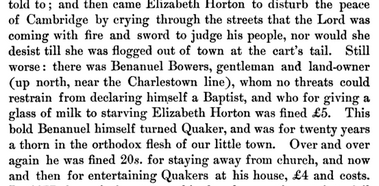
In the above noted case, he came to the aid of a well known early Quaker by the name of Elizabeth Horten. From an account of her travels “So afterwards I returned to Cambridge, where they were very thirsty for blood because none had been there before that I knew of, and I cried repentance through some part of the town. So they took me and had me early in the morning before Thomas Danforth and Daniel Gookin, two of their magistrates who by their jailer thrust me in a very dark dungeon for the space of two days and two nights without helping me to either bread or water. But a Friend, Benanuel Bower, brought me some milk and they cast him into prison because he entertained a stranger and fined him £5.”

Other offenses of his are also documented – Benanuel Bowers appearing before the court and being convicted of absenting himself the public ordinances of Christ on the Lord’s days, by his own confession, for about a quarter of a year past, and of entertaining Quakers into his family two several times, on his examination he affirmed that the Spirit of God was a Christian’s rule. (Source)

Bathsheba, the daughter of Benanuel and Elizabeth, was a “Quaker writer and speaker Bathsheba Bowers wrote a spiritual autobiography, An Alarm Sounded to Prepare the Inhabitants of the World to Meet the Lord in the Way of His Judgments (1709), one of the first published religious testimonials by an Anglo-American woman.” Bathsheba Bowers | History of American Women

Note: Elizabeth Dunster Bowers was the the niece of first president of Harvard University, Henry Dunster.

For further information about Colonial America read:

America’s True History of Religious Tolerance
– The idea that the United States has always been a bastion of
religious freedom is reassuring—and utterly at odds with the historical
record (Smithsonian Magazine, Oct 2010)

© David R. French and French in Name Only, 2019. Unauthorized use and/or duplication of this material without express and written permission from this blog’s author and/or owner is strictly prohibited.


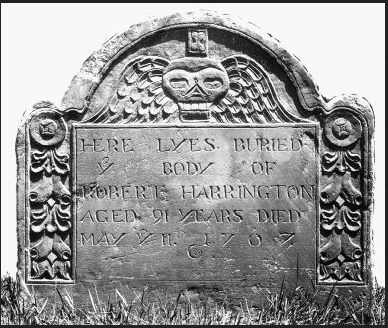
Here Lies Robert Harrington

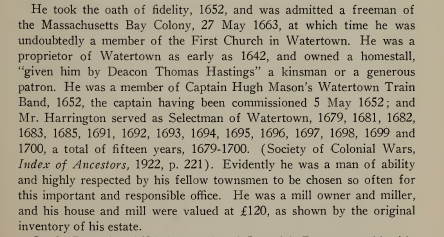
The gravestone of my paternal 9th great-grandfather Robert Harrington notes he was born in 1616 in Somerset, England and died in 1707 in Watertown, Massachusetts at the impressive age of 91!  Robert came to New England on the ship Elizabeth in 1634. His estate lists a house, mill and over 647 acres of land.

Early generations of the family of Robert Harrington of Watertown, Massachusetts, 1634, and some of his descendants. (above)

Genealogical and Personal Memoirs Relating to the Families of Boston and Eastern Massachusetts, Volume 4

Comments/Reviews  Appreciated!

© David R. French and French in Name Only, 2019. Unauthorized use and/or duplication of this material without express and written permission from this blog’s author and/or owner is strictly prohibited. Excerpts and links may be used, provided that full and clear credit is given to David French and French in Name Only with appropriate and specific direction to the original content.


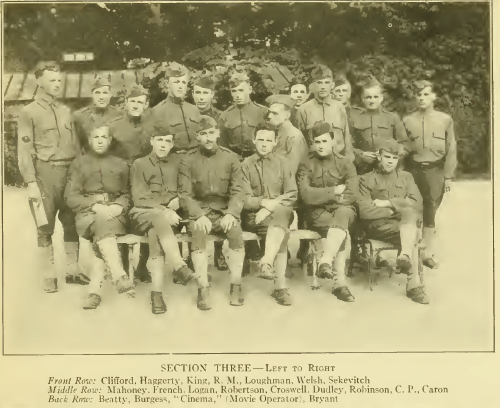
Pvt. George B. French – World War 1

On May 11,
1917, my paternal grandfather, George Bradley French (1898-1983) sailed to
London as a Private in the American Expeditionary Force assigned to U.S. Army
Base Hospital No. 5, referred to as the Harvard University Base Hospital
Unit.  Base Hospital No. 5 was one of six American Expeditionary Forces
Base Hospitals loaned to the British Expeditionary Forces for the duration of
the First World War.  Their first post was with the British Expeditionary
Forces at Camiers, fifteen miles south of Boulogne on the coast of
France.  In the six months Base Hospital No. 5 was stationed in Camiers
they treated over 15,000 cases, with 3,000  patients in June 1917 alone.

Despite being miles behind enemy lines and clearly marked as a hospital, the Base was not exempt from danger.  On the night of September 4th, a Imperial German Air Service heavy Gotha bomber flew over the Camiers area and dropped a succession of seven bombs, five of them being direct hits in Base Hospital No. 5’s compound resulting in several deaths and injuries (The Bombing of the Harvard Base Hospital. In October 1917, the hospital would move to Bolougne, where it remained until the end of the war.

A book about the unit, The Story of Base Hospital #5, includes the following description of George, “A young blond chap who helped Ronnie King to run the reception tent for the first months in Camiers. However, the young man set out to capture a record and tried to corral all the P. U. O. bugs in France. So, he spent most of his time in the hospital, and was eventually invalided home. ”

PUO –
Pyrexia Unknown Origin
or referred to as trench
fever.  It took the military months before being able to identify a
vector, the louse, which was later proved to transmit the disease. 
Recovery was slow, often lasting months.  According to medical studies,
fever associated with PUO had a peculiar characteristic in that it would break
after five or six days, but then climb again several days later. This cycle
might be repeated as many as eight times.  Poor George.

Is it George?

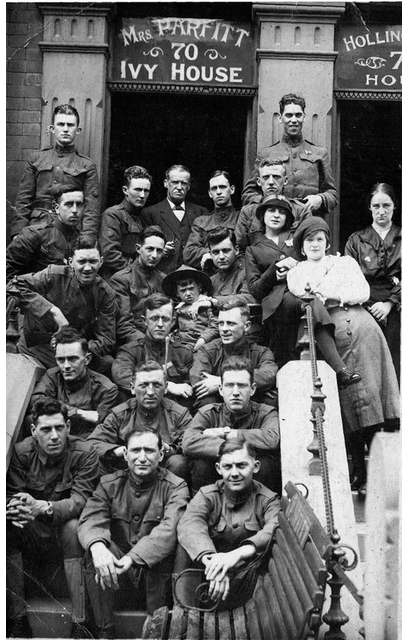
This photograph, entitled U.S. Base Hospital No.5 – London, is in the collection of the Littleborough (England) History Centre.  On the back of the photograph is an address: Pte. A Simpson, US Base Hospital Unit 5, c/o Sir Alfred Keough, War Dept, London

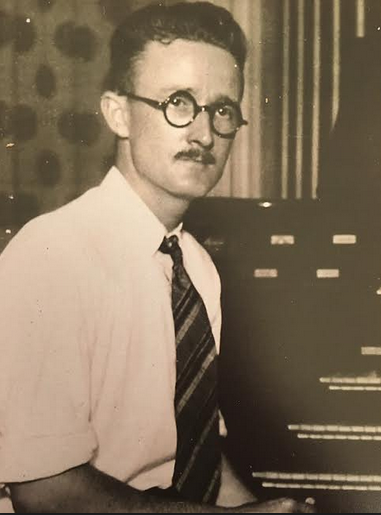
I confirmed that Albert E. Simpson was a Private-1st Class in this unit and that in transit to France, the unit stayed briefly in London.  I was also able to match the identities of several of the soldiers in the photo with those in the unit history.  I am certain that George is also in the photo, standing to the left of the local man near the top of the stairs.  As a comparison, a photo (right) of George taken several years later shown from a similar angle (check out the forehead, nose and eyes).  Update – George’s daughter, Barbara (Bref), confirmed that it is indeed George!

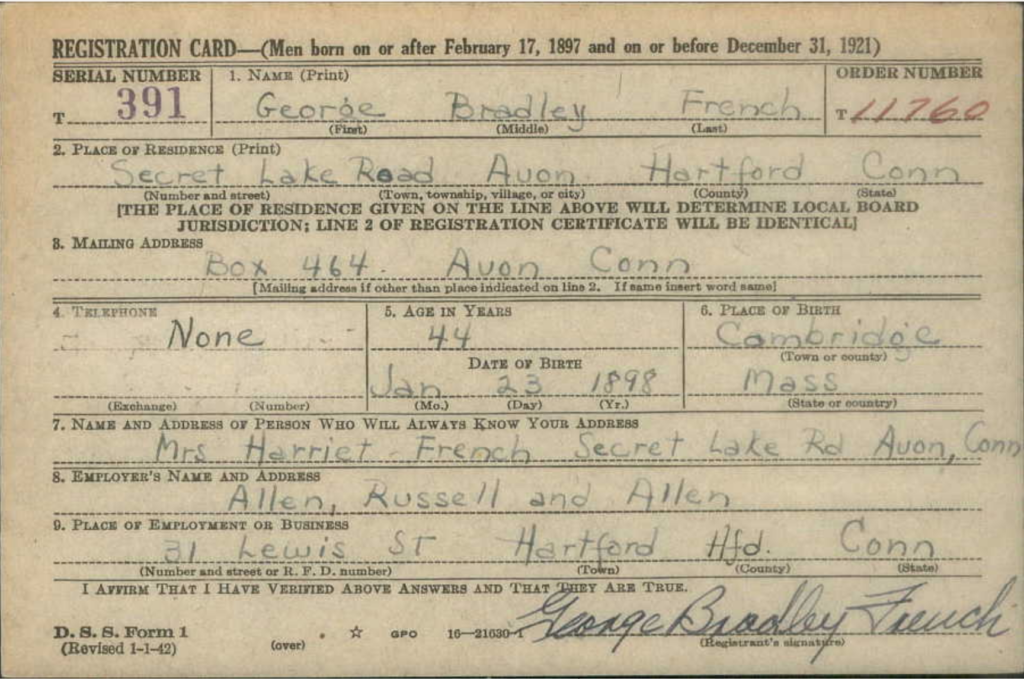
WWII – Draft Card

Comments, corrections and and suggestions appreciated.

Copyright © 2020. All Rights Reserved by David R. French.


Pvt. Edward Fowler

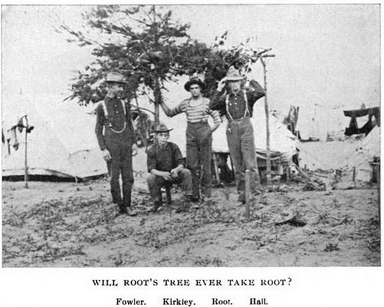
On April 25, 1898 the United States declared war on Spain following the sinking of the Battleship Maine in Havana harbor on February 15, 1898. A quest for adventure and patriotism spurred over three thousand four hundred men Connecticut men to enlist. The First Connecticut Volunteer Infantry was mustered into service between May and July 14, 1898 and mustered out, without having set foot on foreign soil, on October 31, 1898 in Hartford, CT.

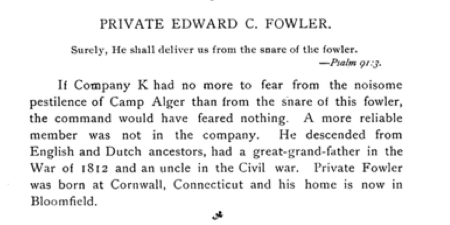
Edward C.
Fowler, my paternal second great-uncle, served as a Private in Company K of the
First Connecticut Volunteer Infantry. The story might had ended there had I not
found a history of Company K written by George B. Thayer.  A history that
is rich in stories, quirky biographies and photographs. The history even
includes a short story penned by Edward entitled, Among the Recruits (p.121),
in which he writes:

One of the
red letter days in our military experience was the one in which we began to
learn the manual of arms. We soon discovered that it was easy to learn the
different movements,but, we had to apply the old adage,” Practice makes
perfect,” to the work. We would think we were doing finely until Captain
Saunders would come and watch us drill, when we soon found how far from perfect
we were.

After boot
camp in Portland, Maine the 1st Connecticut was stationed in Northern Virginia
and they struck camp in East Falls Church (Dunn Loring/Merrifield), only a few
miles from where I currently reside! Below are a couple of excerpts from
Private George B. Thayer:

Friday,
August 26, 1898
– Up at 5 am. After breakfast we
set fire to the arbor, which for so many days has kept the sun’s heat from us,
applied a torch to the kitchen struck camp and at 9.30 left the old cornfield for
good we hope. The route to East Falls Church was by Dunn Loring and alongside
the tracks part of the way and part of the time along the highway.

Monday,
August 29, 1898
– Corporal Gruener and I took the trolley for Washington at 9
o’clock and went by boat to Mount Vernon. Returning at 2 we visited the capitol
and congressional library and got back to camp at 6:30 p.m. The heat was
intense.

Edward C. Fowler returned back to civilian life, working as a farmer in Bloomfield, Connecticut until his death in 1929.

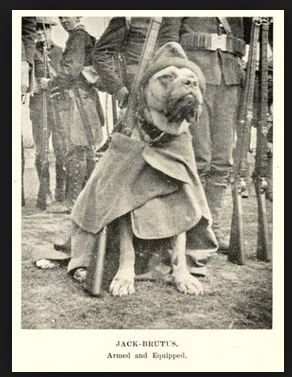
Jack Brutus, Connecticut War Dog – Who Knew?

… that
although Jack Brutus’s military status was unofficial, he became the official
mascot of Company K of the First Connecticut Volunteer Infantry during the
Spanish-American War.

Jack Brutus,
or “Old Jack” as he became known, was born in Cumberland, Maine, in 1891. He
led an exciting life even before his stint in the military as part of Company K
of the First Connecticut Volunteer Infantry. According to Private Thayer, Jack
“had friends in most of the cities in New England through his associations with
the traveling public at the West End Hotel in Portland. Frequently he visited
them in their own homes, taking passage in some steamer or boarding some train,
and returning to Portland in due time.” In his travels, Thayer claims Jack
Brutus visited Boston, New Brunswick, and New York, as well as many other
cities on the steamer lines.

Old
Jack Enters the Military

Company K
first met Old Jack while stationed at Fort Preble in Portland, Maine, in May of
1898. Jack quickly became a favorite of the soldiers and, eventually, the
company’s official mascot. He went on to travel with the unit as they encamped
up and down the Eastern Seaboard providing coastal defense during the
Spanish-American War.

Jack was a
large breed dog and often had health issues throughout his service with Company
K. During a heat spell at Camp Alger near Falls Church, Virginia, Jack had
trouble breathing and suffered in the heat. Thayer noted, “Poor Jack—the noble
mastiff we brought from Portland is suffering from the heat extremely and it is
doubtful if he survives.” Fearing for Jack’s life, the men took to nursing him
and he eventually recovered.

Jack also had
a snoring problem. The men on night duty, to allow the men asleep in their
tents to remain that way, often enticed Jack far away from camp so that his
snoring did not disturb the sleeping soldiers. When “loudest snorer” elections
took place among the men, Jack came in second.

Wagoner
Edward Ahearn mustered out of the army in late 1898, and when he did, he took
Jack Brutus home with him. Old Jack died from spinal troubles and constipation
while under a physician’s care on November 20, 1898, but will always be
remembered as a loyal Connecticut war dog.

Thayer, George B., ed. History of Company K, First Connecticut Volunteer Infantry, During the Spanish-American War. Hartford, CT: Press of R.S. Peck & Co., 1899.

© David R. French and French in Name Only, 2019. Unauthorized use and/or duplication of this material without express and written permission from this blog’s author and/or owner is strictly prohibited.


Death-Capture-Ransom

Margaret Stilson, the granddaughter of John Brown (Samoset and John Brown – Maine), was born in 1679 in Marblehead, Massachusetts. Margaret, my 7 paternal great-grandmother, married William Hilton III on June 2, 1699. They had one child, Benjamin, during their marriage. She died in November 1763 in Manchester, Massachusetts, having lived a long life of 84 years. (See previous post on Hilton Line: New Hampshire’s Founding Father)

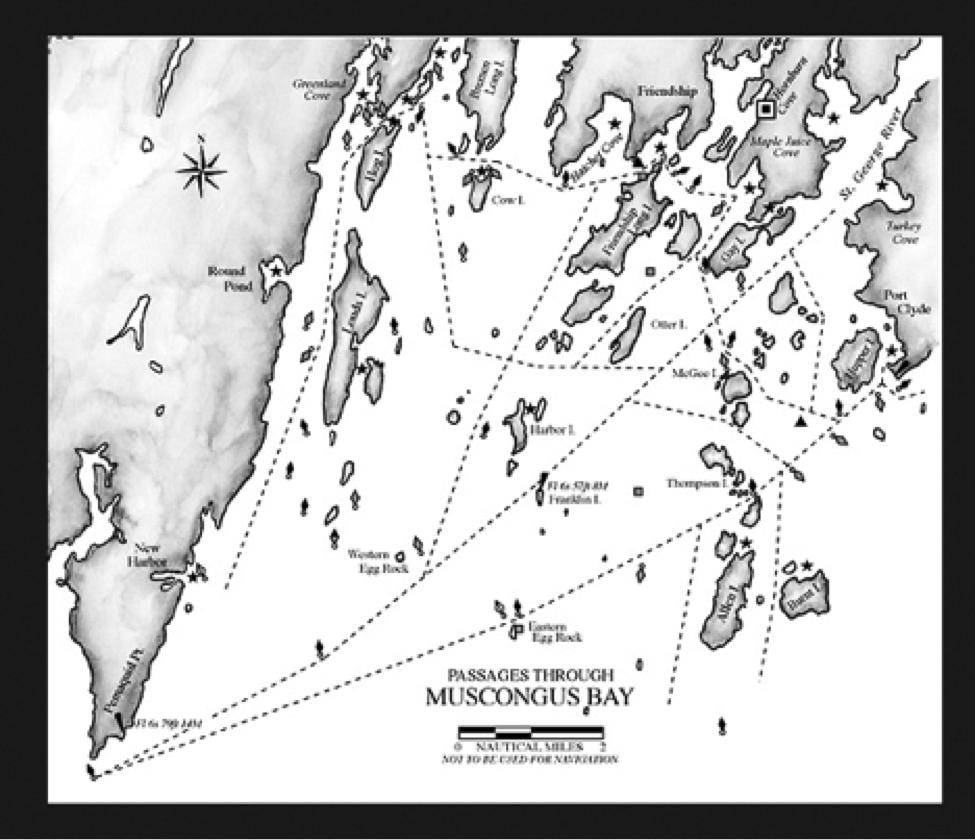
In 1689, on
Muscongus (now called Louds) Island in Maine, Indians attacked Margaret and her
family. As a result, her father James Sr. was killed and she was taken prisoner
along with her mother and brother to the Quebec region of Canada where they
were sold to the French. Records indicate that an infant sibling (unnamed)
either died immediately following the capture or on the way to Canada.

Margaret
remained in French custody for 10 years before being ransomed, during that time
she was reported to be a servant in the house of Monsieur Jean Bochart de Champigny, the Intendant of New France. The intendant served as an agent of
the King of France and responsible for the colony’s entire civil
administration. A fellow captive and servant of the intendant, Hannah Swarton,
had a famous narrative of her captivity published, providing a possible window
into Margaret’s experience.

A Narrative of Hannah Swarton’s Captivity

A Little Side Story About the Republic of MuscongusMuscongus Islanders, capturing a spirit of independence that matched their independence from Maine that they declared in1860. The island was left off the state map and islanders were not allowed to vote. Muscongus Island rejoined the state in 1934.

© David R. French and French in Name Only, 2019. Unauthorized use and/or duplication of this material without express and written permission from this blog’s author and/or owner is strictly prohibited.


Samoset and John Brown (Maine)

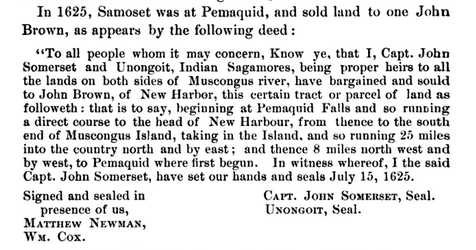
On July 15, 1625, my 10th great paternal grandfather, John Brown of New Harbor, Maine, was the beneficiary of what was likely the first land sale transaction between the Native Americans and the colonists. John Brown was deeded 12,000 acres land on what is known as Pemaquid Point by Samoset, an Eastern Abenaki (Wabenaki) tribal leader. Questions remain unanswered as to the authenticity and propriety of the deed.

Remarkably,
Samoset is believed to be the first Native American to make contact with the
Pilgrims of Plymouth Colony.  According to numerous accounts, on March 16,
1621, Samoset walked into the encampment of the Pilgrims at Plymouth Colony,
saluted them, and announced, “Welcome! Welcome, Englishmen” in
English! Samoset had acquired a rudimentary understanding of English from
English fishermen and traders along the Maine coast.

Days later
Samoset returned with Squanto (Tisquantum), who along with Massasoit, are credited with providing the Pilgrim’s knowledge of
agricultural and other skills that allowed for their survival.

Additional
Resources:

1491: New Revelations of the Americas Before Columbus

Samoset Biography

(John Brown) The New York Genealogical and Biographical Record, Volume 51