Part One: Drought, prairie fires, blizzards and hail storms…..

In an earlier post (Russian the Irish) about the Cronin family, I noted the journey of my wife’s 2nd great grandparents from Massachusetts to Nebraska in 1879. Part One of this post provides a brief glimpse into William Cronin Sr.’s initial years in America. Part Two (7N 15W 25/36 – The Next Generation) explores the lives of Kate and William’s children, the next generation of Cronin’s.  

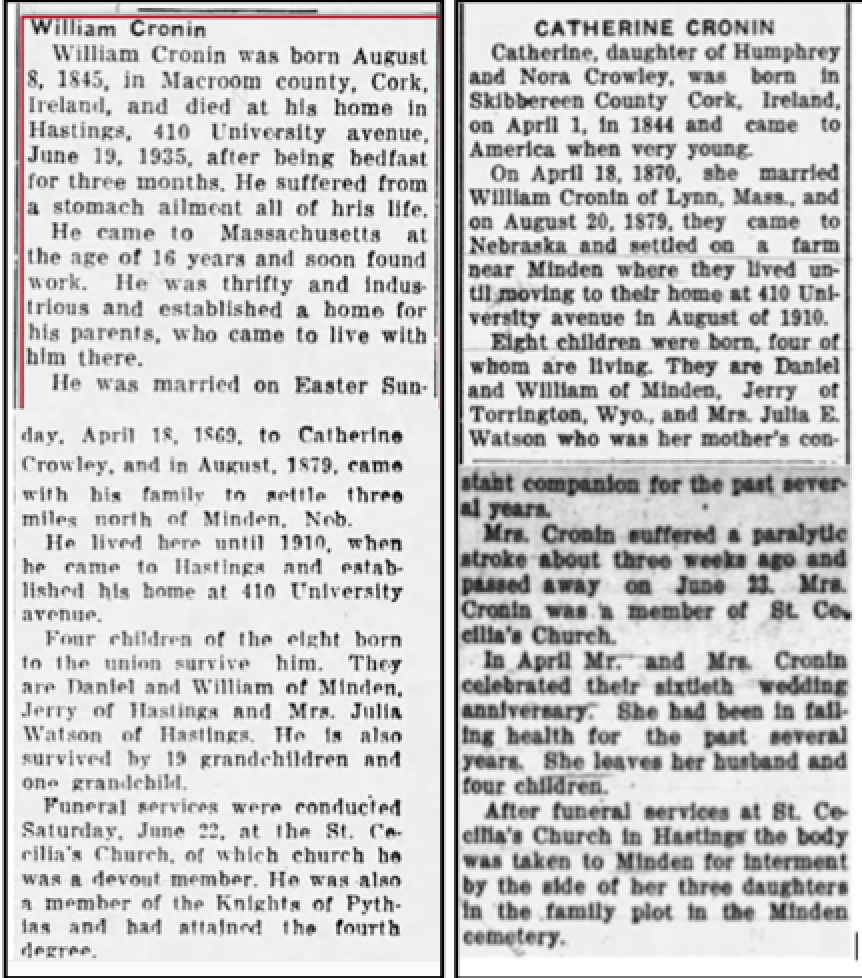
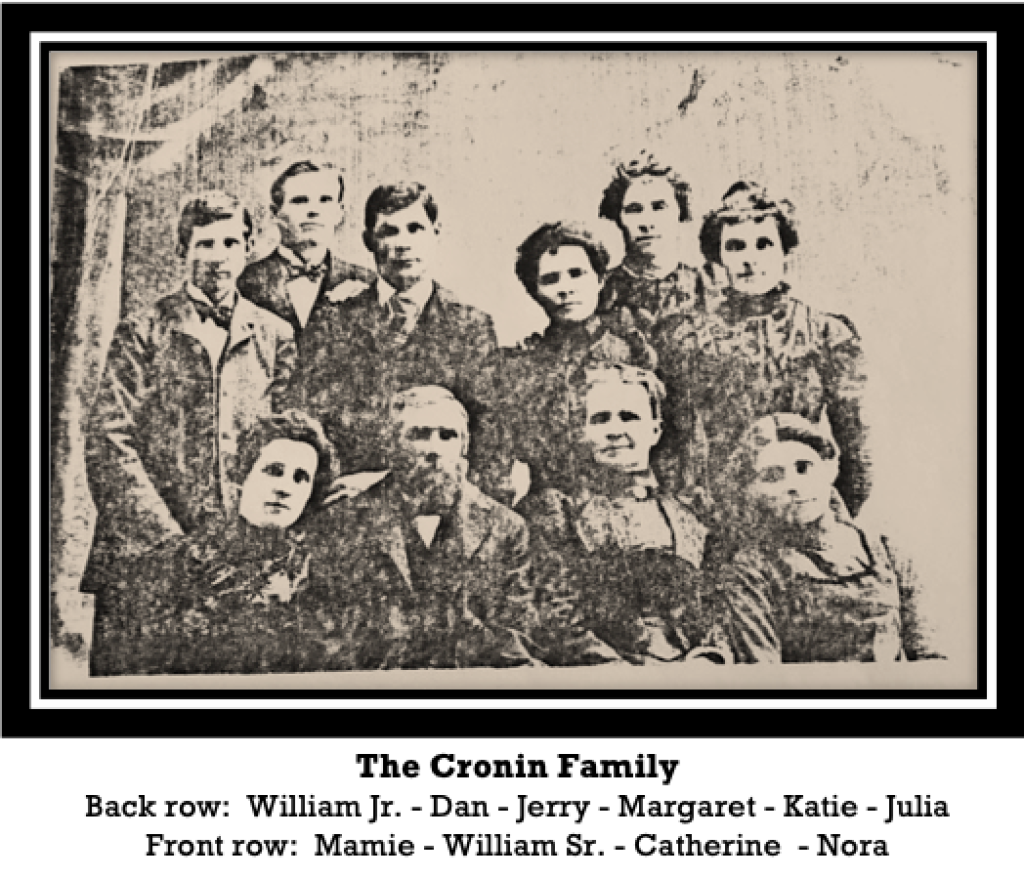
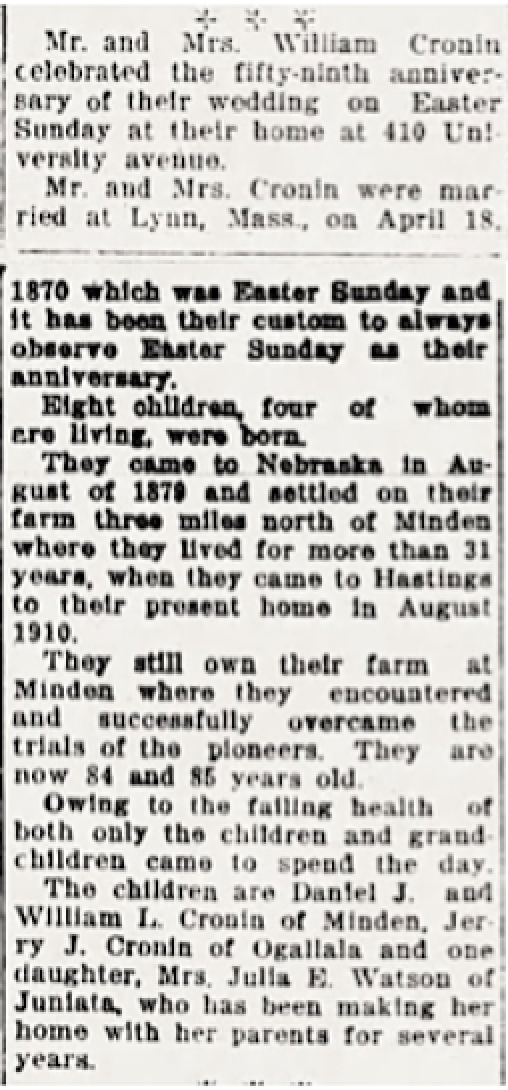
In 1879, Kate (Crowley) and William Cronin and their five children rode in a Central Pacific Railroad boxcar to Grand Island Station, Nebraska and then by wagon to Minden where they established a farm.  According to a newspaper story, celebrating their 60th wedding anniversary (Article and Photo: Slide 1), the couple experienced “drought, prairie fires, blizzards and hail storms” as pioneer settlers. 
William Cronin was born on August 8, 1846, in County Cork, Ireland, the son of Mary and Leonard.  William emigrated from Ireland to Massachusetts in 1862 at the age of 16. In the 1865 Census, William (Wm.) is working as a laborer on the farm of Mr. James Carey in Swampscott, MA.  In the same household is a Julia Cronin, age 20, who working as a domestic servant.  Although I found no additional information regarding Julia, I believe that she was his sister.  (He later named one of his daughters, Julia)
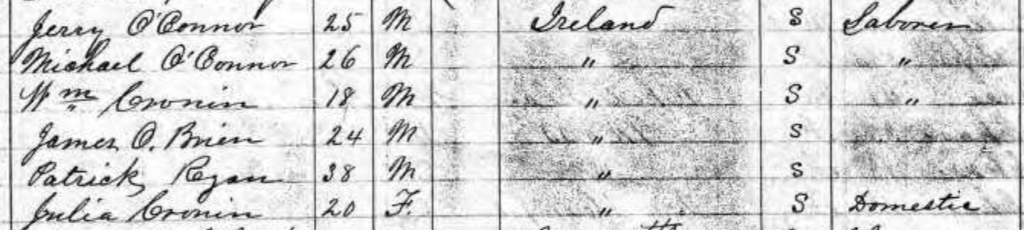
1865 Census

In the 1870 Census, William is listed as one of three farm laborers working on property owned by Ebenezer B. Phillips, in Swampscott, MA. Phillips was one of the countries first millionaires, having perfected a dry fish process. It was noted that in a previous year, that Phillips’ farm(s), raised one thousand five hundred barrels of onions for sale in Boston.

Marriage Record

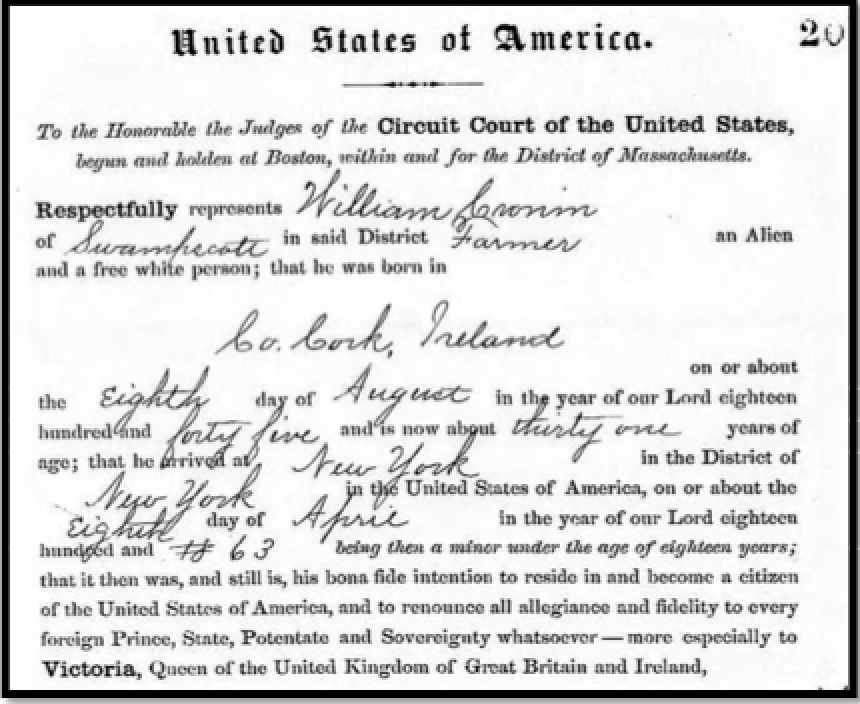
William married Catharine (Kate) Crowley on Easter Sunday, April 17, 1870, in Lynn, Massachusetts. William became a naturalized U.S. citizen in 1876. Kate died in 1930 at the age of 86 and William died in 1935 at the age of 90, both are buried in Minden, Nebraska. The slides above include articles celebrating their 59th and 60th wedding anniversaries, William’s naturalization certificate and both of their obituaries.

Future Research: William’s obituary notice indicated that he “established a home for his parents” in Massachusetts and Catherine’s obituary provides the names of her parents, Humphrey and Nora.  My initial research has been unable to locate their parents.


7N 15W 25/36 – The Next Generation

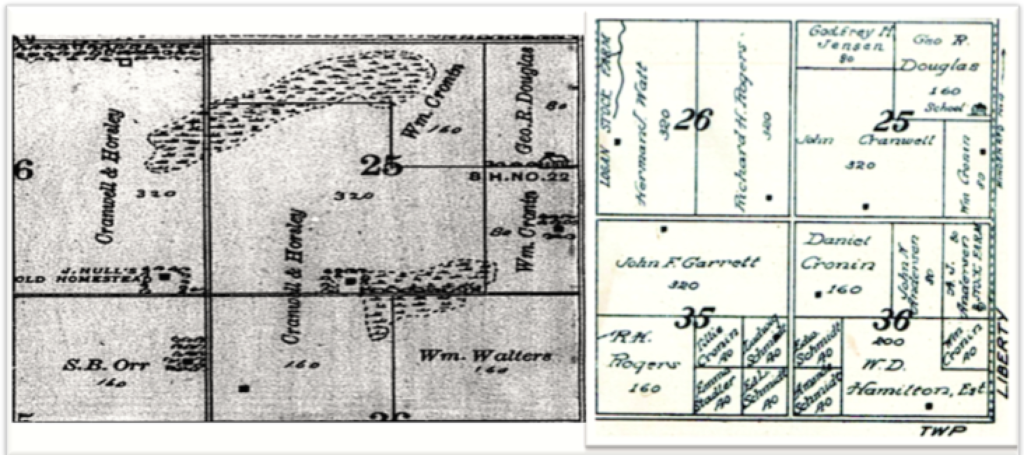
1894 and 1923 – 7N 15W 25/36 – Plat Maps – Logan Township, Kearney Nebraska
Source: Library of Congress

Map: 1894 Logan Township, Kearney, Nebraska – (Located on the on northwest edge of Minden) Shows the location and # of acres for two plots of land (240 acres) farmed by William Cronin Sr.  The 80-acre plot indicates the location of William Sr. and Kate’s home which remained in the Cronin family until at least 1951. 

Map: 1923 Logan Township, Kearney, Nebraska – Shows the location and # of acres for farms managed by Daniel, William, and Tillie Cronin. There are 2 plots of 40 and 80 acres, under the name of Wm. Cronin.  William Sr. was 78 by this time and retired, so the lands are likely William Jr.’s. According to the 1920 Census, the principal crops grown in Logan Township were wheat, corn, wild hay, oats, alfalfa, barley and rye, ranking in acreage in the order named.

The Children of William and Kate Cronin

The Next Generation

William Leonard Jr. (1882-1945) (Wife’s Great-grandfather) – Married Susan Burke on June 20, 1910, in Swampscott, Massachusetts. (Below: Marriage Record) They had 6 children (Margaret, Leo, Cleo, Thomas, William and John (Jack) Note: in the 1930 Census, both William and Susan list that their parents were born in the “Irish Free State.”

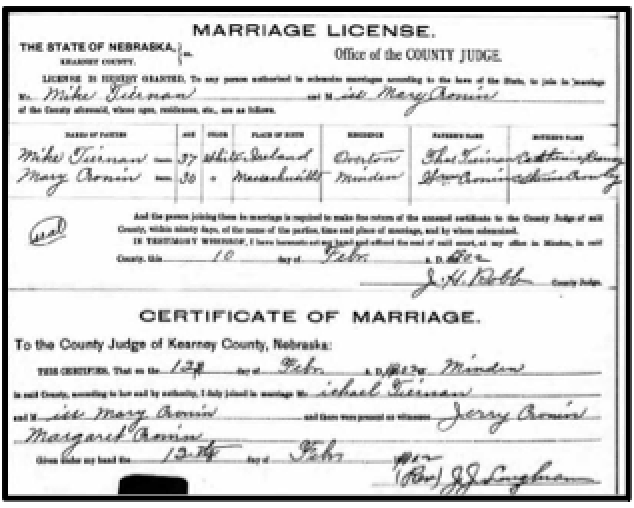
Mary “Mamie” Cronin (1872-1906) In the 1900 Census, Mary is living on the family farm and working as a schoolteacher. In 1902 , she married Michael Tiernan, a farmer in neighboring Overton, NE. (Marriage License)

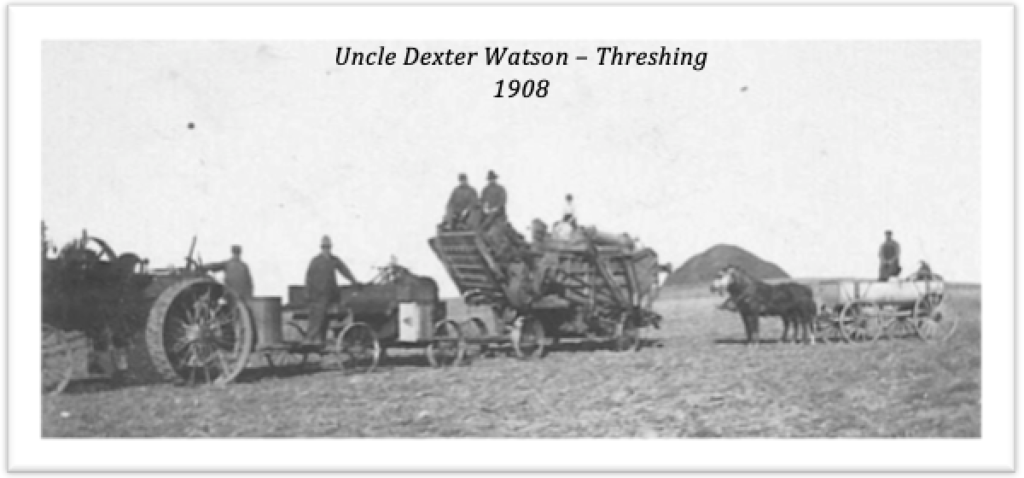
Julia E. Cronin (1872-1959) Married Dexter Watson in Kearney, NE on 14 Sept 1910 and then again on 8 April 1912 in Minden, NE for a church wedding.  According to the 1940 census, Julia E. Watson was running a rooming house in Hastings, NE. Her parents, William and Kate, lived with Julia in their later years.

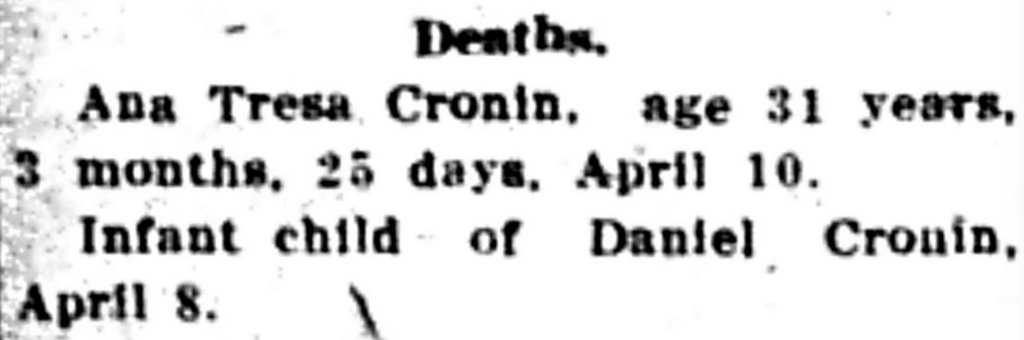
Daniel J. Cronin (1875-1943) First marriage to Ana Tresa Cunningham (1879-1911). Based on a death notice (below), Ana died 2 days after the death of their son, Daniel. Second marriage was to Della Francis Lewis (1891-1979). Dan had 10 children by Annie and Della. The 1920/30+40 census – Farmer in Logan, Kearney, Nebraska.

Jerry J. Cronin (1877-1973) In the 1900 and 1910 Census, Jerry is noted as single and living on parents farm. It appears that he married Tillie (unk. last name) after 1910 and that she died before 1917. Jerry’s is 1918 WW1 Draft Card lists Laurne Catherine Cronin – daughter as his contact. The 1920 Census note Jerry as a widowed farmer living in Logan, Kearney, Nebraska.

Katherine “Katie” Cronin (1879-1913) In the 1900 and 1910 Census’, Katy is working as a domestic servant in Kearney and living on her parents farm. Her gravestone lists her last name as Melvin, no marriage information has been discovered.

Nora Cronin (1884-1906) – Sadly, there is no additional information on Nora. According to family history, Mary and Nora died as a result of tuberculosis.

Comments, corrections and suggestions appreciated.

Copyright © 2021. All Rights Reserved by David R. French


Not Just a Southern Thing

Slavery developed hand-in-hand with the founding of the United States, weaving into the commercial, legal, political, and social fabric of the new nation and thus shaping the way of life of both the North and the South.  Myths & Misunderstandings: The North and Slavery (The American Civil War Museum)

Recently, I helped a family friend research her family history in the southern states of Arkansas, Texas, Tennessee and North Carolina. Her understanding was that her father’s forebears were just “hard working, poor dirt farmers” (which they were). Going back past her great-great grandparents, I did identify a handful of families that worked/owned small farms and owned slaves. So we both share the fact that in our distant past, we are the descendants of slave owners, a discovery that we share with President Barack Obama, Senate Majority Leader Mitch McConnell and countless others.

The truth is that slavery was not just a “southern thing” and that it wasn’t until 1804 that all of the Northern states had abolished slavery or set measures in place to gradually abolish it.  The 1754 Massachusetts slave census listed 2,720 slaves (Children under 16 were not counted). The census for Lexington listed 13 men and 11 women as slaves.  Slavery was not abolished in Massachusetts until 1783.

In Servants For Life, I wrote about my 6th great paternal grandparents, Jonathan Bowers (1674-1744) and Hannah Barrett Bowers (1679-1765), who were slave owners in Billerica, Massachusetts. In a separate post about my 4th great-grandfather, Bildad Fowler, I noted his witnessing a bill of sale for the purchase of a slave (Pegg) in 1761. (Connecticut “the Georgia of the North” – Witness to Slavery)

I recently discovered that my 7th great uncle, Francis Bowman Jr. (1662-1744) of Lexington (MA), was the owner of four slaves: Battiss, Phylliss, Pompy and Domini. His biography states, that “he was a prominent man in Lexington, long holding the offices of justice of the peace, assessor, selectman, and assessor.” I was unable to ascertain if his brother (and my 7th g-grandfather), Joseph Bowman also owned slaves.

Trivia – Joseph Bowman is the 6th great grandfather of actor John Lithgow, which makes him a distant cousin of mine!

Comments, corrections and suggestions appreciated.

Copyright © 2021. All Rights Reserved by David R. French.


Ho Ho No? Christmas in New England

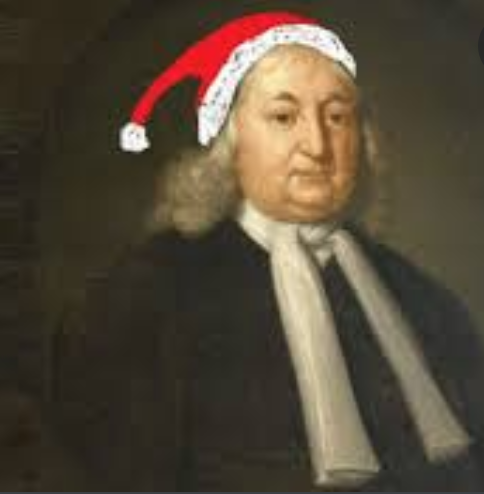
Puritan Samuel Sewall

The latest podcast by Jake Sconyers and Nikki Stewart at HUB History, The Original War on Christmas, is a well-researched story that prominently features the sermons of Increase and Cotton Mather. Definitely a must-listen this holiday season for history buffs.

Celebrating Christmas was against the law for decades, and it was against cultural norms for a century or more.  What were the Puritans’ theological misgivings about Christmas? (The Original War on Christmas)

Puritan Minister Increase Mather (1639-1723) is my 8th great paternal grandfather and his son, Cotton, would be my 7th great-uncle. (My post about Increase Mather’s role in the Salem Witch Trials and his service as president of Harvard College – In Cases of Conscience, Increase Mather)

Quotes from Increase Mather expressing his beliefs about Christmas:

  • Christmas occurred on December 25 not because “Christ was born in that month, but because the heathens’ Saturnalia was at that time kept in Rome, and they were willing to have those pagan holidays metamorphosed into Christian [ones].”’
  • He referred to December as Mensis Genialis, ‘the Voluptuous Month.’

Grace Defended, A Censure on the Ungodliness

A Sermon Preached on the Twenty-Fifth Day of December 1712, by Cotton Mather:

“Can you in your Conscience think, that our Holy Savior is honoured,” he lectured, “by Mad Mirth, by long Eating, by hard Drinking, by lewd Gaming, by rude Revelling; by a Mass fit for none but a Saturn, or a Bacchus, or the Night of a Mahometan Ramadam?” “You cannot possibly think so!

Comments and suggestions appreciated.

Copyright © 2020. All Rights Reserved by David R. French.


Rowdiness in Massachusetts Bay Colony

Nathaniel Bowman, my 9th great grandfather (paternal) was born in Leek, England in about 1605 and immigrated to the Massachusetts Bay Colony in I630.  Nathaniel, a yeoman, was one of the original settlers of Watertown, Massachusetts.  In 1652, Nathaniel moved to the Shawshine division in Cambridge (Lexington) where he farmed on 20 acres.  Descendants of Nathaniel resided in Lexington for over 250 years and his g-g-grandson Ebenezer Bowman was one of the militia that stood on Lexington Common (only 17 years old) and witnessed the “shot hear round the world.” (Check out this previous post: The Shot Heard Round Buckman Tavern)

There is also no evidence that (Nathaniel) Bowman ever joined the church in Watertown or Cambridge; this is partly indicated by the fact that he applied for freemanship in 1630, but never became a freeman, which after May 1631 required church membership. (Great Migration Study Project)

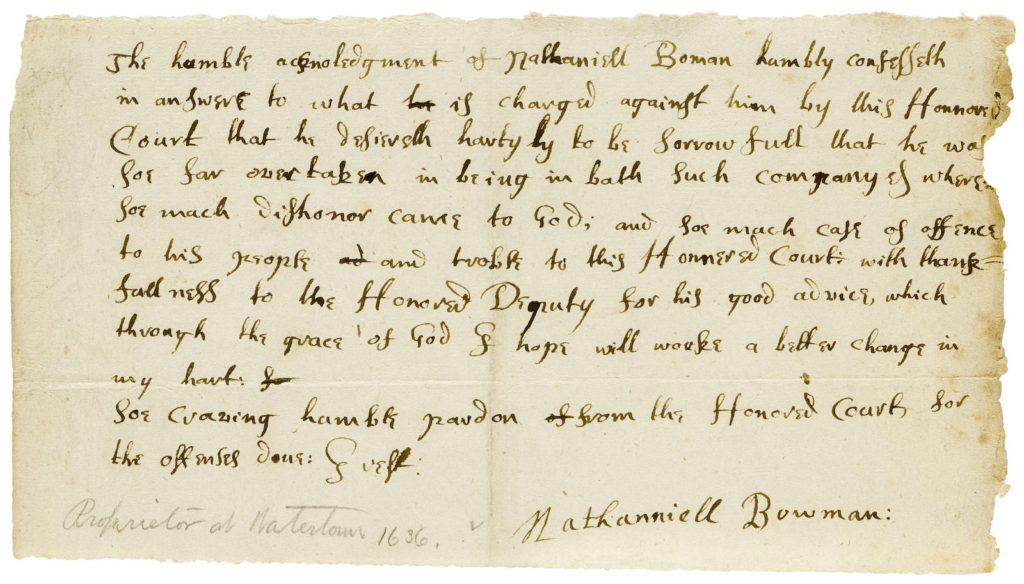
Nathaniel’s story, while remarkable in his decision to risk venturing across the ocean to start a new life, was largely uneventful with little actual documentation.  What makes him interesting is the mystery of a court confession attributed to him and sold at auction for $2,000 in 2016.

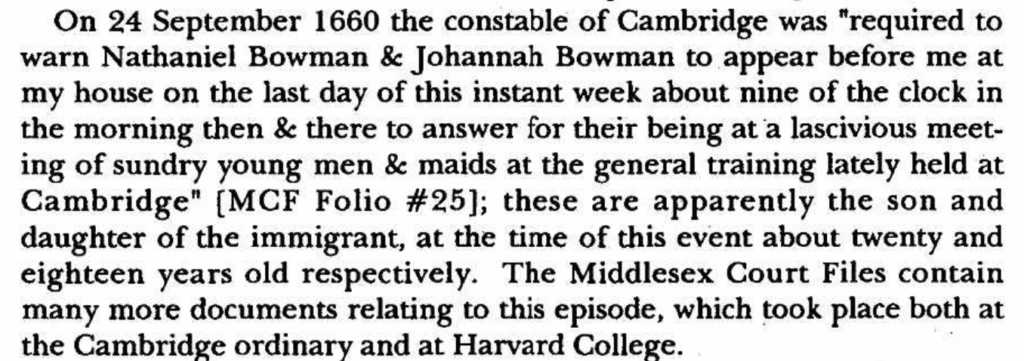
However, the true culprits appear to be his son Nathaniel Jr. (1641-1707) and his daughter Johanna (1642-1682), Cambridge “townies,” who were caught carousing with Harvard University students in 1662.  They were ordered to appear before the Middlesex Court, as described below, that later resulted in a signed confession by Nathaniel Jr. I was unable to uncover a record of any fines or other punishment by the court against Nathaniel or Johanna.

The Great Migration Begins
Confession

An edited version of the document reads: “The humble acknowledgment of Nathaniel Bowman humbly confesses in answer to what is charged against him by this Honored Court that he desires heartily to be sorrowful that he was so far overtaken in being in both such company & whereas so much dishonor came to God; and so much ca[u]se of offence to his people and trouble to this Honored Court; with thankfulness to the Honored Deputy for his good advice, which through the grace of God I hope will work a better change in my heart. So craving humble pardon from the Honored Court, for the offenses done.”

Comments, corrections and and suggestions appreciated.

Copyright © 2020. All Rights Reserved by David R. French.


A Sordid Tale – George Mitton

I have been fortunate in the exploration of my family history to uncover individuals who bravely faced the British on the Lexington Common and documented others who served in World War I and II, the Korean War and Spanish-American War. I have shared stories about individuals who worked as midwives, farmers, tavern owners, tailors, preachers, teachers, and many who were elected to serve their communities or faith.  

My family tree consists of well over 1,000 individuals and a couple branches extend over 10 generations.  Until now, I never crossed paths with an individual whose actions were so abhorrent that I wish I could just shake from my family tree.  The person that I am referring to is George Mitton, my 10th great grandfather, who was born 25 August 1617 in Shrewsbury, England and died in 1660 in Falmouth, Maine.

George Mitton was married to Elizabeth Cleeve (1619-1691). Elizabeth’s father, George Cleeve, came to New England in 1630 and in 1632 established a settlement called Casco, later to be named Portland, Maine. George was also commissioned as Deputy President of the Province of Lygonia. A statue of George Cleeve stands on the Eastern Water front on private land in Portland. The statue was not accepted by the city council who claimed, without evidence, that Cleeve may have owned a slave.

The Great Migration Begins by Robert Anderson, pp. 385-6

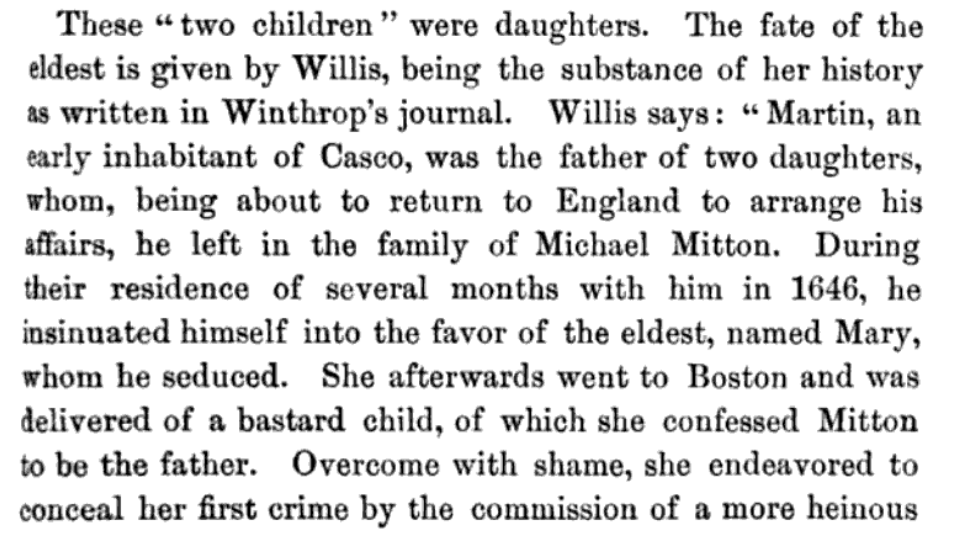
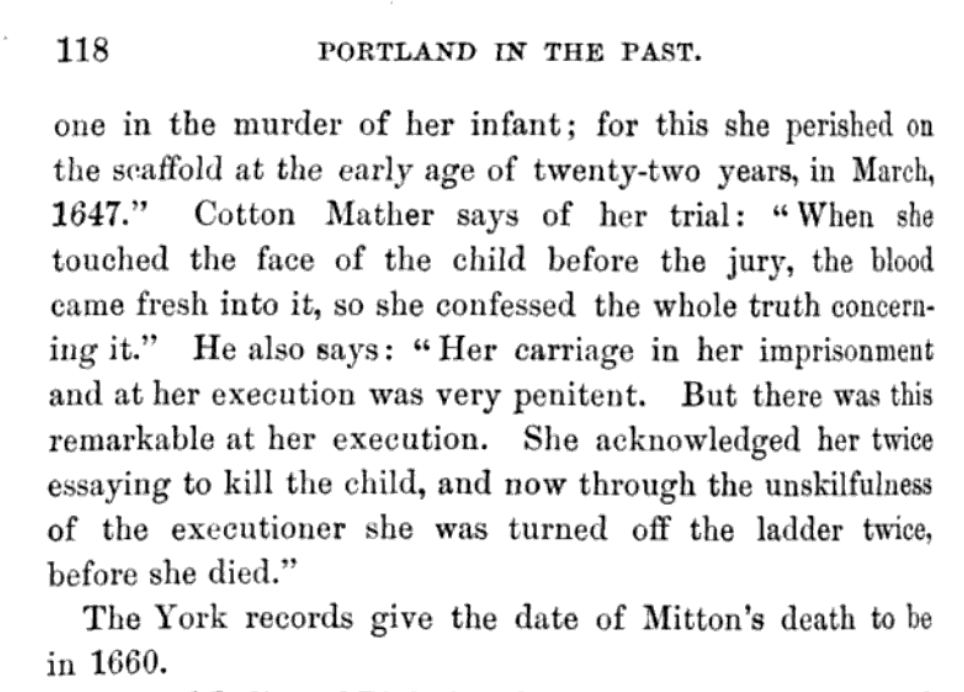
The following is the sordid tale of George Mitton and his betrayal of his neighbor Richard Martin, which led to the death of a child and the hanging of Mary Martin. Richard Martin, a destitute merchant, returned to England and placed his daughter Mary in service as a servant to his neighbors, George and Elizabeth Mitton. Mary was 22 at the time and George (29) proceeded to “seduce” her, resulting in her becoming pregnant and later taking the life of her own child. There is no record of George Mitton suffering any consequences for his adultery, the death of his child or actions that led to the death of Mary Martin.

Portland in the Past by William Goold (1886)

Comments, corrections and and suggestions appreciated.

Copyright © 2020. All Rights Reserved by David R. French.


Playing Baseball in the 1930’s!

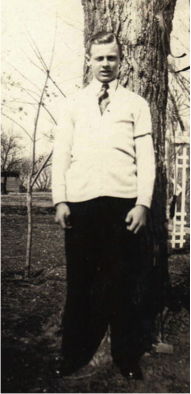
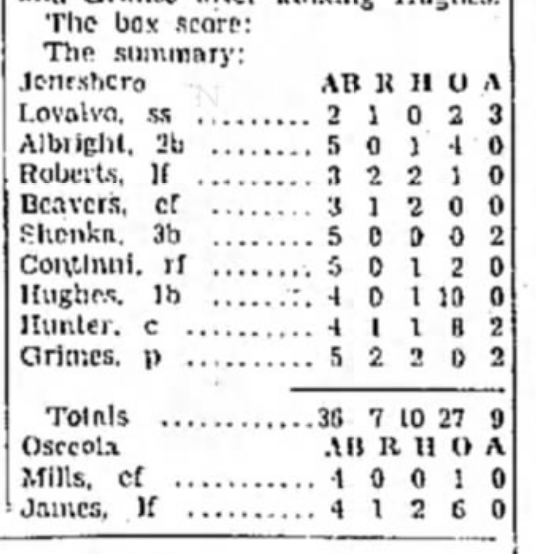
In 1937, my daughter’s great grandfather, Glenn Thomas Shonka Sr., played one season of minor league baseball in the Northeast Arkansas Baseball League (Class D) for the Jonesboro Giants. Class D would be the equivalent of today’s rookie leagues. Glenn was born in Richland, Nebraska in 1916 and passed away in 1978 in Columbus, Nebraska. (Left: photograph of Glenn in 1933)

Glenn was a twenty-three year old third baseman who compiled a career batting average of .160 with 0 home runs and 0 RBI in his 24-game career with the Jonesboro Giants. He played in 8 games, had 81 at-bats with 13 hits including 2 doubles and one triple.

Osceola Loses to Jonesboro, Monday, 7 to 1
11 May 1937

The Jonesboro Giants played in Jonesboro, Arkansas in the American Legion Ball Park. The Giants ended the season (May 6 – Sept. 5) with a record of 56 wins and 53 losses, in third place. The league consisted of the following teams: Blytheville, Arkansas, Jonesboro, Arkansas, Newport, Arkansas, Osceola, Arkansas, Paragould, Arkansas, and West Plains, Missouri.

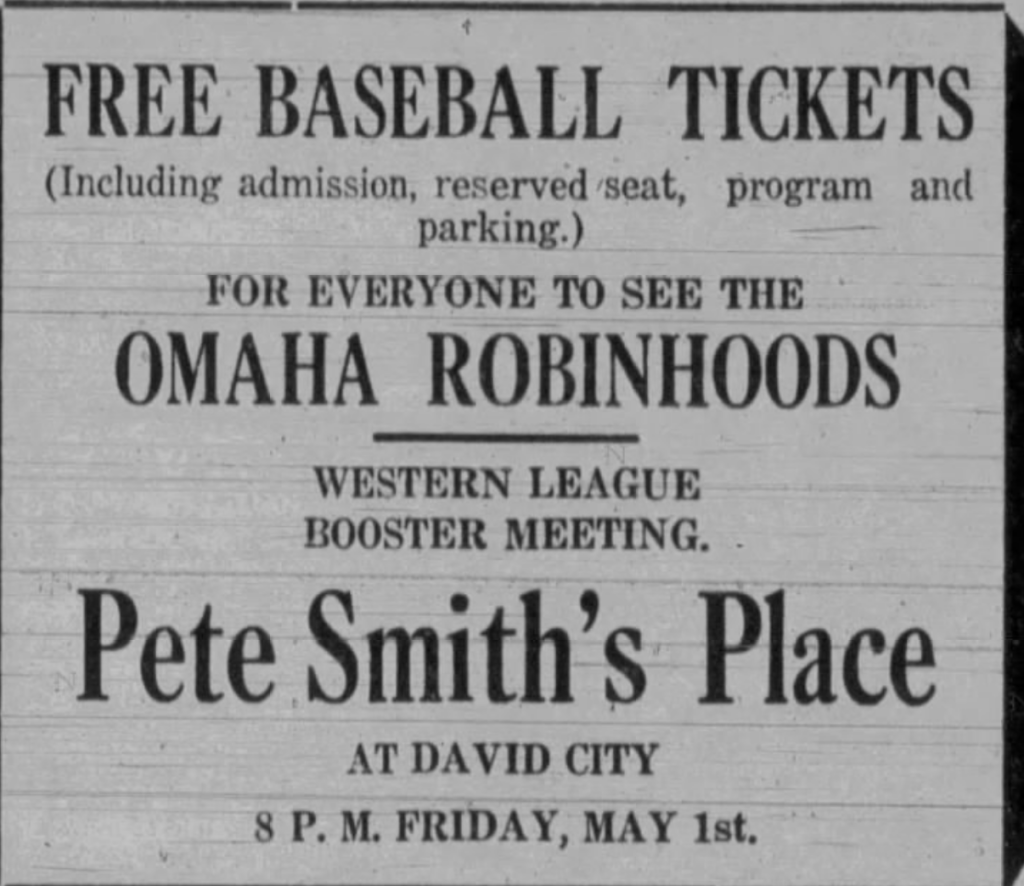
1936 Omaha Robin Hoods

There is a reference that Glenn was a member of the Omaha Robin Hoods, who existed (under that name) for less than one season in 1936. However, I was unable to find his name listed on a team roster for that year. If he was a player on that team, boy, that season must have been a roller coaster!

In 1936, the Omaha entry in the Western League was the Omaha Robin Hoods.  The team established a partnership with the Fontenelle Brewing Company and named the Robin Hoods after the flagship beer made by Fontenelle. The park was spruced up, new uniforms (photo of unidentified player) were acquired and it looked like it would be a great season.

However, the team was beset by troubles, as a windstorm forced the team to play several games in Lincoln, NE. Then the stadium burned down and the team was moved to Rock Island, IL where they became the Rock Island Rocks. Overall the team was 33-29 in the first half and 29-35 in the second half. (Source: Baseball Reference and Nebraska Baseball History)

1936—In August, a three-alarm fire shortly after midnight destroyed Western League/Vinton Street Park and 12 nearby homes. Destroyed were uniforms, bats, balls, and $1,000 worth of beer and hot dogs. 

Comments, corrections and and suggestions appreciated.

Copyright © 2020. All Rights Reserved by David R. French.


Pvt. Edward F. Daly Jr. – WW1 Pv Co C 3 BN 20 Eng

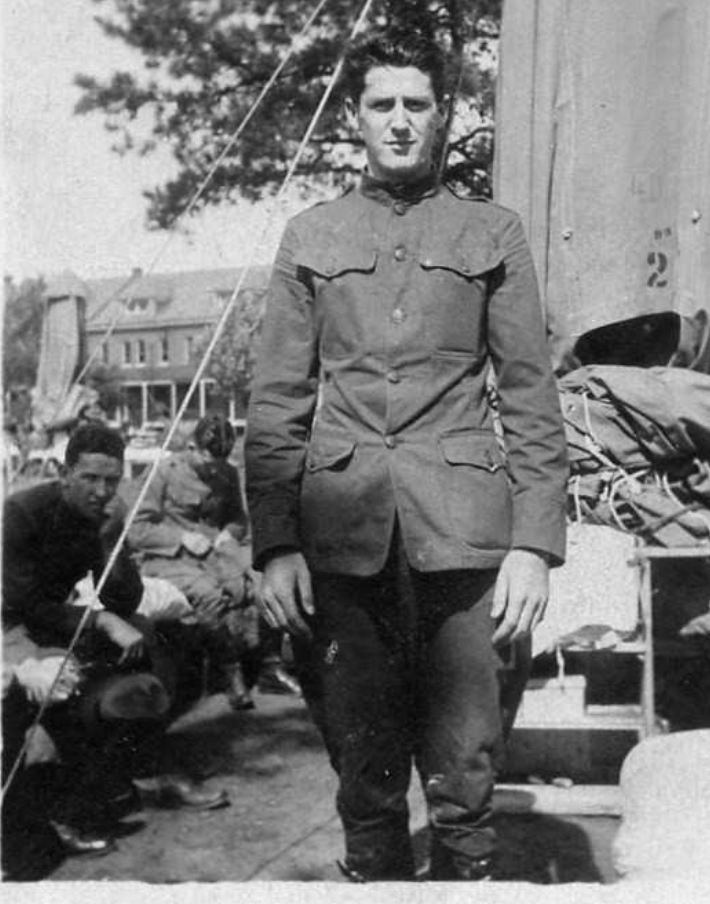
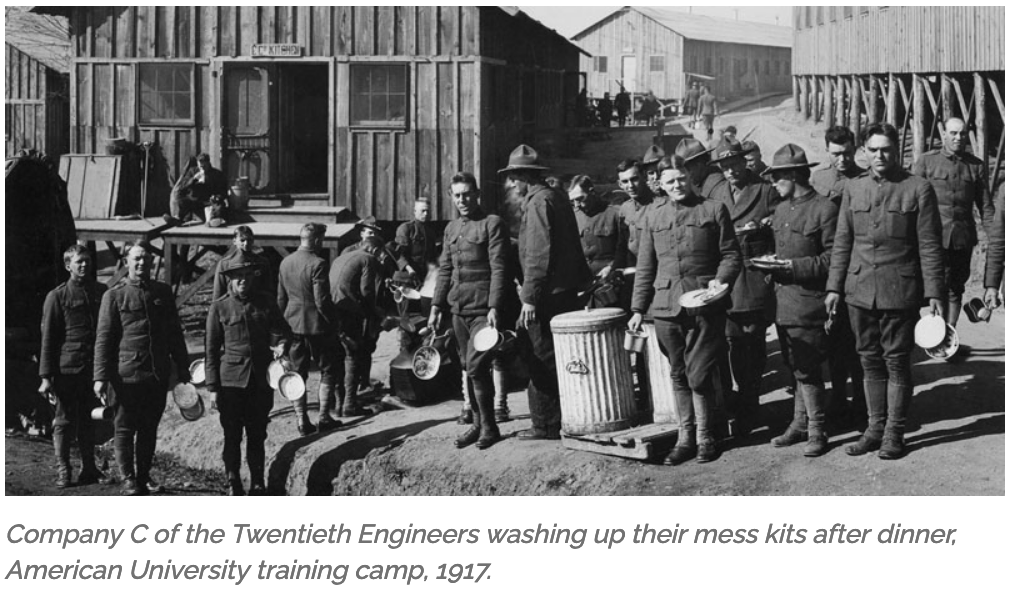
My maternal great uncle, Edward Francis Daly Jr., was born 20 October 1899 in Portland, Connecticut. Edward enlisted in the American Expeditionary Forces on August 8, 1917 and joined Company C, 3rd Battalion of the 20th Engineers (Forestry). According to the transit document for his passage home, Edward served in the Medical Detachment for the 3rd Battalion.

Drawing from a unit history of the 20th Engineers, I provide select highlights of the journey Edward took from enlistment to his discharge from the Army. The hint that allowed me to develop this post – Pv Co C 3 BN 20 Eng – was on an index card from the U.S. Veterans Bureau that listed his service record. My appreciation to Michael Daly for the amazing photograph of his grandfather in uniform and his research on the Daly family.

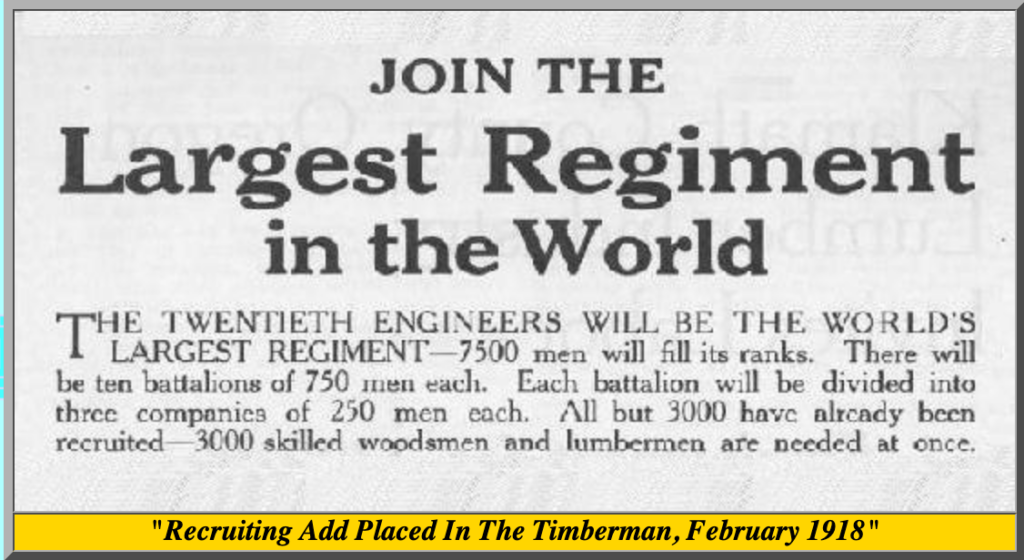
15 August 1917 – General Order Number 108 authorized the formation of the 20th Engineer Regiment (Forestry) at Camp American on the campus of American University in Washington, D.C. Due to overcrowding, the 3rd Battalion moved first to Fort Belvoir, Virginia and then to Fort Myer, Virginia for basic training.

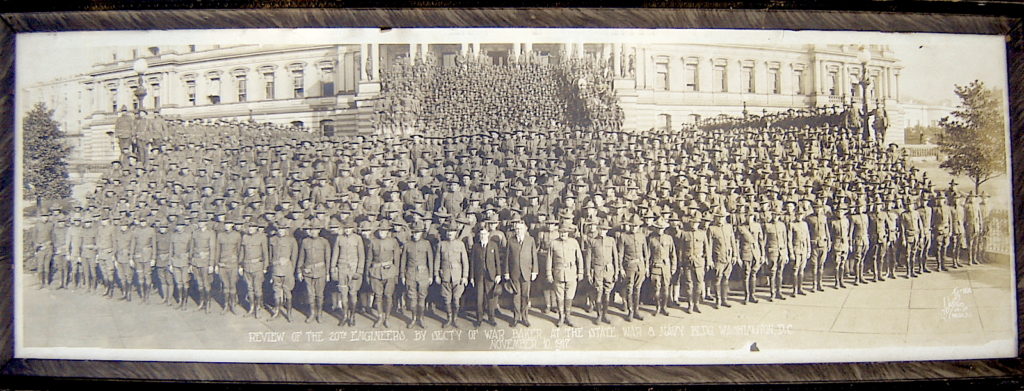
15 December 1917 – Washington, D.C.  – The Third and Fourth Battalions paraded Pennsylvania Avenue, led by the Fourth Band, they were reviewed from the portico of the War Department Building by the Secretary Baker. (below – photograph)

2-3 January 1918 – the 3rd Battalion moved to Jersey City, New Jersey to sail for France. They joined the 4th Battalion on the U. S. S. America and sailed, with 44 officers and 1956 enlisted men on board, for France, arriving in Brest, France on January 17th

17 January 1918 – (Three hours from France) Lookouts sighted a torpedo wake heading for the America, it narrowly missed the stern of the ship by twenty feet. The submarine was never sighted.

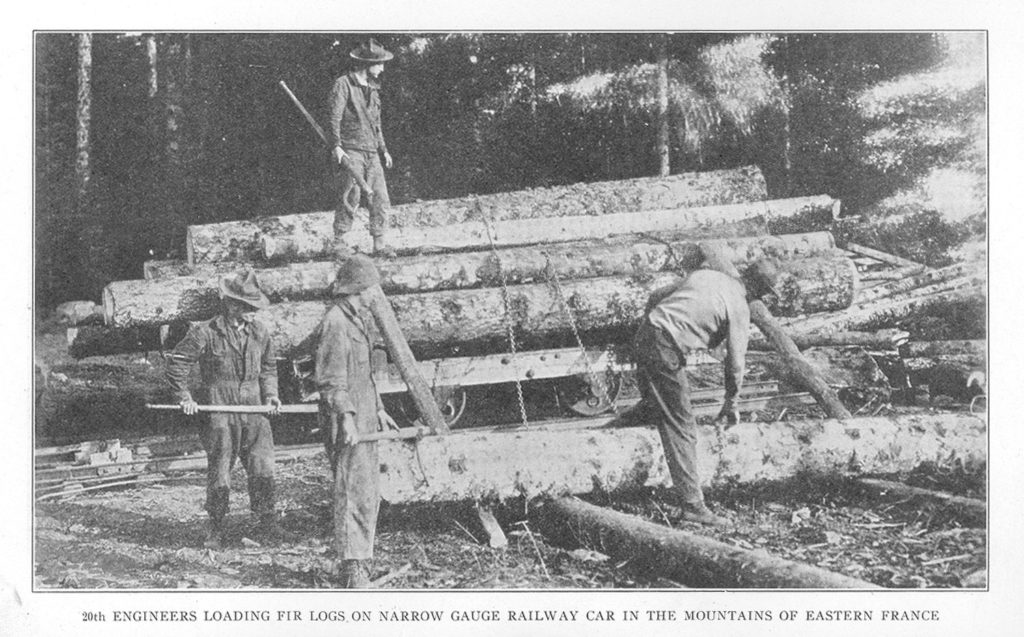
23 January 1918 – Company C was sent to a hardwood operation at Sauvigney les Gray, in the upper valley of the Saone, and under the Dijon administration. The timber harvest required long hauls to the mill by narrow-gauge logging railways.

The forestry troops of the 20th Engineers produced roughly 200 million feet of lumber in France. The current monthly needs of the Army (1918) were 50,000,000 feet of lumber and timbers, 250,000 railroad ties, 6,500 pieces of piling and cribbing, 1,500,000 poles and entanglement stakes, and over 100,000 cords of fuel wood. The the great bulk of the material was produced by the forestry troops. (Forest History Society)

11 Nov 1918 – Following Armistice, Company C, 3rd Battalion remained in France for six months providing fuel, rebuilding roads and dismantling the mills and camps. 

14 May 1919 – Edward boarded the Santa Paula and arrived in Brooklyn, New York on 28 May and was disbanded at Camp Merritt, NJ.

Sources:

3rd Battalion, 20th Engineer Regiment (Forestry) – Unit History

Forest History Society – World War I: 10th and 20th Forestry Engineers

Comments, corrections and and suggestions appreciated.

Copyright © 2020. All Rights Reserved by David R. French.


James C. Daly – Communicating in Battle – WW1

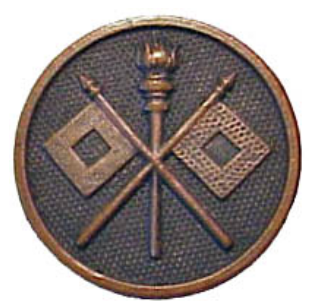
Enlisted Collar Disc
Signal Corp – WW1

My maternal great-uncle, James Charles Daly, was born February 1892 in Portland, Connecticut.  A cigar maker by trade, James enlisted in March 1918 in the American Expeditionary Forces and was assigned to Company C, 103rd Field Signal Battalion, 28th Infantry Division.  At the time of enlistment he was twenty-six years old and was described as tall, medium build with black hair and brown eyes. After two months of military training at Camp Devens (MA) and Camp Mills (NY), James sailed for France, arriving in La Harve on June 5, 1918.   

During World War 1, the 103rd Field Signal Battalion was the main signal support organization for the 28th Infantry Division of the American Expeditionary Forces. The strength of the 103rd Signal Battalion was close to 500 personnel in 1918.

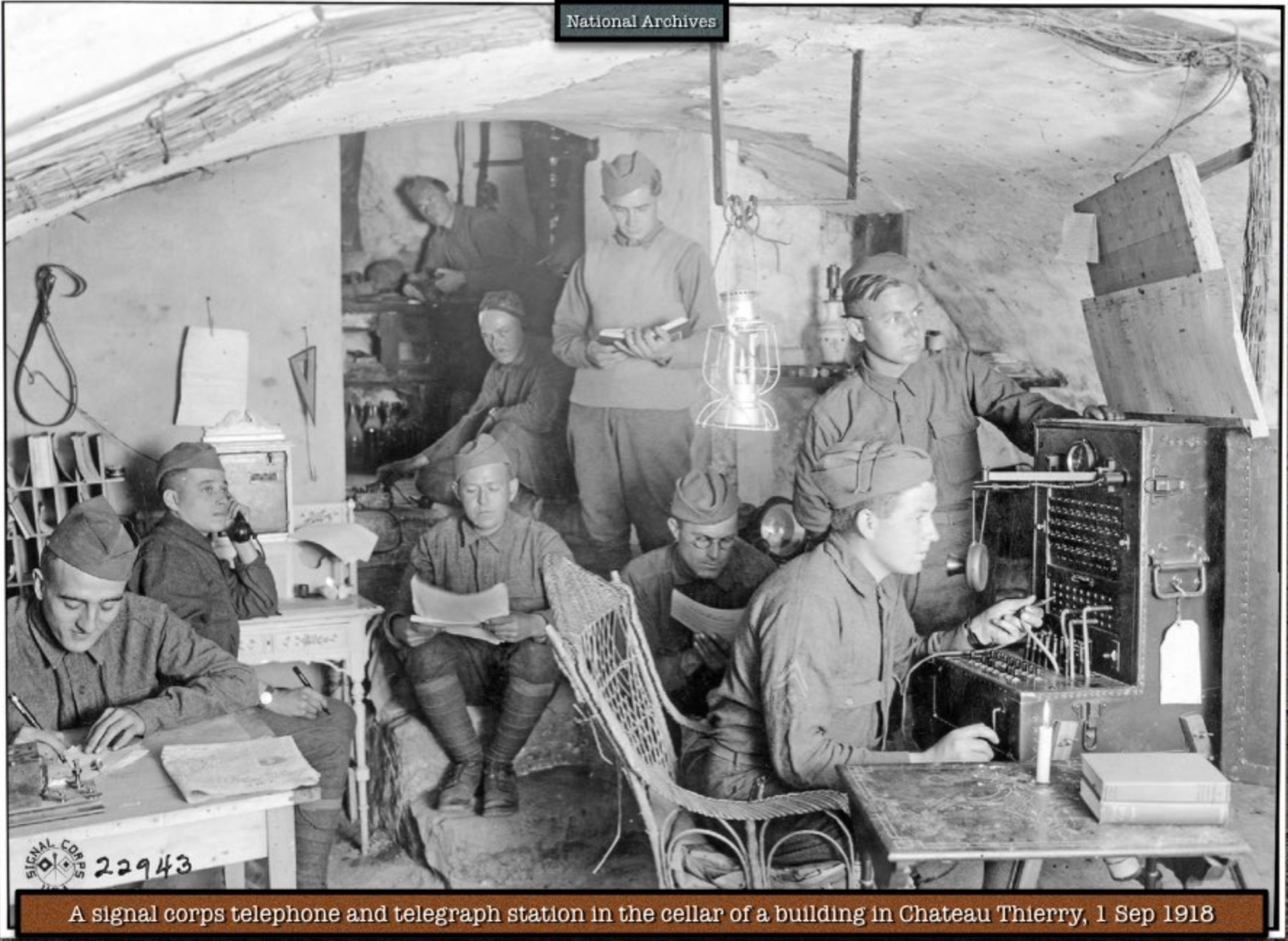
According to his service record, James participated in battles at Marne (2nd), Thiacourt, Meuse-Argonne, Chateau Thierry (note photograph above – was Charles in the room?), Oise-Aisne, and Saint Michel.

On September 7th, during the Battle of the Ourcq River, James was gassed and needed to be transported to Hospital No. 5 on the coast near the town of Camiers.  He was treated at the hospital from September 10 to October 18 and then returned to his unit for duration of the war.  

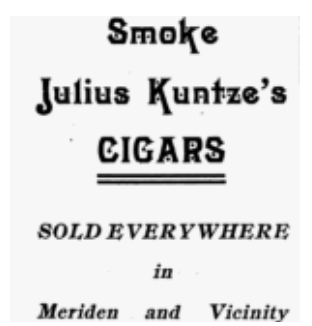
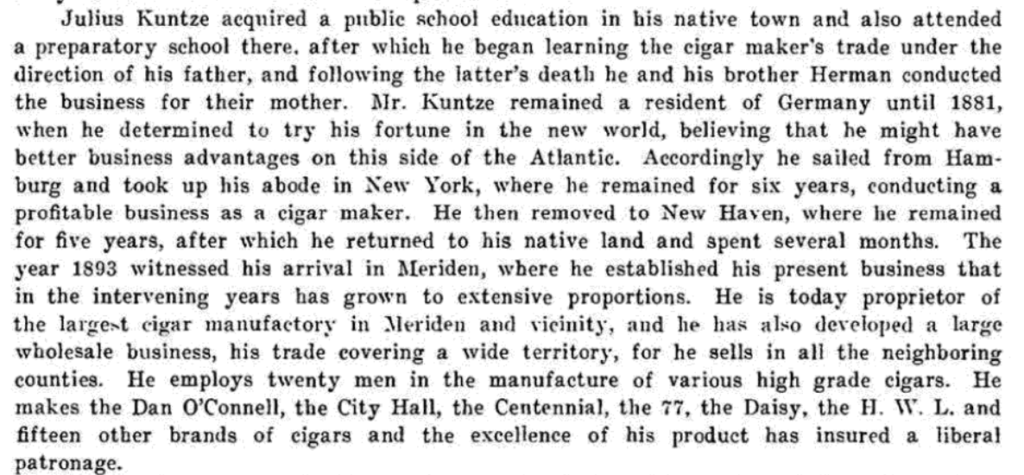
James was cited for bravery for his service and was honorably discharged from service in May 1919 at Camp Dix, New Jersey. He returned to Portland, Connecticut to live with his parents and work for a cigar manufacturer, Julius Kuntze, in Meriden, CT. James never married and died in October 1926 at the age of 34.

James C. Daly worked for Mr. Julius Kuntze
before and after his service in World War 1.

Cousin Joe – I wrote a previous post on Charles’ cousin, Sargent Joseph Aloysius Grace (1892-1918) who died on October 11, 1918 during the Meuse-Argonne Operation in World War 1. Anything, Anytime, Anywhere, Bar Nothing (AAA-O)

Hospital No. 5 – At the time the Charles was recovering from being gassed, my paternal grandfather, George B. French was working at this hospital. Pvt. George B. French – World War 1

Comments, corrections and and suggestions appreciated.

Copyright © 2020. All Rights Reserved by David R. French.


Walter and Minnie – 2 Peas in a Pod

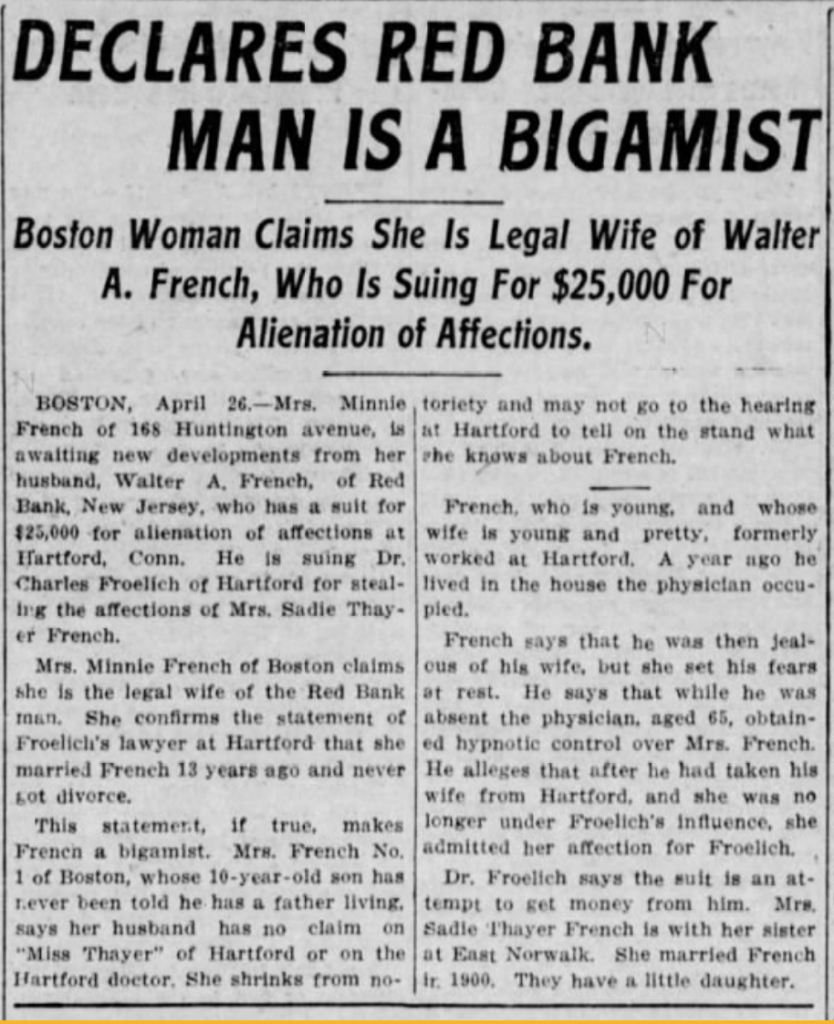
How is that to catch your attention? The person making the declaration was my great grandmother Mary “Minnie” MacEachern French who was calling out her husband, Walter A. French, for being a bigamist. The irony in all of this is that Minnie was, just a few years later, involved in a sensational court case against a wealthy Bostonian for breach of promise – to wed! Into the Breach-Promises, Promises. The newspaper articles highlighted in this post can be viewed in their entirety below. They are a great read!

Walter’s Tale

  • Walter Abram French was born in January 1877 to Horace and Laura Foster French in Medford, Massachusetts.
  • May 1896, his mother, Laura French, passed away.
  • April 1897, Walter marries Minnie MacEachern. (Hello Minnie)
  • January 1898, Walter has a son (my grandfather), George French, in Boston with Mary “Minnie” MacEachern. Minnie, originally from Nova Scotia, was working as a dressmaker in Boston. Walter was employed as a wagon maker.
  • June 1899 – Birth of Horace French to Walter and Minnie. No additional record of Horace has been discovered, he likely died as an infant.
  • 1899/1900 – Walter abandons Minnie and Walter and moves to New York.
  • 1903 – June – Walter marries Sadie Elizabeth Thayer in New York. They have a son, Walter Cornelius, born in November 1903.
  • 1907 – Walter, Sadie and Walter Jr. move to Hartford, Connecticut. (1907/8 – at some stage they board at home of Dr. Froelich)
  • 1908 – In Hartford, Walter files for bankruptcy with business partner James Tilden (d.b.a. Auto Body and Top Manufacturing Company). Walter claimed that Tilden had assumed all financial responsibilities and he did not respond to additional court inquiries.
  • 1909 – Sadie separates from Walter.
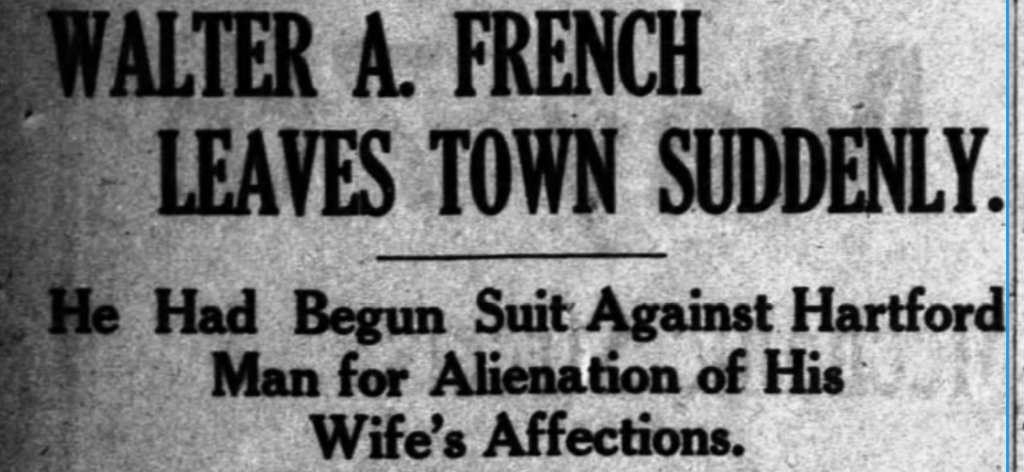
  • April 1910 – Walter is living in Red Bank, New Jersey with his son, Walter Jr. Walter files a $25,000 lawsuit against Dr. Charles Froelich for “alienation of his wife’s affections.” Walter skips town in dark of night without paying his rent.
(click to read)
  • May 1910 – After being requested by the court to clarify the date of his “marriage” to Sadie Thayer and if he was legally divorced from Minnie, Walter drops the case.

The last trace of Walter was a September 1918 WW I draft registration card that lists him living in New York City and working as an oil operator.

What about Sadie? By 1915, Sadie had returned to Brooklyn with her son Walter C. and was running a boarding house with 14 tenants. In 1918, she married Michael Schroeder, an immigrant from Luxembourg and they had a daughter (Dorthy) together. Sadie passed away in 1944.

Notes/Questions:

  • While the article (Declares Red Bank) closes by stating that Sadie and George have a little daughter, all evidence points that it should have stated they had a little son, not a daughter.
  • Did my grandfather, George, ever know he had a half brother?

Comments, corrections and and suggestions appreciated.

Copyright © 2020. All Rights Reserved by David R. French.