Where There is a Will, There is a Lawsuit

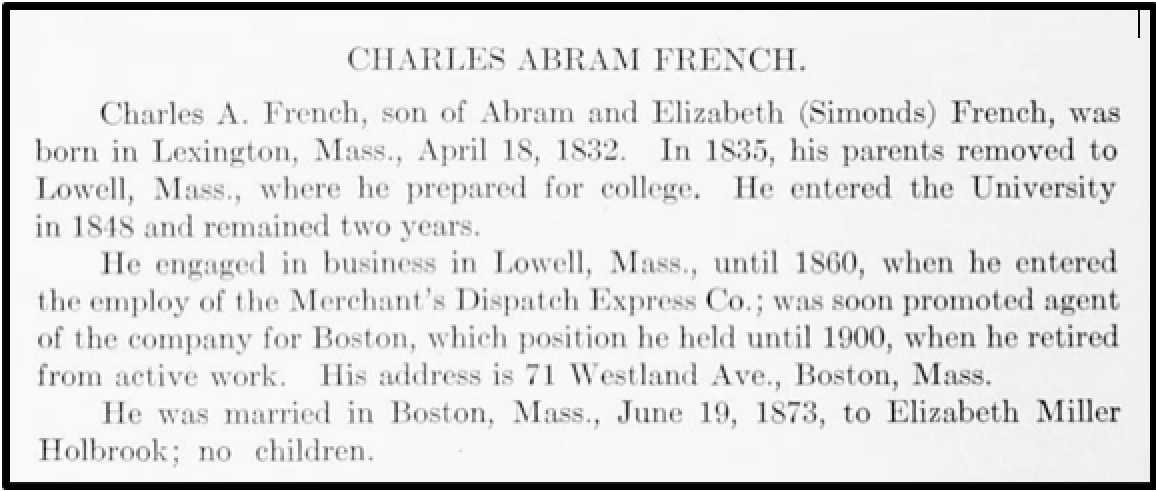
This is a story about Elisabeth (Holbrook) French (1847-1914) who was the wife of my 2nd great uncle, Charles Abram French (1832 – before 1914). According to a newspaper account, Charles was a family friend who first meet Elisabeth when she was only four years old. In the 1860 census, Charles (27) is listed as living in the home of Mahala (34-widow) and Lizzie (14) Holbrook. Thirteen years later, Charles and Elisabeth were married in Boston, Massachusetts. They had no children.

The interesting twist to this story is that upon her death in 1914, Elisabeth left $85,000 (the total estate was estimated to be $100,000) to homes for “aged” men and women, the Animal Rescue League, a couple of close friends and two of her doctors. Funds were also provided to the Red Acre Farm in Stow, Massachusetts, which was one of the first animal rescue organizations specifically for horses.

What is $85k in 1914 worth in today’s money? The answer is $2,214,029!

Elisabeth’s will provided no money for extended family members such as cousins, nieces or nephews. This really fried her cousin, Florence Bacon, who contested the will claiming that her aunt was not of “sound and disposing mind” when she made her will. The jury did not buy Florence’s argument, it took them only 10 minutes to decide that the will was valid. (below: news articles)
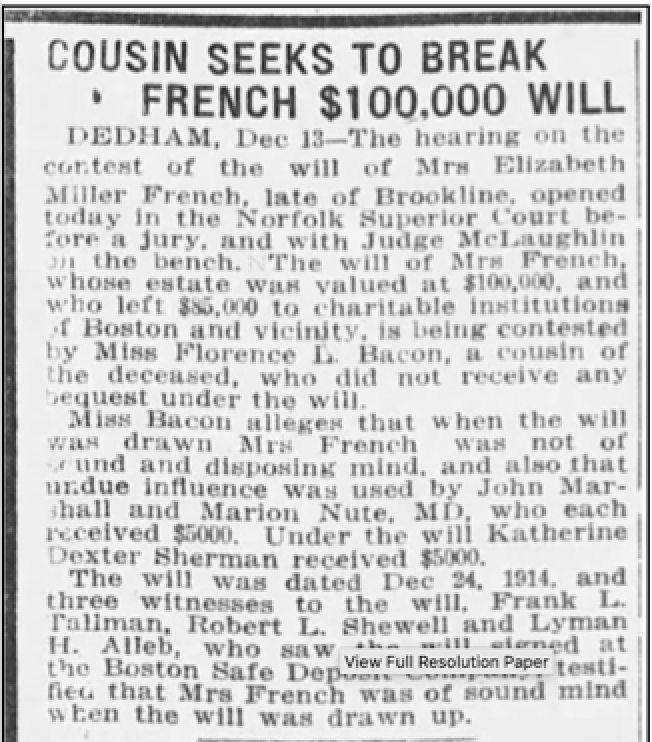
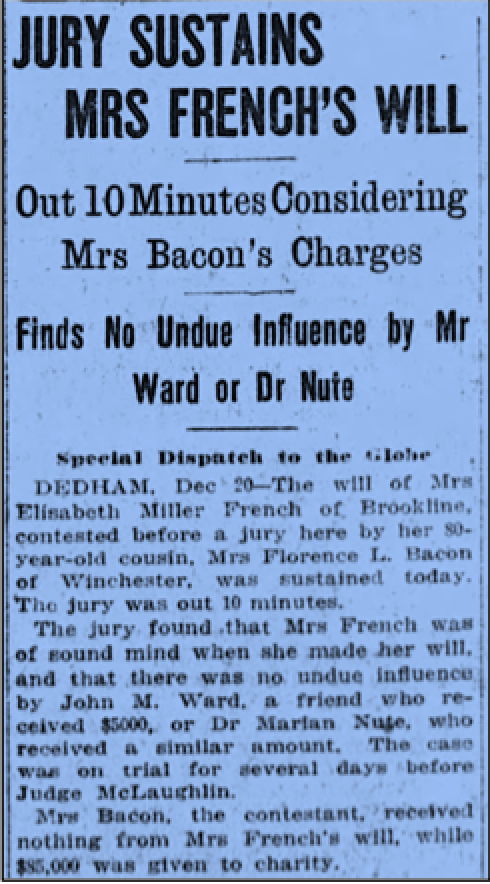
Charles was an agent for the Merchants Despatch Transportation (MDT) Company in Boston. MDT was established by the American Express Company and the company manufactured refrigerated rail cars. (Source: Norwich University, 1819-1911)

Note: One of the witnesses called in the case was my paternal great-grandmother, Mary McEachern French whose husband, Walter, was Charles cousin. There is no record of whether she was a witness for Elisabeth or Florence, however, if I could hazard a guess…..she may have cut a deal with Florence. Mary would be involved in a sensational court case a year later – Into the Breach-Promises, Promises.

Comments, corrections and suggestions appreciated.

Copyright © 2021. All Rights Reserved by David R. French


Mug of Flip + George Washington

On January 13, 1803, Theodore Hillyer walked into Viets Tavern in East Granby, Connecticut, put 8 pence on the table and had a cup of flip on a cold winter’s day. The tavern owner, Luke Viets, dutifully recorded the transaction in his ledger. We know this because the original ledger and the tavern survive til this day! (Inn’s Ledger Tells of Meals Long Past – Hartford Courant)

Check out the beautifully done Salmon Brook Historical Society Website for more about Granby, CT.

I have no way of knowing if the flip was purchased by my paternal 5th great grandfather Theodore Sr. (1754–1838) or my 4th great grandfather Theodore Jr. (1780–1845).

Flip was the quintessential tavern drink. Its preparation gave an industrious barkeep a chance to show off his steady-handed pour – transferring the mixture of ale and rum between two pitchers until smooth. Finally, a hot “flip dog” poker was plunged into the pitcher, frothing the drink and providing a burnt taste. Versions varied slightly, with the main ingredients of heat, ale, rum, and sweetener (usually molasses) being constant. Eggs contributed to the characteristically smooth texture, though nutmeg might be accompanied or replaced by ginger or lemon peel. Except from Early Connecticut Drinks: The Quintessence of Public Spirit (edible Nutmeg)

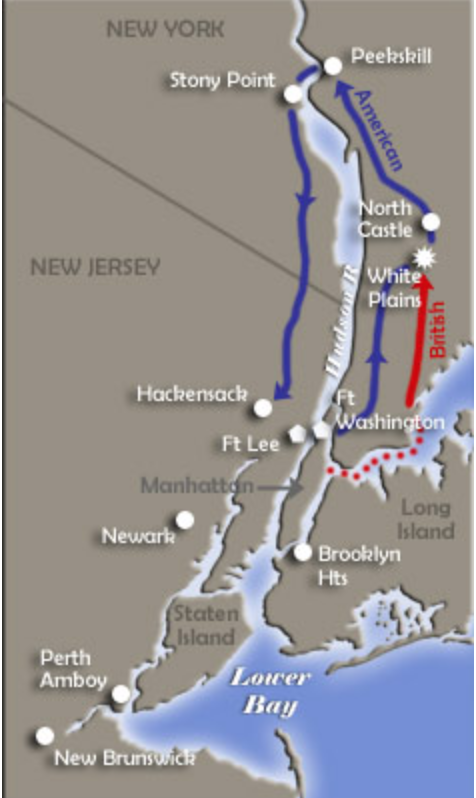
Theodore Sr. served in the Revolution during the New York and New Jersey campaigns. It is noted in his war pension application that he fought at the Battle of White Plains (NY). After British forces failed to trap the Continental Army on Manhattan, General George Washington marched north of Manhattan, withdrawing to the hills of the village of White Plains. Depictions of the battle are conflicting if it was a draw or a defeat for the American forces. 13,000 British and German troops against 14,500 Americans, although only around 4,000 on each side were actually engaged. This was the first appearance of Hessian troops deployed by the British.

Source: U-S-History.com

Comments, corrections and suggestions appreciated.

Copyright © 2021. All Rights Reserved by David R. French.


Miracle Child

The follow is an excerpt from article published in the Omaha World-Herald on May 8, 2021. Above are articles published in Aug-Sept 1952 in the Alliance Times-Herald/Hastings Daily and Columbus Telegram. The ‘miracle child’ is Connie Finney, the mother of my wife and the grandmother of my daughter.

Worse than COVID? 1950s polio epidemic struck terror in Nebraska until quelled by vaccines

The epidemic built to a crescendo in 1952, a year children and medical professionals remember with horror.“ Polio came in like the whirlwind of a tornado,” Oberst said. He worked at Children’s Hospital, which he said treated 360 polio patients that year. The 14 iron lungs — large machines that immobilized the patients, and pressed on their bodies to keep them breathing — were constantly filled.

For Oberst, the polio patients passed by that summer in a busy blur. But over all these years, the one he remembers the best is Connie Cronin Finney, a 10-year-old from Columbus he calls his “miracle child.” She was the oldest of three daughters. In late August 1952, her younger sister, Kathy, just 3 ½, contracted polio and died within days at a hospital in Grand Island. Connie’s parents had not even buried Kathy yet when Connie fell ill. Instead of seeking treatment in Grand Island, where one daughter had just died, they got her admitted to Children’s Hospital in Omaha just before Labor Day weekend. Dr. Oberst was her supervising physician.

“My temperature was between 105 and 108. I was having almost continual convulsions and was surrounded by cold body packs,” Finney, who now lives in Omaha, said in an email. Oberst described Connie’s case in his 2013 memoir, “Miracles and Other Unusual Medical Experiences,” noting that he had tried all the standard treatments at the time, but nothing worked. He said few people could survive with a temperature elevated so high for so long. On Labor Day Sunday, her parents asked what they could do. Their doctor urged them to pray.

“I’ve done everything in my quiver,” Oberst, in an interview, recalled telling them. “I said, ‘Why don’t you storm Heaven?’” Two days later, Oberst returned to the hospital, expecting the worst. But over the holiday, Connie’s fever had broken and the convulsions stopped. “I had my first real, true miracle at that time,” Oberst said. “It had to be the prayers — no question in my mind.”

Connie had turned a corner, but her battle wasn’t yet over. She was hospitalized for another seven weeks, part of it in an iron lung — the ominous specter that hung over children of the polio generation. Connie was placed in a room with four or five other children in iron lungs. It was a helpless feeling, needing nurses to take care of every need. “They bathed us, fed us, talked to us, and tried to keep us entertained,” said Finney. “We saw the other children and the nurses through mirrors above our iron lungs. I often had a book affixed to the mirror, and I would wait for a nurse to come along and turn the page for me.” She took physical therapy during short periods out of the iron lung and slowly regained strength. Amazingly, she had no paralysis. “For awhile they had not known whether I would walk again or not,” Finney said. “But one evening I walked to (my parents) when the elevator doors opened.”

Comments, corrections and suggestions appreciated.

Copyright © 2021. All Rights Reserved by David R. French.


Integrity of the Union

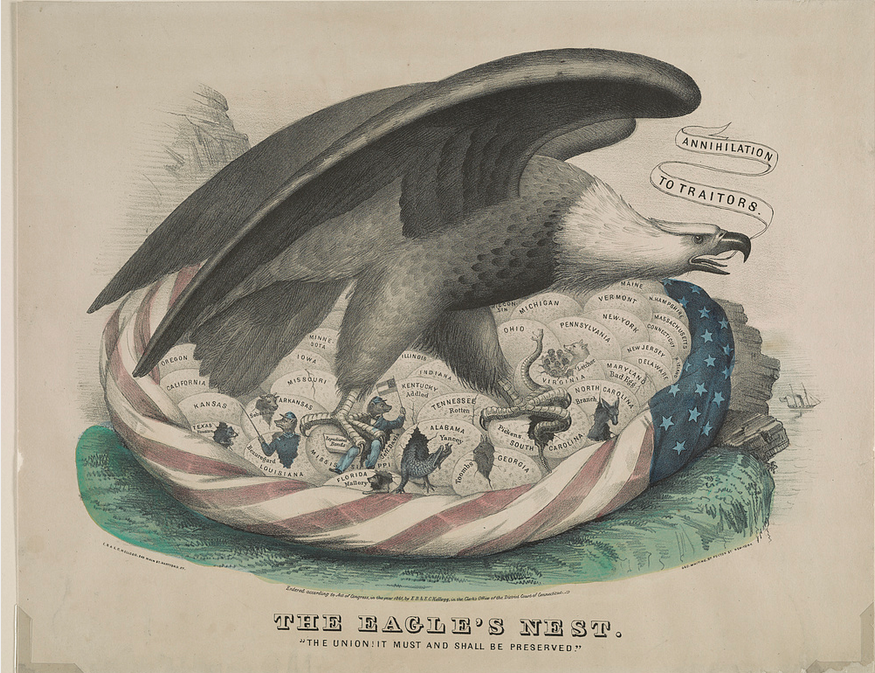
1861 Print – Shows American eagle in its nest of the American flag, which holds 34 eggs representing the states; the eggs representing the Southern states are cracked, rotten, or have various animals being hatched from them; the eagle says “Annihilation to traitors.” (Library of Congress)

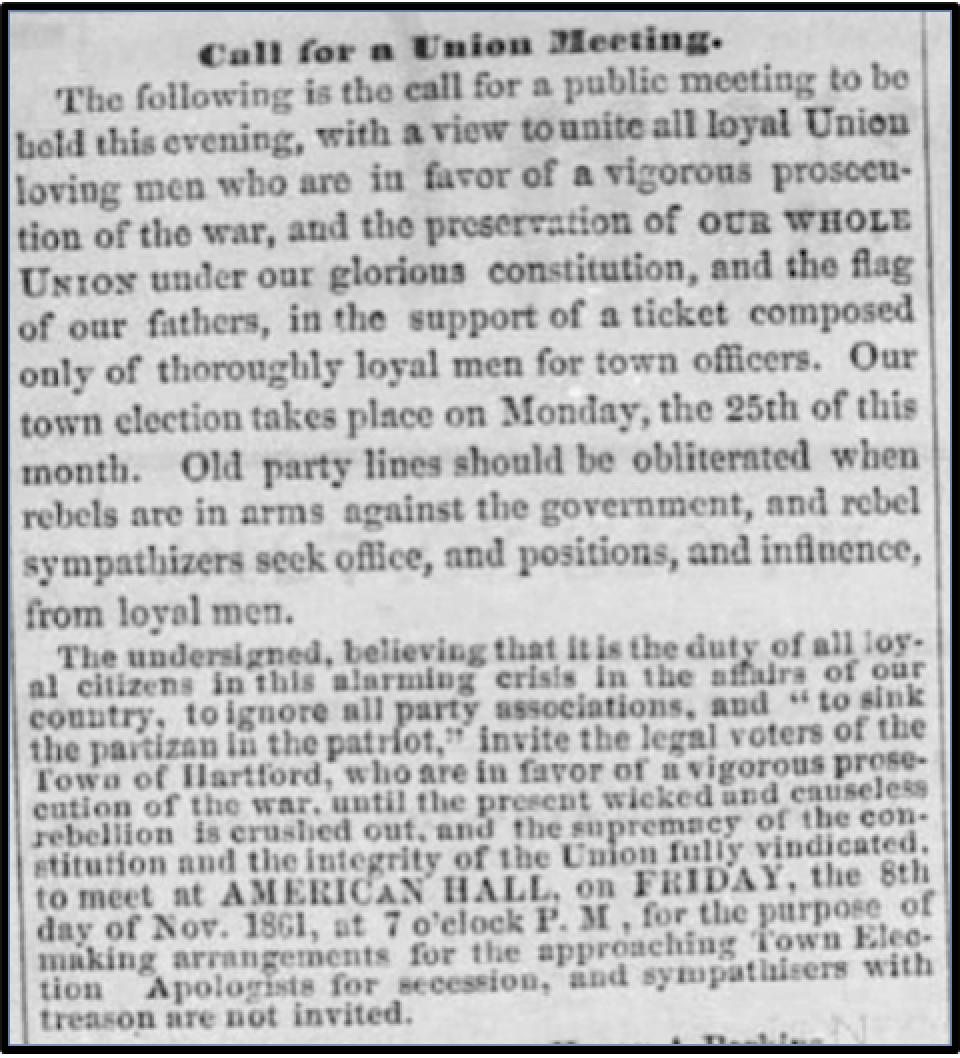
My 3rd great-grandfather, Abiram Spencer (1812-1871) has been the subject of several posts including one about his election to the Hartford, CT City Council in 1860 on the Republican ticket (Wide-Awakes for Abraham Lincoln!). Abiram was one of the over 1,000 men in Hartford signed this (below) petition in November of 1861. The closing line, “Apologists for secession, and sympathizers with treason are not invited” points to the heated emotions of this country in the early months of the Civil War.

Comments, corrections and suggestions appreciated.

Copyright © 2021. All Rights Reserved by David R. French.


What Cute Kids!

My mother and father had back to back birthdays on April 15th and April 16th. Even with a 50/50 chance, I don’t think we ever got the days right.

Mary Kathryn Grace French 1933 – 2004

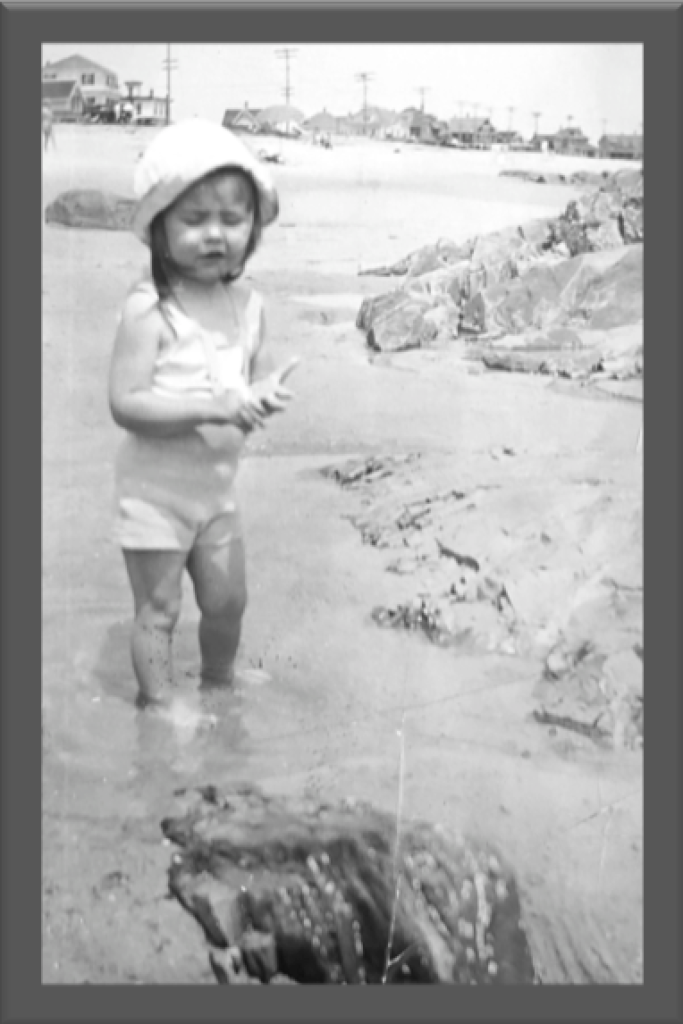
Photo (left) of Mary on the Connecticut shore (1936-7)

John Spencer French 1931- 2014

Below – Photos of John. In the picture (upper right), John is sitting with his Uncle Orrin’s children (his cousins) William Spencer, Joan Spencer, Marjorie Spencer, John Spencer, and Orrin Jr. (est. date 1934)


1953-4 – John S. French – Photographs while serving in Korea


Samuel E. Spencer – The New Haven Railroad

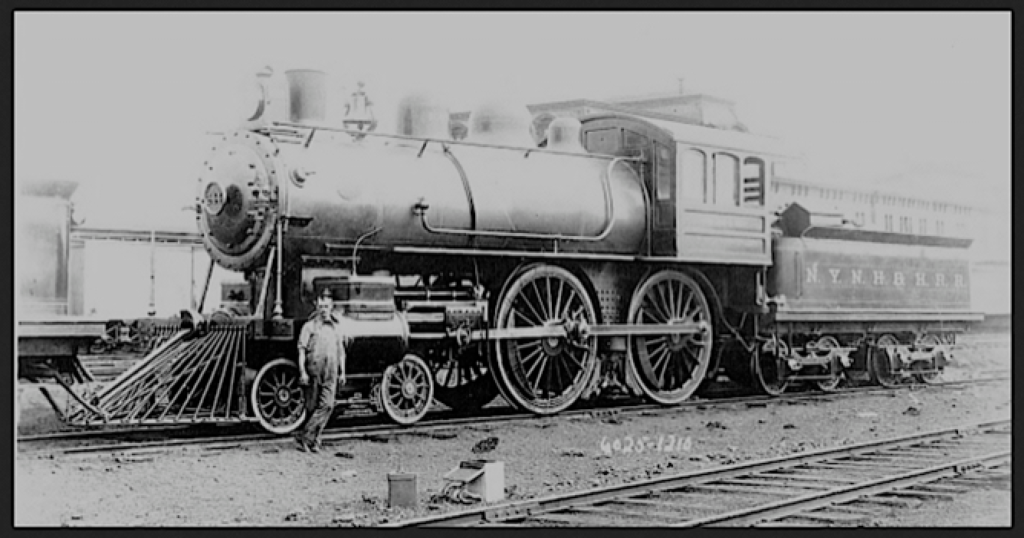
A-2 CLASS  – 16 built by the Rhode Island Locomotive Works in 1893

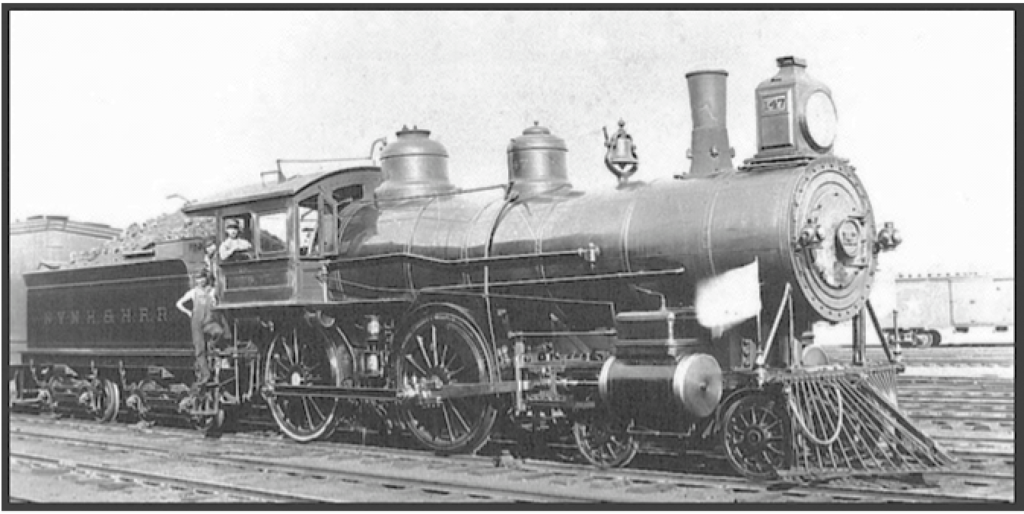
My paternal great-grandfather, Samuel Eggleston Spencer (1867-1906), was a locomotive engineer for the New York, New Haven and Hartford Railroad Company (NYNH&HRR) where he was an employee for 19 years. Operating a steam locomotive combined two responsibilities: managing a highly complex steam boiler and controlling the safe speed of a massive vehicle. For example, a class G-4 (built 1904-1907) which weighed 151,000 pounds. The photographs that accompany this post (NYNH&H Steam), depict the immensity and raw power of these steam locomotives, I can only imagine that Samuel is one of the men pictured!

In a sad coincidence, Samuel’s grandfather, Abiram Spencer, was killed in 1871 after being struck by a New York, New Haven and Hartford Railroad train. (Article – Hartford Courant)

Samuel, the son of John W. Spencer (1834-1896) and Anna Eggleston (1843-1921), was born in Bloomfield and lived in Hartford, CT.  In 1897, he married Minnie M. Fowler (1858-1957), the daughter of Edward Gamaliel Fowler (1840-1912) and Ellen Jane Thompson (1845-1924). Samuel and Minnie had six children, including my grandmother Gladys. 

The New York, New Haven and Hartford Railroad Company, commonly known as the New Haven Railroad or simply, ‘The New Haven”, operated in the states of New York, Connecticut, Rhode Island, and Massachusetts. The New Haven operated freight and passenger trains over a Boston – New York City main line and was made up of 8 railroads, several trolley companies and coastal steamship lines which were controlled through stock purchases or long term lease. (Source: New Haven Railroad Historical and Technical Association, Inc.)

B-4 147 later 1403 Baldwin 1888

Comments, corrections and suggestions appreciated.

Copyright © 2021. All Rights Reserved by David R. French.


Special Delivery – Edward Francis Daly, Sr.

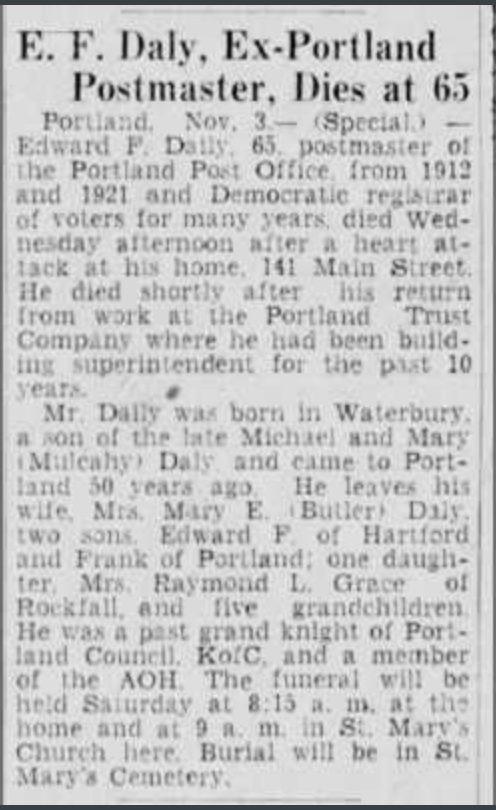
Edward Francis Daly Sr., my maternal great-grandfather, was born on May 13, 1870, in Waterbury, Connecticut. Edward was the son of Michael Daly and Hannah Mulcahy, both immigrants from Ireland. In 1889, Edward married Mary Ester Butler in Portland, Connecticut. In the census of 1900 and 1910 for Portland, CT., his occupation is listed as carpenter.

From 1914 through 1921, he was the appointed postmaster for Portland. Edward died on November 13, 1937 at the age of 67. His obituary (left) notes that he was the building superintendent at the Portland Trust Company (Bank) for the 10 years prior to his death. Edward was a member of the Ancient Order of Hibernians (AOH), the largest and oldest Irish Catholic organization in America and was grand knight of the local Knights of Columbus council in Portland.

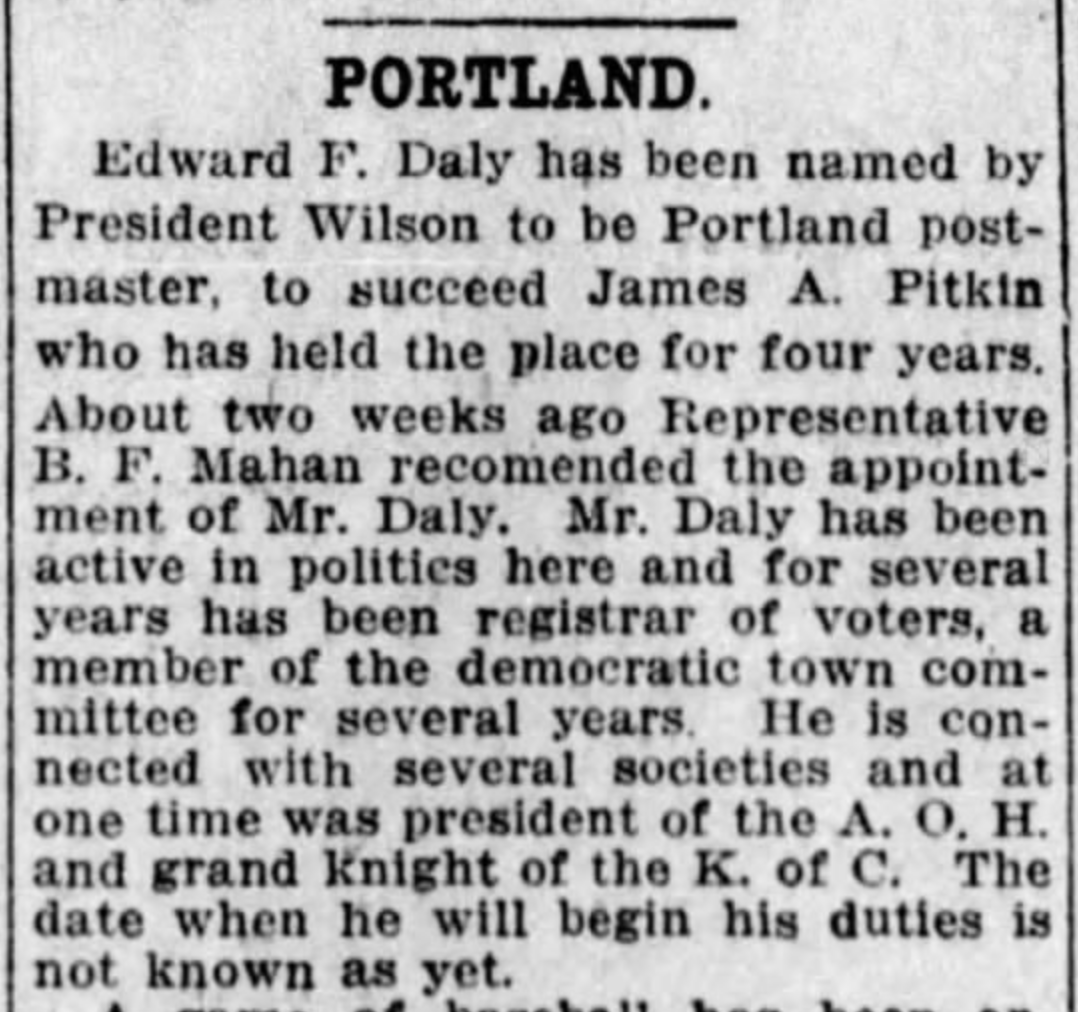
In 1914, Edward was named by President Woodrow Wilson to be the postmaster for Portland, Connecticut.  He was nominated to be postmaster by Congressman Bryan Francis Mahan (New London, CT.), who was a lawyer by trade and postmaster of New London, CT. before and following his term in Congress. Note: The service record of Edward’s son (Edward Jr.), lists his employment in 1917 as a clerical worker for the postmaster (his dad) of Portland, CT. Here is a post about Edward Jr. – Pvt. Edward F. Daly Jr. – WW1 Pv Co C 3 BN 20 En

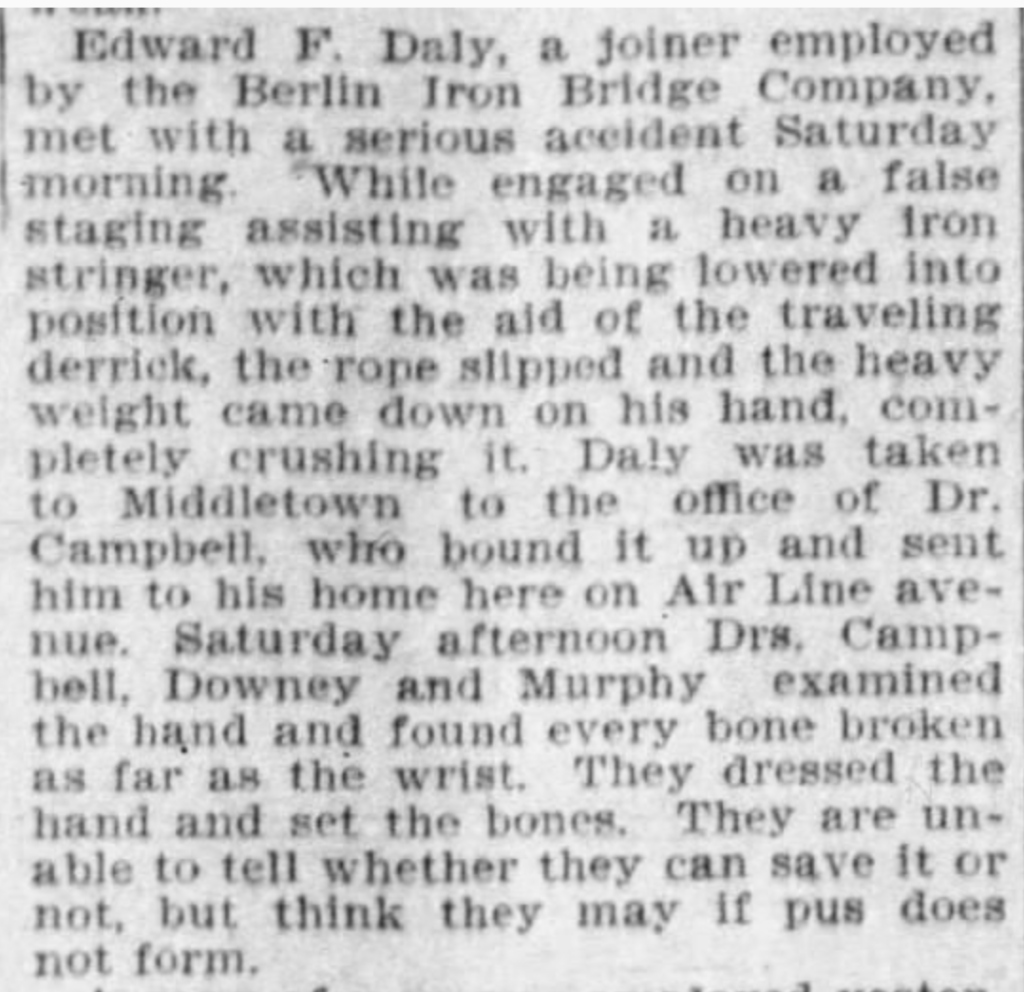
Did Edward suffer a horrible injury in 1895 while working as a joiner for the Berlin Iron Bridge Company? While I have no confirmation, everything (name/occupation/residence) lines up that this was my great grandfather. (Article – 1895 – Hartford Courant)

Comments, corrections and suggestions appreciated

Copyright © 2021. All Rights Reserved by David R. French.


“You Dog, and Damn You, I’ll Inoculate You With This, With a Pox to You!”

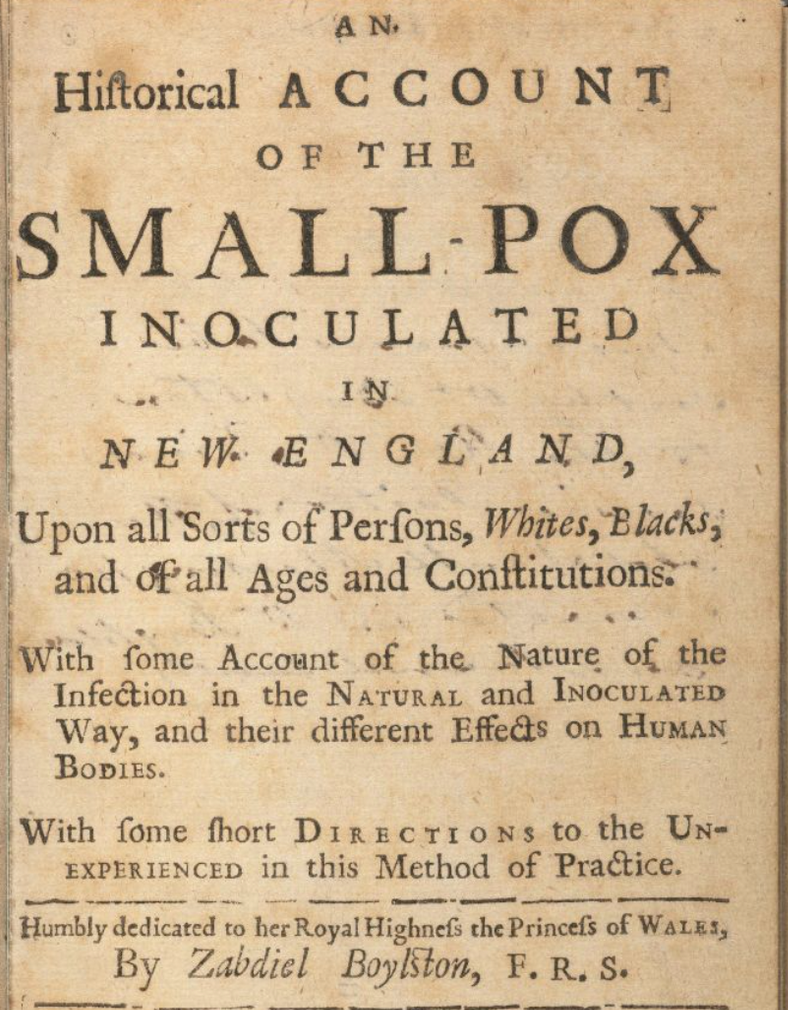
Dr. Bolyston

This is the first of two posts about Thomas Walter (1696-1722), a 6th great paternal uncle.  Thomas was born and spent his life in Roxbury, Massachusetts.  He graduated at Harvard in 1713 was a preacher, as was his father Nehemiah, a 1684 Harvard graduate!  His wife was Sarah Mather (1671-1746, daughter of Increase Mather (In Cases of Conscience, Increase Mather), and the sister of Puritan Minister Cotton Mather (my 7th great uncle). 

Small Pox – From spring 1721 through the winter of 1722, a smallpox epidemic afflicted Boston. By the end of 1722, over half of the city’s population of 11,000 had been infected and over 800 had died.  At the time the only known remedy for smallpox was to quarantine the infected individuals in their homes, with the hope that this would prevent the spread of the disease. 

Cotton Mather learned of the practice of inoculation from his slave, Onesimus. According to his diaries, Cotton received Onesimus in 1706 as “a gift” from his congregation.  By embracing a little known and controversial treatment, Mather and Onesimus changed the fate of Boston, and ultimately the future of the British colonies.

But the smallpox epidemic of 1721 was different than any that came before it. As sickness swept through the city, killing hundreds in a time before modern medical treatment or a robust understanding of infectious disease, an enslaved man known only as Onesimus suggested a potential way to keep people from getting sick. Intrigued by Onesimus’ idea, a brave doctor (Zabdiel Boylston) and an outspoken minister(Puritan minister Cotton Mather) undertook a bold experiment to try to stop smallpox in its tracks. How an Enslaved African Man in Boston Helped Save Generations from Smallpox (History.com – Erin Blackmore – Feb. 2021)

One of the first inoculated by Dr. Zabdiel Boylston (after his children) was Thomas Walter who stayed at Cotton Mather’s home while he was treated for smallpox. The debate over Cotton’s support for inoculation became so heated that an explosive device was thrown through a window into Cotton’s house (landing in the room where Walter was staying), luckily the device failed to explode.  A note attached to the explosive read, “Cotton Mather, I was once of your meeting, but the cursed lye you told of – you know who, made me leave you, you dog, and damn you, I will inoculate you with this, with a pox on you!”

Thomas’ treatment is noted below in Dr. Boylston’s records

October 31st (1721), I inoculated the Reverend Mr. Thomas Walter, Mr. Samuel Aspingwall and Mr. Dana, each between 25, and 30, they all had the Smallpox at the usual Time, and of the distinct Sort. Mr. Aspingwall had several restless Nights, which obliged me to give him an anodyne (narcotic pain medicine) for two or three nights following. The other two Gentlemen laughed at him & said he was troubled with vapors. They all in a short time, were well. These Gentlemen came from Roxbury into Boston to be inoculated, and lay in one Room; and their Recommendation of this Practice, at their return proved to be of great Service to that Town, in carrying the Inhabitants soon thro’ that distemper, and in saving many Lives, if I may be allowed to judge from the Success of the different Ways of Infection, viz. out of the first thirteen men and they chiefly heads of Families who had the Smallpox in the natural way, ten of them died; and in above 40 Men that were inoculated at or near the same Time, in the same Town, not one Man died.

Comments, corrections and suggestions appreciated.

Copyright © 2021. All Rights Reserved by David R. French.


Childhood Sweethearts

In an earlier post, I described the journey of the Maul, Sinner and Hamburger families from Russia to Nebraska (A Sinner, a Hamburger and a Tsarina).  These “Volga Germans,” even after centuries living in Russia, never lost their German identity. This post is a story of love, of childhood sweethearts, together again in a later chapter of their lives. Heinrich “Henry” Jacob Maul Sr. was born in 1863 in Norka, Russia and in 1885 he married Elisabeth “Lizzie” Sinner. They had five children together. In 1924, Lizzie passed away.

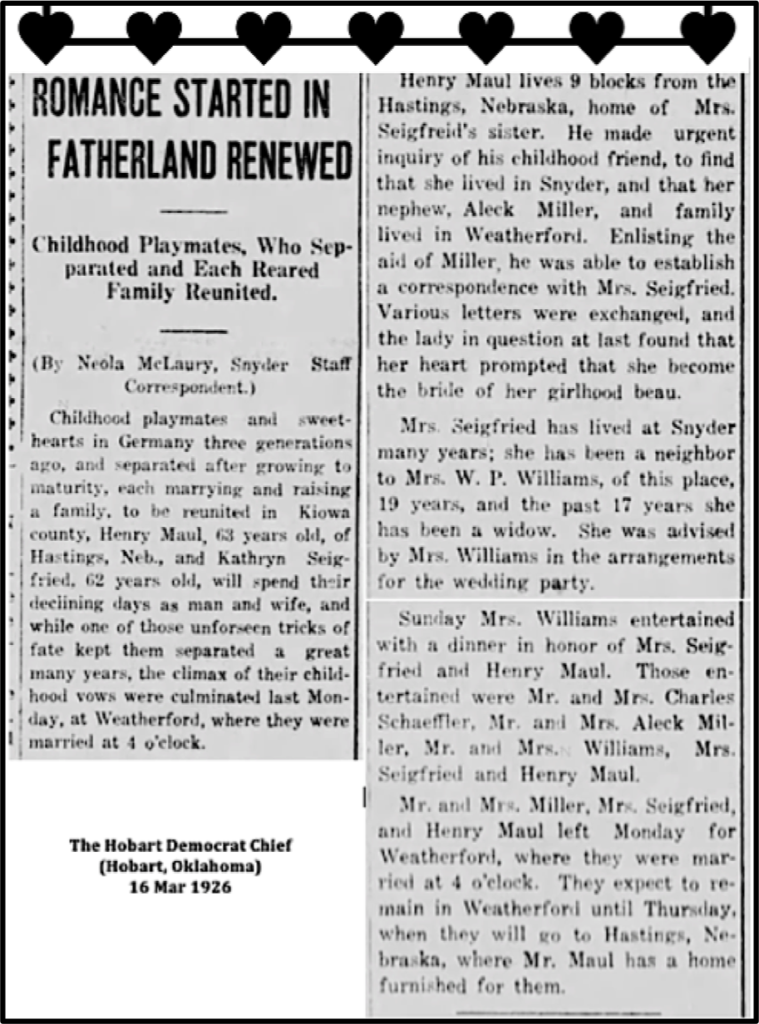
A New Love – On March 8, 1926, in Weatherford, Oklahoma, Henry married Katherine (Pfeif) Seigfried. The details of his courtship and special connection to Katherine is described in a wonderful newspaper article (below) about their marriage along with their marriage certificate. In the 1930 and 1940 U.S. Census’, Henry is listed as working for the City of Hastings as a common laborer. Henry died in June 1947 at the age of 83, and was buried in Hastings, Nebraska.

Katherine Pfeif was born in 1863 in Frank, Saratov, Russia. She married there in 1860 to Jacob Seigfried and immigrated to America in 1887. Katherine and Jacob had 10 children. Jacob died in 1909 in Oklahoma and Katherine was a widow for 17 years until Henry came along. The article mentions Katherine’s sister, Margaretha Sitzman, who lived in Hastings, NE. Sadly, I have found no record of Katherine passed after the 1930 Census, in 1940, Henry is listed as widowed.

Special thanks to Henry’s 2nd great granddaughter, Michele, for her input on this post!

Comments, corrections and suggestions appreciated.

Copyright © 2021. All Rights Reserved by David R. French.