Lord How They Died

In researching Robert Lord Jr., my 9 great-grandfather who resided in Ipswich, Massachusetts, I came across an account regarding the death of his son Joseph (1638-1677).  The account read, “upon the death of Joseph, son of Robert Lord Sr., of Ipswich, who was killed in the woods about two miles and a half from Ipswich meeting house, that he with others was felling a tree and a limb, as it fell, hit another tree breaking it and it fell upon said Lord killing him.” Records and Files of the Quarterly Courts of Essex County, Massachusetts (p.397)

A remarkable
thing about researching New England history is the depth and extent that they
recorded their lives and in this case, deaths. The History of Ipswich, Essex, and Hamilton (p. 202-4) records some rather notable deaths:

Feb 21st 1787 – Francis a child of William Cogswell of Chebacco (Essex, MA) died by falling into a kettle of boiling chocolate.Oct 16th 1727 – We are informed from Ipswich that on Wednesday night last a young woman of that place being more merry than wise dressed herself in men’s apparel intending a frolic at a place some distance off but as she was riding through a river or pond her horse in all likelihood threw her into the water where she was taken up the next day drowne.

September 1771 – At the Hamlet, a child of Mr. Bolles died by drinking scalding water from a tea pot.

Jan 5th 1814
– Betsey Telock AE 49 is burnt to death. It has been commonly reported that she
came to her end by spontaneous combustion from the inordinate use of ardent
spirits. But it is the opinion of the gentleman who first discovered her body
soon after the flames in her room were extinguished that she caught her bed
clothes on fire with a candle and thus lost her life.
The History of Ipswich, Essex, and Hamilton also mentioned the Dark Day, a day many New Englanders believed
carried prophetic meaning.  The true cause is believed to have been a
massive forest fire combined with a thick cloud cover and fog.

May 19th 1780  – Darkness came on like that of an eclipse. By 9 o clock
a.m. persons could not see to weave. Candles were lighted to dine by.  As
the day began prematurely to put on the appearance of twilight cattle lowed and
fowls went to roost. The darkness of the succeeding evening was almost
palpable. Many feared and trembled lest the end of all things had come. They
alone are truly wise who seek the Lord when the bow of his mercy is over them,
as well as, when they hear his thunders and behold his lightnings. (p.202)

General
George Washington, who was encamped with his Continental Army in nearby New
Jersey, commented on the strange weather in a May 18 diary entry. “Heavy and
uncommon kind of clouds,” he wrote, “dark and at the same time a bright and
reddish kind of light intermixed with them…” (Remembering New England’s Dark Day)

Additional Stories about the Dark Day:
On the dark day, May 19th, 1780. Library of Congress

The
Dark Day – BBC Story


Lord How They Lived

Robert Lord Jr., my 9 great-grandfather, was born in Sudbury, Suffolk, England in 1603. Robert arrived in Massachusetts in 1634/5 with his wife Mary Waite and four children. He took the freeman’s oath (example below) at Boston in 1636. Robert lived for 80 years and died on August 21, 1683 in Ipswich.

My family relation continues through their daughter Abigail who was born in 1646 and died June 04, 1729. Abigail married Jacob Foster on February 26, 1665/66 in Ipswich. Jacob’s 4th g-granddaughter, Laura Maria Foster, married Horace French.

In September 1636,
Robert was appointed Town Clerk and Clerk of the Court of Ipswich and continued
to hold that position until his death. His duties included what would now be
considered Clerk of Probate and Register of Deeds. As Marshal, he is said to
have served more than twenty years in the Indian wars and became so inured to
camp life and exposure that he could never afterwards sleep upon a feather bed.
He is said to have been below the medium stature, but of powerful mold and one
of the most athletic, strong, and fearless men in the Colonial service.

Robert Lord House

In 1660, Henry Kingsbury sold his home and land on High Street to Robert Lord for “two oxen in hand — 5 pounds to be paid Robert Paine and 40s to Edmund Bridges” (to perhaps settle debts?).  The Henry Kingsbury – Robert Lord House, 52 High Street still stands and was featured in Historic Ipswich, a fine blog about the history of Ipswich.

Background: Genealogical and Family History of the State of New Hampshire: A Record of the Achievements of Her People in the Making of a Commonwealth and the Founding of a Nation, Vol 4.

FREEMAN’S NEW OATH (Post 1636) Being by God’s providence, an Inhabitant, and Freeman, within the Jurisdiction of this Commonwealth; do freely acknowledge my self to be subject to the Government thereof: And do therefore do here swear by the great and dreadful Name of the Ever-living God, that I will be true and faithful to the same, and will accordingly yield assistance & support thereunto, with my person and estate, as in equity I am bound; and will also truly endeavor to maintain and preserve all the liberties and privileges thereof, submitting my self to the wholesome Lawes & Orders made and established by the same. And further, that I will not plot or practice any evill against it, or consent to any that shall so do; but will timely discover and reveal the same to lawful Authority now here established, for the speedy prevention thereof. Moreover, I doe solemnly bind my self in the sight of God, that when I shall be called to give my voyce touching any such matter to this State, in which Freemen are to deal, I will give my vote and suffrage as I shall judge in mine own conscience may best conduce and tend to the public weal of the body. So help me God in the Lord Jesus Christ.


Walter’s in the House

UPDATE: After listening to an amazing episode of American History Teller entitled the Reconstruction Era: The Great Betrayal (Ep. 6), an important piece of Walter’s story made perfect sense: The year 1877 marked the last year of Reconstruction for the nation.

“The results of the U.S. presidential election of 1876 were a mess. A Democratic candidate had emerged with the lead in the popular vote, but 19 electoral votes from four states were in dispute. In 1877, Congress convened to settle the election—and their solution proved to be the beginning of the end for Reconstruction in the south.” (How the 1876 Election Tested the Constitution and Effectively Ended Reconstruction – History)

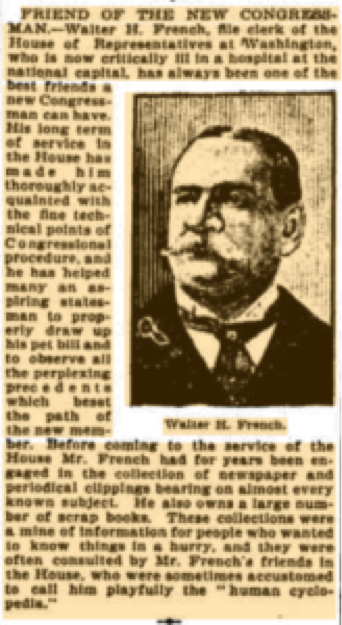
Walter Henry French Jr. was born on December 2, 1837 in Lowell, Massachusetts to Walter and Sarah (Bowers) French.  Walter Jr. is my 1st cousin-4x removed.  His grandfather, Luther French, is my 4th great grandfather.

On May 5,
2016, the U.S. House, Office of the Historian, published an article
entitled,  An Early Effort by the House of Representatives to Preserve Its
Records
.   The article noted that in
1899, Walter urged Congress to protect and preserve congressional records,
stating “the extreme heat in summer from the iron roof and the dampness in
winter from the condensation of hot air coming against the cold iron of the
roof renders the place unfit for documents of such value.

Walter Jr. is
a genealogists dream, an interesting life in Washington D.C. ripe with
political history and well documented.  He was frequently noted for
his  extensive collection of scrapbooks full of newspaper and periodical
clippings and for his knack for uncovering priceless documents.  To keep
this post manageable, I am providing links to newspaper articles in which
Walter was referenced.  I believe Walter enjoyed being mentioned in the
news and he was even able to document his imminent demise…several times!

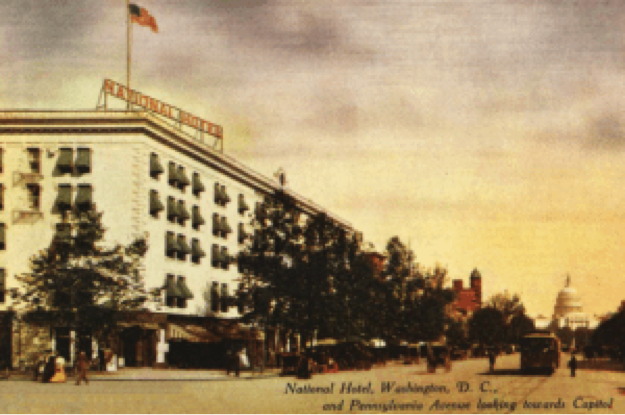
National Hotel

In 1857,
Walter moved from New Hampshire to Washington D.C. and worked as a
clerk/manager at the National Hotel.  He came to Washington with Franklin Tenney  who
“assumed charge” of the National, which had been closed following a
mysterious and fatal sickness that had broken out among its guests.”  Tenny was married to Mehitable Swett Varnum who was
a niece of Brigadier General James Varnum of Revolutionary War fame and of
Bradley Varnum who was at one time Speaker of the U.S. House of
Representatives.   This political connection appears to have
played an important role in Walter’s life.  In 1876, he was appointed as journal
clerk
for the U.S. House of
Representatives.

U.S. House of Representatives – Mr. Walter H. French, of Boston Mass., who has been appointed Journal Clerk in place of Mr. Smith, who resigned, took his place today.  May 1, 1876 – Alexandria Gazette (Virginia)

However, in December 1877, Walter was removed and replaced by Albert Lamar of Georgia.  Lamar was clerk for the Congress of the Confederate States (CCS)  from May 1862 to March 1865 at Richmond, Virginia.  Just how a avowed secessionist and former clerk for the CCS became a clerk for the U.S. House of Representatives twelve years after the end of the Civil War is a mystery?

Following his dismissal, Walter moved to Boston and later New York City where he opened an office on Wall Street, working as a stock broker.  According to his obituary, three times he made and lost his fortune playing the market as a plunger.  To quote P.J. O’Rourke, “Giving assets to a stock market plunger is like giving beer and car keys to teenage boys.” A plunger makes daring emotional investments, risking a large percentage of capital on a single trade.  By the age of 45 he was out of the market and back in Boston were he tried his hand in politics, supporting the Democratic Party.

Walter’s
support of Democrats paid off in 1891 when he was appointed file clerk for the
U.S. House of Representatives for the 52nd United States Congress.  His
dedication to the preservation of legislative records and knowledge of
congressional procedure made him a respected staff member and a gifted
researcher for drafting legislation.

In a way, he was google before google with Members of Congress referring to him as a human cyclopedia. Walter was a dedicated keeper of scrapbooks (newspaper and periodical clippings) for over 20 years.  He is quoted as saying, “I think all public men should keep scrapbooks, they are a handy reference and when kept in order you can find in a moment the history of any measure or question.”  According to news article, Walter was also in possession of autographs and of rare old public documents, or discovered rare documents.

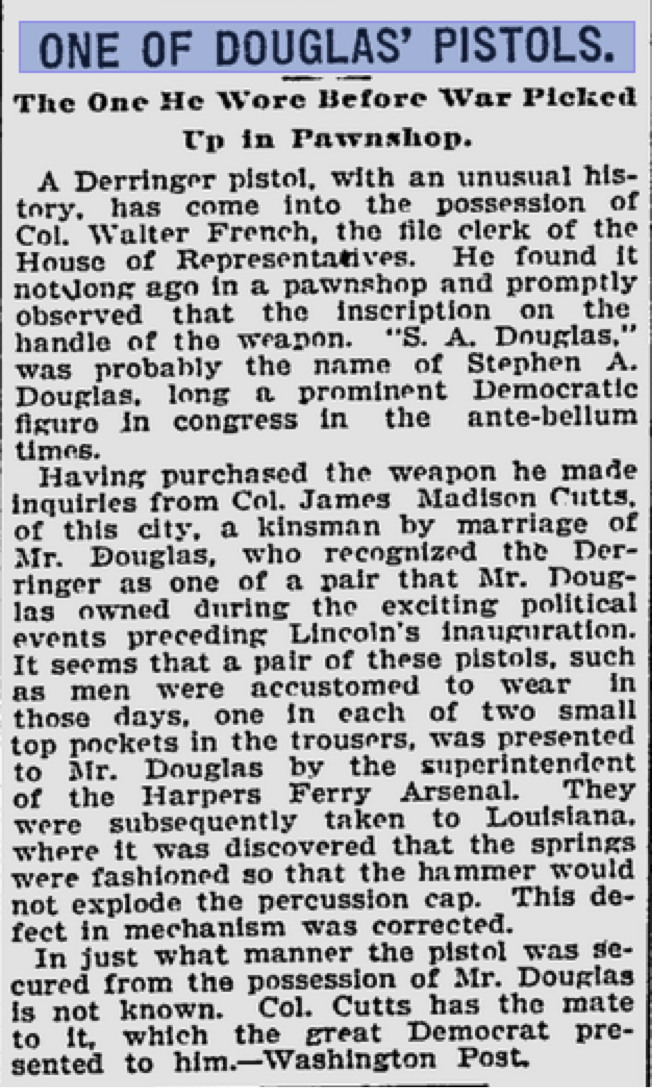
Stephen Douglas’ Pistol

Once again, Walter French is in the middle of history.  This time a widely distributed newspaper story tells of Walter’s purchase of a derringer, with a inscription of S.A. Douglas on the handle.  Of course, Walter knows who to consult to see if it was once owned by Stephen A. Douglas, the Democratic Party nominee for president in the 1860 election, losing to Republican Abraham Lincoln. Walter happens to know a ‘kinsman’ of Douglas by the name of James Madison Cutts, Jr.,(below) the only American to ever be awarded the Medal of Honor three times! (Article)

(Biography – Arlington National Cemetery) “Colorful” hardly describes the career of this Union officer. From a prominent family and a graduate of Brown University and Harvard Law School, Cutts joined the army in 1861 and was awarded a triple Medal of Honor, the only such medal ever issued, for bravery at the Wilderness, Spotsylvania, and Petersburg. However, the medal was not given until 1891, the delay due in part to a string of career-busting events. These include being caught peering over the transom at a married woman while she undressed, refusing a challenge to a duel, three courts-martial, involvement with a pyromaniac army doctor, ripping the chevrons off one soldier’s uniform and hitting another so hard that Cutts broke his own hand, and seizing property owned by an influential carpetbagger.

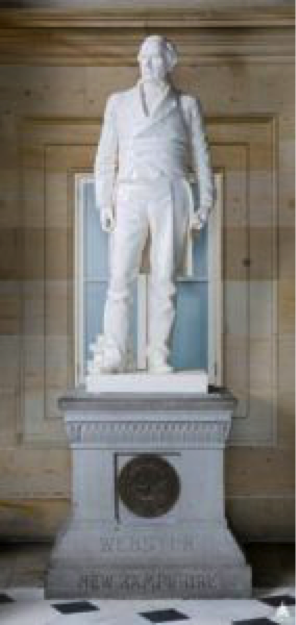
(Image) Daniel Webster’s Pants – When a question arose in 1894 regarding the new statue of Daniel Webster in Statuary Hall at the U.S. Capitol, specifically about the cut of his trousers, they turned to Walter French.   Walter, as was his nature did have an answer, he just happened to know the tailor in Boston who measured and cut Webster’s trousers!

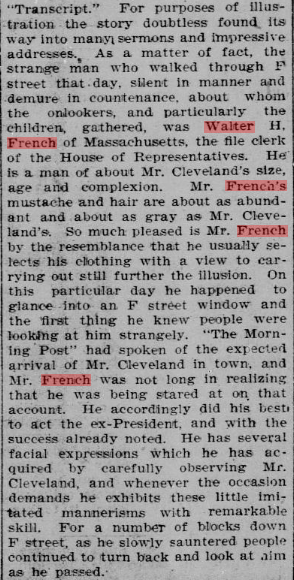
Personating Presidents – Walter happened to resemble (and cultivate his resemblance to) President Grover Cleveland.  In 1899, an article was published, becoming a national sensation, about individuals who were misidentified as being “presidential.” (Sacramento Daily Union – March 22 ,1899)

Dead Almost, Then Dead for Real

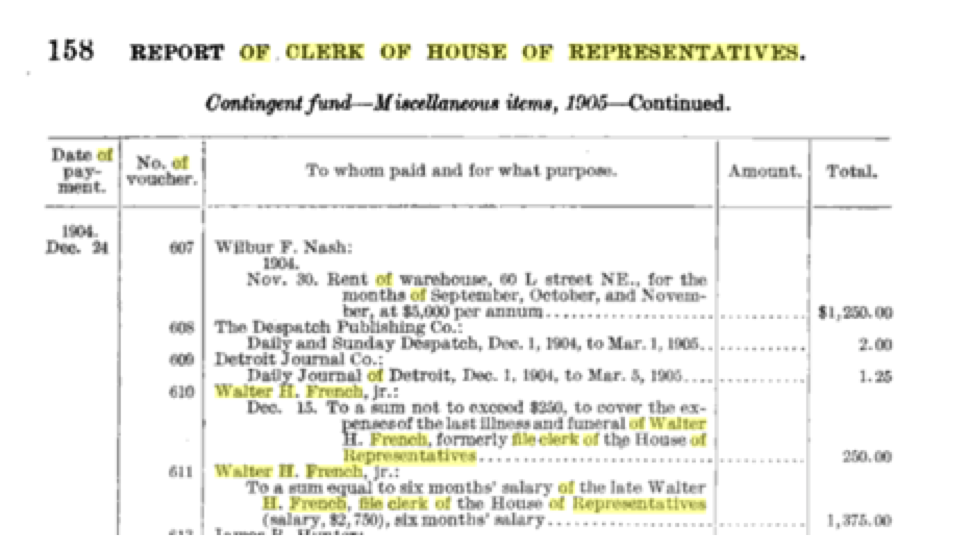
On several occasions, it was reported in newspapers that Walter was seriously ill and near death, as was his nature he collected and took great pleasure in these articles.  When death did finally come in 1904, Walter was in Wiesbaden, Germany on an European tour that included visits to England, Italy, Greece and France.  Walter was remembered as one of the best liked men in Washington with close friends among members of Congress and those who frequented the building.  Following his death, Congress approved payment for expenses associated with his illness and funeral and a sum equal to six months of his salary ($1,375). The last item to share is a thoughtful, long obituary that sketches Walter’s life and times. Colonel French Dead – Evening Star August 14, 1904


A Sinner, a Hamburger and a Tsarina

This is a story of immigration on a global scale. The starting point for the tale is Helen Maul, the daughter of Henry and Anna Maul.  Her father, Henry or Heinrich, was born in Norka, Russia, a 4th generation Volga-German.  Although Henry represented the 4th generation of Maul’s born in Russia, when he came to America he identified as a German.

Helen was
born and raised in Hastings, Nebraska and later married Jack Cronin. 
Helen Cronin is my daughter’s maternal great grandmother.

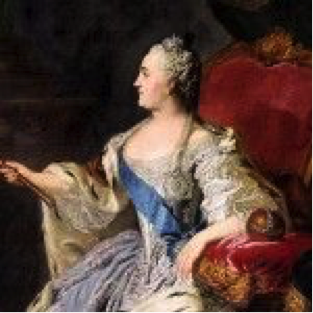
Catherine the Great

In 1763,
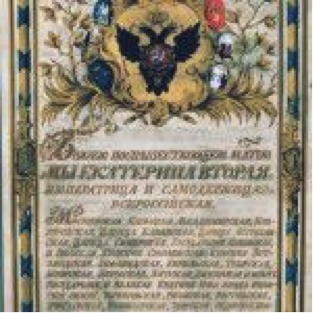
Russia’s tsarina Catherine the Great signed a manifesto inviting foreigners to
settle in Russia. A German national herself, Catherine’s decree marked the
beginning of the journey of the Maul family from Germany to Russia and then
America. As we move back through the generations, Maul men married women who
were Sinner’s and Hamburger’s. These families moved from Germany to Russian in
an effort to escape religious strife and economic hardship. A century after the
first Germans settled in Russia, Czar Alexander III revoked many of the
privileges promised to them by Catherine the Great and it was time to find
another promised land.

The manifesto promised the immigrants: exemption from military service, self-governance, freedom of language, tax breaks, initial financial aid, 75 acres of land per settler family, and “the free and unrestricted practice of their religion according to the precepts and usage of their Church.” Between 1763 and 1768 more than 25,000 Germans established 104 colonies in Russia. The families highlighted in this story resided in Isenburg, which was a former county located in the German state of Hessen near Frankfurt and settled in Norka, Russia. The trip to the Volga region of Russian (map) was no easy exploit; it was a 1,600-mile trek from the Hesse region to Norka, Russia. It is estimated that 17% of those who attempted this journey did not survive the trip.

Tsar
Alexander III in the 1870’s revoked Catherine’s privileges. Rather than face
compulsory schooling in the Russian language and five years of service in the
Russian Army, many Volga German families decided to emigrate to America.

Catherine the Great and the ‘Russian-Germans’ – Article about those that stayed behind in Russia.

The Hesse-Norka Families

Maul Family

Carl (Karl)
Maul
b: 1747 in Isenburg, Hesse, Germany d. 1799 in Norka,
Russia Married: Anna Margaretha Doerr b: 1749 in Hesse, Germany d. 1798 Norka,
Russia.

Original
Norka settler, 1st wife Anna Margaretha Dörr, 2nd wife Margaretha Weigandt in
1775, daughter of Konrad Weigandt.  Carl was an apprentice to Konrad
Weigandt, a craftsman from Isenburg. Reformed faith church, farmer from
Isenburg, arrived in Oranienbaum (not far from St. Petersburg) on Sept. 9, 1766
by the ship Elephant, arrived in Norka colony on Aug. 15, 1767.

Johannes Maul
b: ABT 1784 in Norka, Balzer, Saratov, Russia d. 1819
Russia. Married: ?

Conrad Maul b: 22 Aug 1809 in Norka, Russia d. 1876 in Norka, Russia.
Married: Anna Margaretha Gobel b: 26 Jul 1812 in Norka, Russia d. 1851 Russia.

Heinrich Maul b: 2 Feb 1835 in Norka, Russia d. 1888 in Norka, Russia. Married:
Magdalena Hamburger b: 21 Oct 1835 in Norka, Russi.

Heinrich Maul b. 17 Sep 1863 in Norka, Russia. Married: Elisabeth Sinner b: 3
Sep 1862 in Norka, Russia.

Heinrich
Jacob Maul
b. 1 Apr 1886 in Norka, Russia.
Married: Anna Schwenninger b: 1887 in Iowa, USA.  Daughter: Helen May
(Cronin) b. 1919.

Hamburger Family

Hamburger Family

Johannes Hamburger b: 1744 in Isenburg, Hesse, Germany d. 1821 Norka,Russia. Arrived in Norka colony on 15 Aug 1767. Handicraftsman, Tailor – Reformed Church. Married: Anna Catharina Bauer b: 1747 in Germany.

Johannes
brother,
Philipp, served in the
Hesse-Hanau Regiment of the Crown Prince on the side of the British in the
American Revolution. During this time he was captured and ransomed.

Philip
Hamburger
b: 1775 in Norka, Balzer, Saratov,
Russia d. 1829 Norka, Russia. Married: Elisabeth Huck b: 23 Nov 1777 in Norka,
Russia.

Johannes Hamburger b: 15 Mar 1808 in Norka, Russia. Married: Catharina Schreiber b: 2 Feb 1808 in Norka, Russia. ( I believe both are in photo above)

Magdalena Hamburger b. 1835 in Norka, Russia.  Married Heinrich Maul.

Sinner Family


Johann Sinner b: Abt 1715 in Isenburg, Hesse, Germany Married: Anna Maria ? b:
Abt 1720 in Isenburg, Hesse, Germany.

Conrad Sinner b: Abt 1747 in Isenburg, Hesse, Germany. Married: Elisabeth ? b:
1752 in Isenburg, Hesse, Germany.

Johann Heinrich
Sinner
b: Abt 1774 in Balzer, Saratov,
Russia. Married: Elisabeth Loos b: 25 Sep 1776 in Norka, Russia.

Conrad Sinner b: 1 Aug 1798 in Norka, Balzer, Saratov, Russia. Married:
Margaretha Koehler b: 22 Jan 1801 in Norka, Russia.

Georg Heinrich Sinner b: 11 Oct 1823 in Norka, Russia d. 1885 in Russia. Married: Magdalena Scheidemann b: 19 Dec 1826 in Norka, Russia.

Elizabeth Sinner b. 3 Sep 1862 in Norka, Russia. Married: Heinrich Maul Jr. on 5 Feb 1885 in Norka


Priceless – Abram French

Abram French – Probate

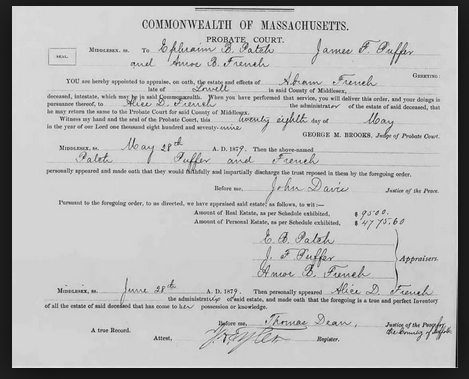
This post was originally intended to be a short piece on the 1879 probate record of my 3rd great-grandfather Abram French, who resided in Lowell, Massachusetts. Nice visuals and quick facts estimating the value of his estate in 2019 dollars. I have featured Abram in a previous post: Which Abram are You?

$9,500 – The appraised value in 1879 of the real estate Abram French owned.

The buying power equivalent in 2019 would be $240,137.

$4,775.60 – The appraised value in 1879 of Abram’s personal estate.

Would be worth $120,700 in 2019.

To punch up the piece, I wanted to provide a little background on the individuals mentioned in the document. However, the oddity of the relationship between the French and Dean families was much more interesting then the story of the probate. 

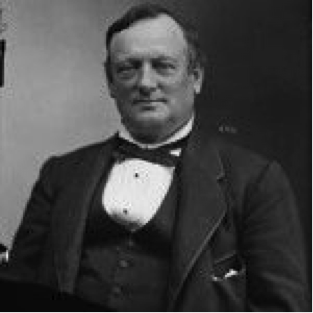
Benjamin Dean

Alice Dean
French (1826-1923), the administrator of the estate, was Abram’s second
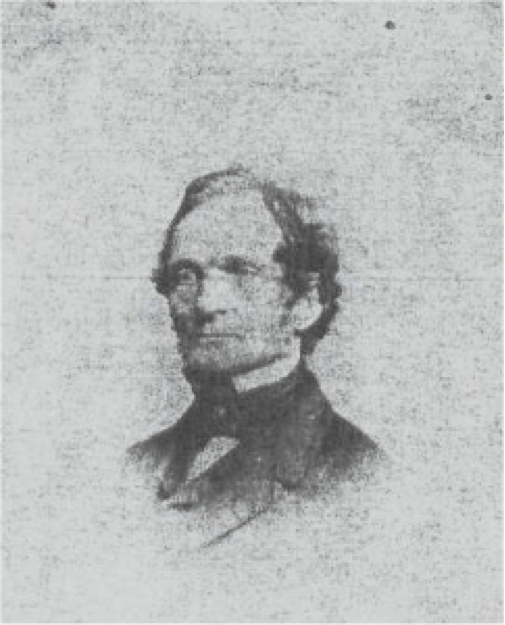
wife.  Alice was twenty-three years his junior.  Her brother, Benjamin Dean (photograph), was a
member of the U.S. House of Representatives from Massachusetts.  In in odd
twist, Benjamin was married to Mary Anne French, the daughter of Abram’s
brother Josiah Bowers French, who was a
former Mayor of Lowell (click his name to read about his life).  So, if I
have this familial relationship right, Alice was both Mary’s aunt (by marriage)
and sister-in-law.  Alice also happened to be three years younger than her
niece, Mary.

In addition,
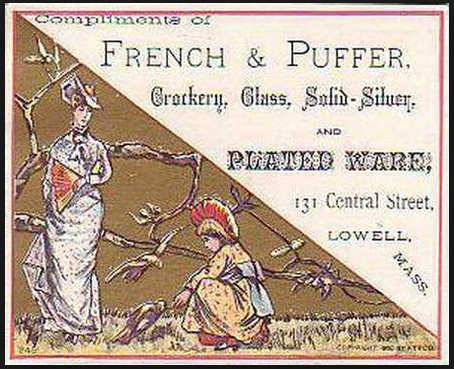
one of the appraisers, Amos Binney French, was Abram’s brother and to other was
James F. Puffer.  James and Amos were business partners.


Home Sweet Home

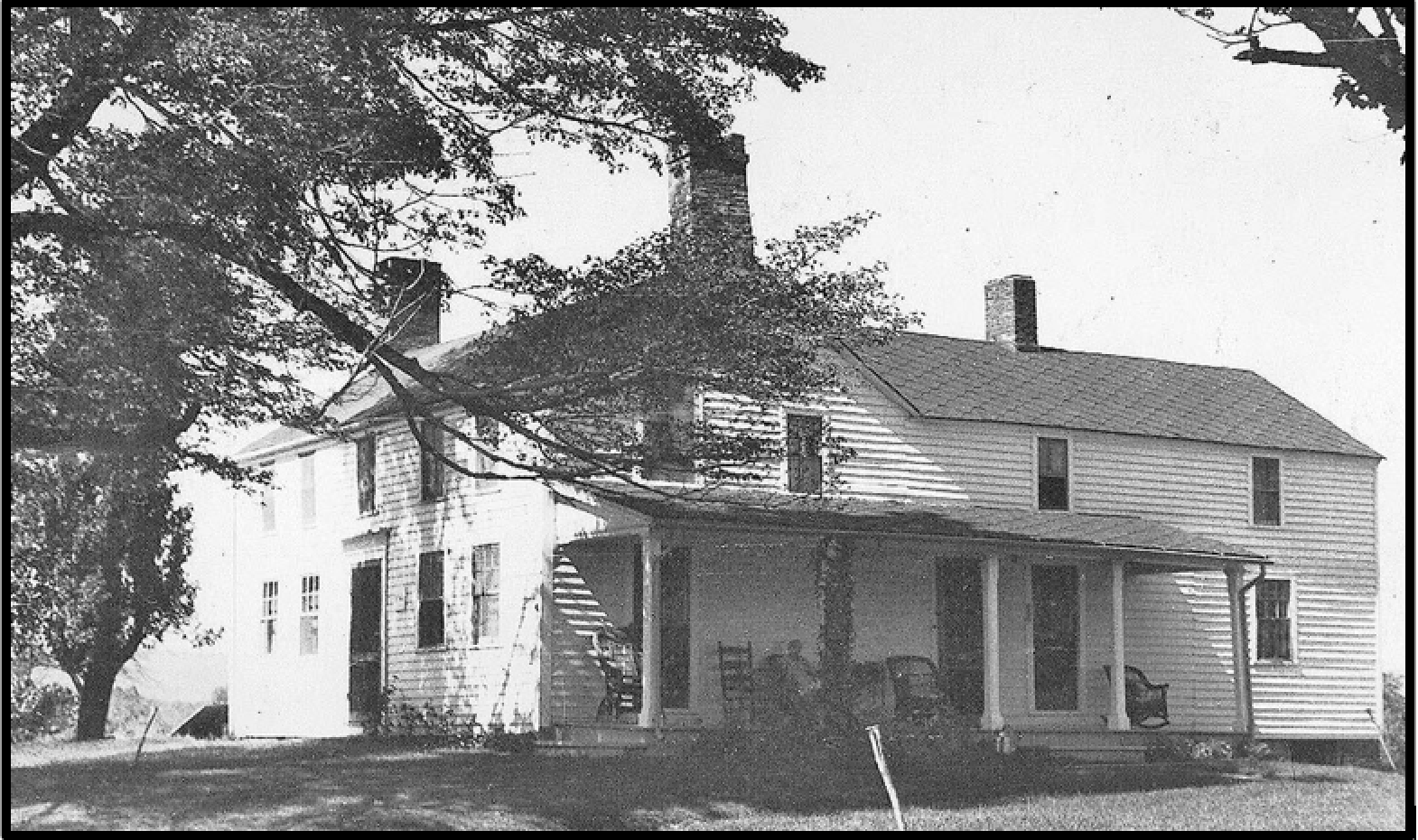
W.P.A. Federal Writers Project, Bloomfield, State of Connecticut

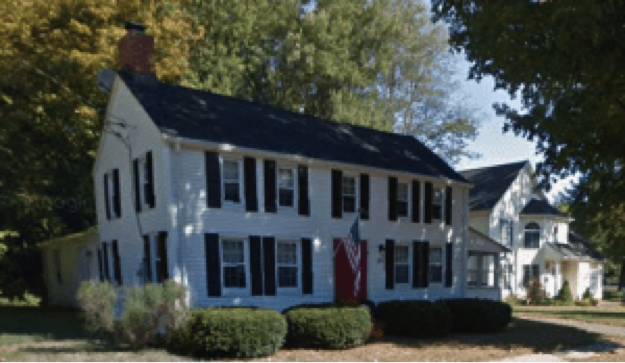
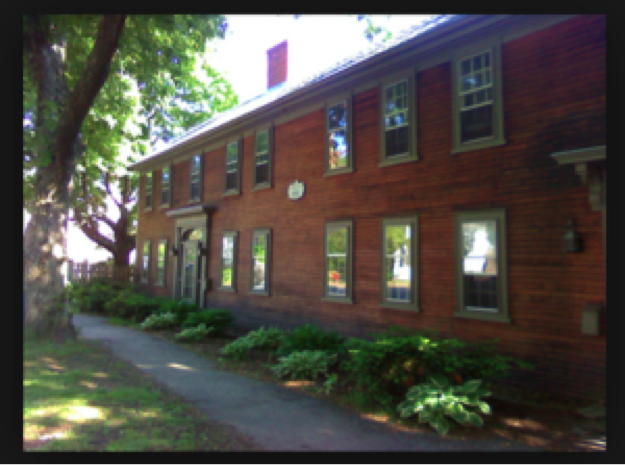
In 1935, the Federal Writers’ Project was created as part of the United States Work Progress Administration (WPA) to provide employment.  One of these projects in Connecticut was the Architectural Survey, Census of Old Buildings. According to a description provided by the Connecticut State Library, nearly 5,000 buildings were documented and often illustrated with photographs.  Included in this collection is the home (built by/for) my 5th great-grandparents Samuel Eggleston (1747-1837) and Dorcas (Loomis) Eggleston (1752-1834). How cool is it to see the house, which still stands and to know that several generations of the Spencer and Eggleston families lived in the house!

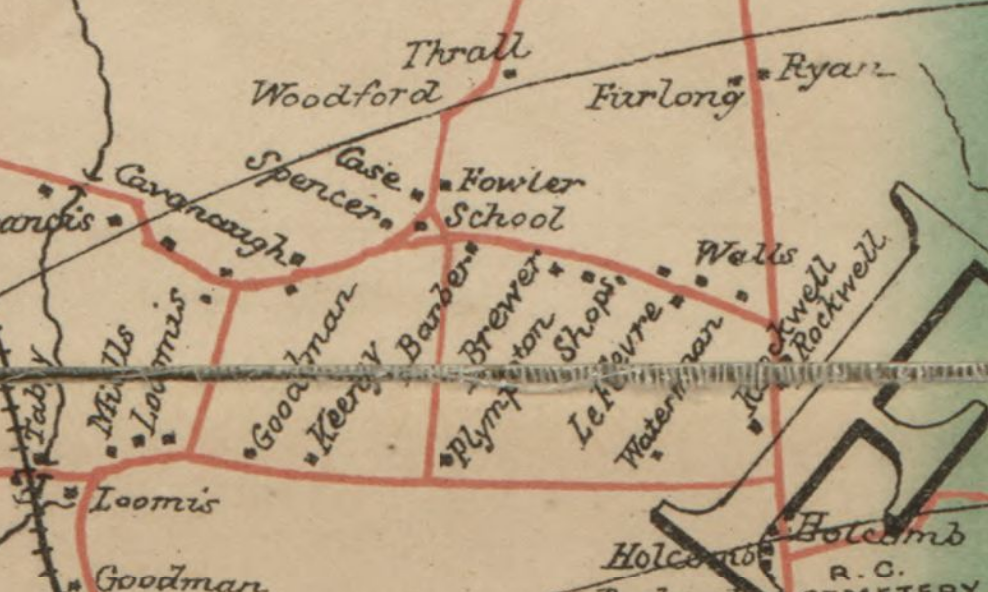
According to a very well informed cousin, this 1886 map of Bloomfield, Connecticut (below) highlights how proximity can be the path to marriage. The Fowler family moved from Suffield, Connecticut to Bloomfield sometime after 1880. In 1889, Minnie M. Fowler married Samuel Spencer from across the road (they are my great-grandparents), and in 1890 George T. Fowler married Eugenia Thrall, from just up the road (my cousins great-grandparents)!

1884 – Driving Chart of Hartford and Vicinity (LOC)

Architectural Survey Information

Title: Bloomfield historic building 023

Date [built](Source): 1780 (marker)

OriginalOwner: Samuel Eggleston

Present Owner[1935-37]: F. L. Putnam; Julia and Frank Spencer

Julia and Frank Spencer were the son and daughter of John W. and Anna Spencer (my 2 great grandparents), their other daughter, Alma Spencer, was married to Frank L. Putnam. (I wonder who is sitting in the shadows on the porch?)

Location:Faces south on Park Avenue, corner of School Street.

Description[Material]: Wood

Roof: Peak(rather flat)

Chimney Type/No.of: Brick / end / 3, 1 in ell

Height: Two stories and half (small)

Ell:  21/2 story rear ell with brick central chimney.

Fenestration:9 window front; paired; 6/1 sash.

Overhang:None

Foundation: Brick

Condition -Physical: Good

Authenticity:Remodeled

Exterior:Side porch. Rear additions. Clapboarded walls.

Interior: One fireplace. Original front stairs.

Comments and corrections appreciated. Copyright © 2022. All Rights Reserved by David R. French


New Hampshire’s Founding Father – William Hilton

In November 1621, thirty-five colonists on the ship Fortune arrived in Plymouth from England. According to their published accounts, “they found the (Plymouth) settlers in very low condition – many were ragged in apparel and some little better than half naked. The best dish they could offer their friends was a lobster or a piece of fish without bread or anything else but a cup of fair spring water” It is believed that the timely arrival of Fortune ensured the future of the first settlement at Plymouth.

On board the Fortune was my 10th great-grandfather (maternal), William Hilton. Below is a letter that William Hilton wrote to his cousin Anthony Hilton of South Shields, England after arriving in New England.

Loving Cousin,

Three Visitors to Early Plymouth: Letters

In 1623, two
more ships, the Anne and the Little James, arrived carrying some 90 new
settlers, including William’s his wife, son and daughter. In 1623/4, William
and his family (including his brother Edward) left Plymouth and relocated to
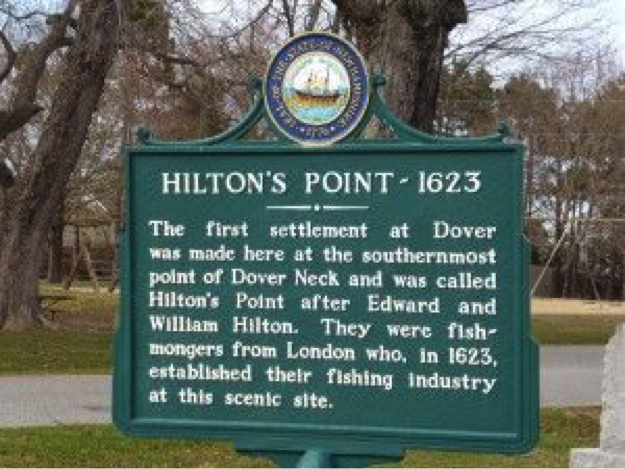
would later be known as  Dover, New Hampshire. They were the first
non-natives to settle in this region.  William and his brother are often
referred to as the founding fathers of New Hampshire. By 1648, he had moved
approximately 11 miles to Kittery, Maine where he is listed as a tavern keeper
and a ferry operator.  “Mr. William Hilton, being licensed for to
keep the ordinary (tavern) at the mouth of the river of Pascataquack and that
none other shall keep any private ordinary there, nor to sell wine, beer nor
liquor upon any pretense.”  
A year later he was admonished for
not keeping “victual and drink at all times for strangers and
inhabitants.”  William died in in 1656 in York, Maine.

Side note:  On the return journey the Fortune was captured by French
pirates in the English Channel who pilfered the hold of all the goods. 
However, the pirates did not take or destroy the settlers letters.  One of
those letters contained the only account of the Pilgrims’ first Thanksgiving
dinner! (Letter from Edward Winslow 11 Dec 1621)

Part II of
this post will focus on the exploration of the Carolina’s by William’s son who
had a head for navigation.


Which Abram Are You?

Between 1803
and 1815, three sets of parents named three babies Abram French.  They
were born within 25 miles of each other in the Boston region of Massachusetts
and lived most of their lives in close proximity.  One became a crockery
merchant in Boston, another the owner of a leather making factory in Framingham
and the third was a clothing merchant in Lowell.  All were very successful
businessmen in the early-mid 1800’s.

While doing
genealogical research, a common name or geographic location can often create a
roadblock or confusion.  In this case, I have a clear genealogical record
of Abram French, my 3rd great-grand father.  However, I kept coming across
the other Abram’s and wondered if they might be related and/or did they know
each other?   It is also fun to imagine that they might have been in
the same place at the same time together.  Below is a brief snippet about
each Abram.

(My) Abram French – Born in 1803 in Billerica, Massachusetts the son of Luther French and Sarah Bowers.  Married Elizabeth Simonds.  He died at Lowell, Massachusetts in April 11, 1879.

I have written about Abram previously, you can read a post on his life and also a separate story about his brother Walter who died in a train crash in Connecticut.

Abram French – Born in
1815 in Chelmsford, Massachusetts to Ephraim French and Rebecca Abrams. 
Abram married Sophia Cobb and had 8 children. He died in May 1884 in Jamaica
Plain, Massachusetts.  Abram was a very successful crockery, glassware and
china dealer in Boston.  This Abram is related to my Abram through their
common 4th great grandfather William French (1603-1681)!

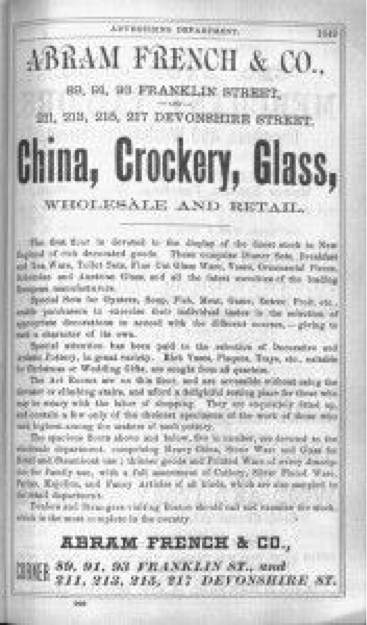
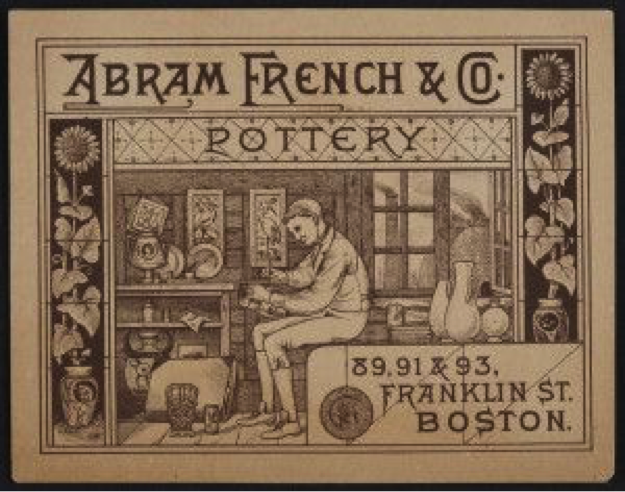
Boston and Bostonians – Abram French & Co. – “One of the finest and
undoubtedly one of the most extensive establishments in this line of trade on
the American continent is the old established.  Leading Manufactures and
Merchants of the City of Boston, 1885.”

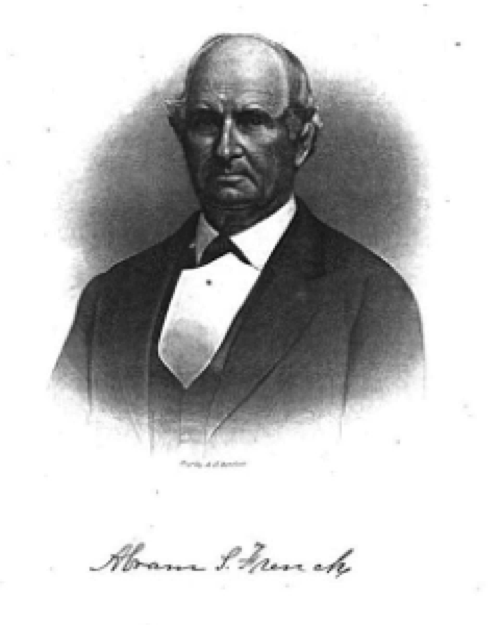
Abram
Stickney French
– Born in 1809 in Boston,
Massachusetts to Abram French and Elizabeth Kidder.    Abram
married Lois Page Richardson and had 4 children. He died in March 1896 in
Townsend, Massachusetts.

At this time,
I can find no genealogical connection between this Abram S. and my French
family line.  However, his wife was from Billerica where another Kidder, a
generation prior, had married someone in my family line.  For now, I will
leave Abram S. in the possible column!

Abram S. made one or two voyages to the West Indies as a cabin-boy, but not being pleased with a maritime life he was sent to New Ipswich Academy, where he acquired a good education. He preferred a business life rather than to pursue a course of studies with the view to enter upon one of the learned professions.

In 1833, he
built a morocco factory on the brook running northeasterly from Bayberry Hill
(Framingham), near its confluence with the river, and near where James Giles
built his sawmill. This establishment was in successful operation for twenty
years, employing constantly ten or twelve workmen; and considering the length
of time the business was prosecuted, it must have been a source of wealth to
the proprietor.

Morocco
leather is made from goatskin, it is tougher than sheep or cow skin, and its
denser texture makes it more suitable for being worked into a variety of
products. To produce the distinctive red Morocco color, the untanned but cured
leather is soaked in a dye made from dried insects.

In 1853, he
went to Lockport, NY. and stocked a tannery, where he carried on business
successfully with a partner, to whom he sold his interest in the business in
1858, and removed to Wellsville, N. Y., and built an extensive tannery, and
pursued that branch of industry for several years, doing a large and profitable
business. Partially losing his health, and seeing a good chance to sell out, he
disposed of this factory and its stock in trade and retired from business in
1864.

Mr. French
has always been fond of books, which, during the days of bad health, have been
a source of pleasure to him. He has a retentive memory is well posted on
historical matters and possesses a large amount of miscellaneous information.
He gives liberally to the poor, and enjoys life at his advanced age in a
remarkable manner. He is a member of the Republican Party, and in 1861-62 he
represented the Twenty-seventh District (Ashby and Townsend) in the General
Court.

Source: (Abram S. French) History of the Town of Townsend, Middlesex County, Massachusetts: From the Grant of Hathorn’s Farm, 1676-187


Special Delivery – Nova Scotia

Mouth of North River, Bras d’Or Lake, Cape Breton, NS

While scant information is available, history shows us that Effie MacPherson MacLeod was certainly made of sterner stuff.  Effie is my paternal 4th Great Grandmother.

In 1803, six-year old Effie came from the Isle of Skye, Scotland to Prince Edward Island, Canada with her family.  Later, with her husband Robert MacLeod, she moved to Lake Ainslie and Pleasant Bay, Cape North and finally Victoria.  In 1828, she made the trip from Pleasant Bay to Cape North in an open boat.  During that perilous voyage, Effie gave birth in the boat to her son Angus MacLeod.  Effie was a midwife and was for a time the only doctor in the Cape North area.  According to a history of the region, Effie journeyed  on horseback and snowshoes to reach those in need of her services

Marie-Henriette LeJeune Ross 

In
researching Effie, I came across another pioneer midwife who lived in north
Cape Breton during the same period.  In Nova Scotia, the story of Granny
Ross is widely known and she is considered to be a “trail-blazer in the
world of women in science.”

During the
learning years of her adult life, Marie-Henriette became aware of her gifts as
a healer and midwife. The legend of Granny Ross began in Little Bras d’Or,
where she cared for and saved the lives of many settlers during a smallpox
epidemic. Since she had already contracted the disease, she was immune to its
effects.

Marie-Henriette
can be considered a pioneer. She did more than just birth children in her
neighborhood. Settlers called on her for miles around and she used her
knowledge of plant medicine in the service of her fellow citizens until she
reached an advanced age. (Library and Archives of Canada)


You fought in the Revolution?

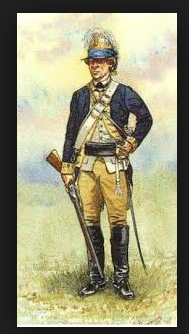
Second Regiment CT. Continental Light Dragoons

My paternal 5th Great-Grandfather, Samuel Eggleston, was born on December 9, 1747 in Windsor, Connecticut.  Samuel was the son on Nathaniel  Eggleston (1702-1792) and Abigail Goodwin (1708-1801) and the husband of Dorcas Loomis ( 1752-1834).

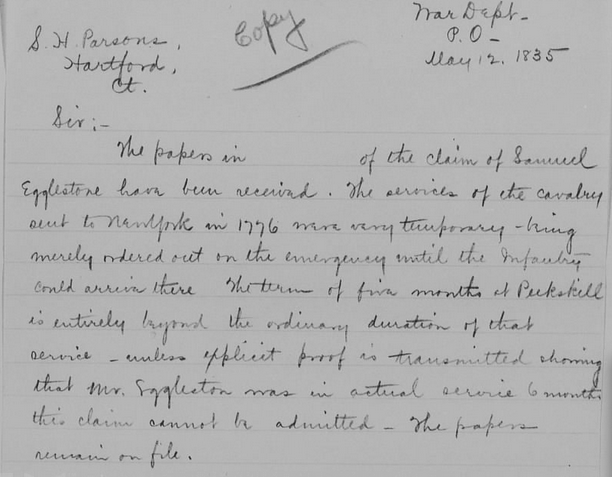
When Samuel was 88 years old, a pension was applied for on his behalf, as provided for by the Pension Benefit Act of 1832.  Truth be told, it alleges he did a bit of riding, saw no action and returned home.  The application claimed he was a soldier during the American Revolution. The petition states, that he entered the service of the United States as a private in a company of dragoons commanded by Captain Thomas Seymour, Lt. Reuben Ellsworth and Colonel Edward Griswold at Windsor in the County of Hartford in the State of Connecticut. He marched from Hartford, Connecticut to the Peekskill in State of New York and in a few days crossed the Hudson River and proceeded to Hackensack and afterward Newark, then to Elizabethtown, then to New Brunswick and eventually New York.  He went with the company many places that the names of which he has entirely forgotten, – and returned in a different route to the Hudson River above Peekskill where they crossed the river where deponent was discharged in a place near Peekskill in the State of New York by General Charles Lee and returned home sometime (he is pretty certain) the later part of December 1776.

After review, the petition was rejected stating that Samuel “failed to furnish satisfactory proof” of his service. There was no record that the decision was contested.

REJECTED

Click here to see Samuel’s complete transcribed pension petition

More about the 1832 Pension Act.

On June 7,
1832, Congress enacted pension legislation extending benefits more universally
than under any previous legislation. This act provided for full pay for life
for all officers and enlisted men who served at least 2 years in the
Continental Line, the state troops or militia, the navy or marines. Men who
served less than 2 years but at least 6 months were granted pensions of less
than full pay. Benefits were payable effective March 4, 1831, without regard to
financial need or disability and widows or children of were entitled to collect
any unpaid benefits due from the last payment to a veteran until his death.
Everyone who claimed benefits under this act were required to relinquish their
claims under any prior federal or state pension laws, but by amendment on
February 19,1833, invalid pensioners were exempted from the operation of this
release of their prior pension benefits. Source