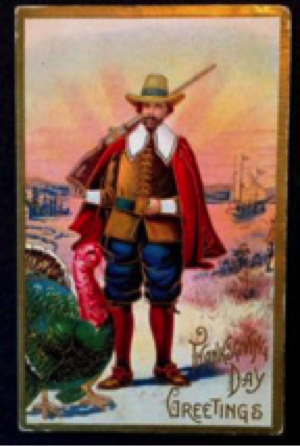
Puritans + Thanksgiving

Fowler Family Post Card 1908

Two of my posts highlighted relatives who lived in New England in the mid-1700’s.  They describe how my 8th great-grandfather Humphrey Atherton persecuted Quakers while my 7th great-grandfather’s step-brother, Benanuel Bowers was persecuted for being a Quaker.  Researching and writing about the history of America through the lives of distant relatives is a great experience.  However, the posts about Atherton and Bowers illustrate the fine line’ between myth and reality and (for me) create a struggle on how to accurately portray these stories.  I always question if I am getting the historical context correctly. In 2016, the Washington Post ran an excellent story (below) by Lori Stokes about the Puritans.   I dropped her a note and she was kind enough to respond!

Five myths about Puritans – Washington
Post – November 20, 2016

I visited your blog and it’s very interesting. Keep up the good work! Family histories and historians are invaluable to the body of research. Together, eventually we’ll get everyone in the record.

Lori Stokes

© David R. French and French in Name Only, 2019. Unauthorized use and/or duplication of this material without express and written permission from this blog’s author and/or owner is strictly prohibited.


The Trowbridge Saga: Abandonment, War, and a 40-Year Court Battle

Thomas and Elizabeth (Marshall) Trowbridge are my 8th great-grandparent’s on my paternal line. Thomas’ life was a whirlwind of high-society status and low-level betrayal. Born into a English wool dynasty, he moved from Taunton, England to the Massachusetts Bay colony in 1634-35 with his wife Elizabeth and two sons – Thomas, Jr. and William – (another son, James, was born 1636). They left their oldest son, John, with his grandfather in England.

In 1638, Thomas moved his family from Dorchester, Massachusetts to establish the Plantation of New Haven, Connecticut under the leadership of John Davenport, a Puritan minister, and Theophilus Eaton, a successful merchant. (Background: The New Haven Town Plan)

+ James (1636-1717), the youngest son of Thomas and Elizabeth, born in Massachusetts, is my 7th great-grandfather.

The Great Abandonment

In 1641, following the death of his wife Elizabeth at the age of 37, Thomas decided to return to England, but his decision was disastrous:

  • The “Home Alone” Move: He left his three sons, Thomas, Jr., William and James (ages 10, 8 and 4) in the care of his business steward, Henry Gibbons.
  • The Ultimate Betrayal: Entrusted with a sizable £500 estate, Gibbons instead seized the property and neglected the boys. The Court of Magistrates intervened and placed the children under the care of Thomas Jeffrey and wife to “be well educated and nurtured in the fear of god.”

The Captain and the Courtroom

Thomas never returned to his children. His “quick trip” to England turned into a permanent stay when he was swept up in the English Civil War, serving as a “Roundhead” captain for Oliver Cromwell’s Parliamentary forces.

While Thomas spent the rest of his life overseas writing letters “marveling” at Gibbons’ corruption, the legal battle dragged on for decades. Thomas eventually granted his sons power of attorney to finish the fight he started from across the Atlantic.

In 1680—nearly a decade after Thomas’s death and 40 years after the original betrayal—the Trowbridge sons finally won and the property was deeded back to them.

Brockett’s Map of New Haven in 1641 (Trowbridge property – lower left)

© David R. French and French in Name Only, 2026. Unauthorized use and/or duplication of this material without express and written permission from this blog’s author is strictly prohibited.

Questions, Comments and Corrections are Appreciated


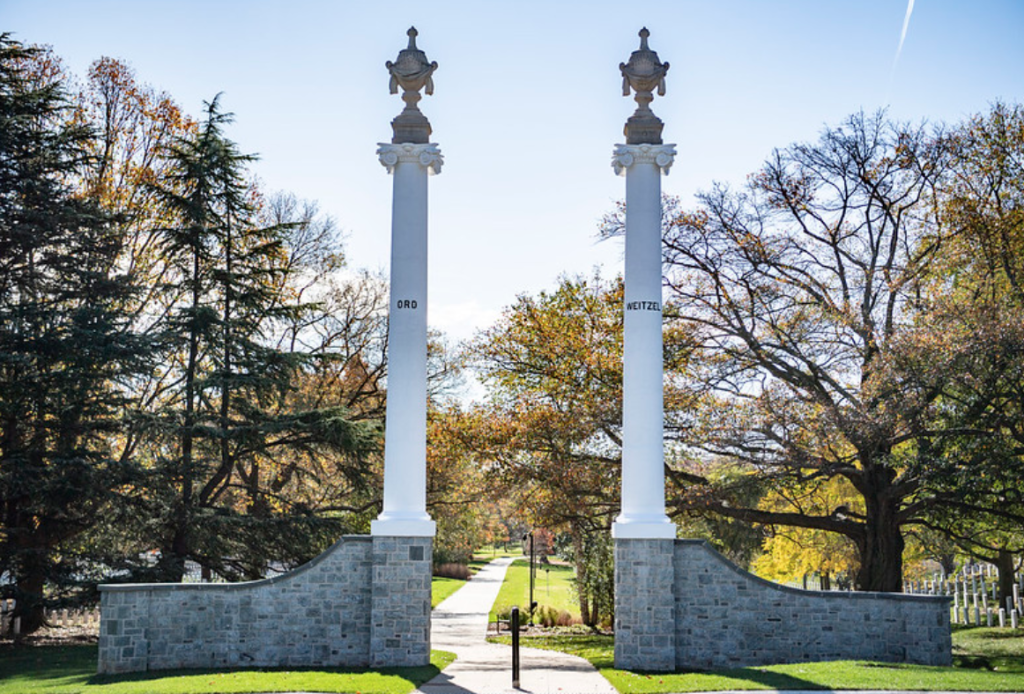
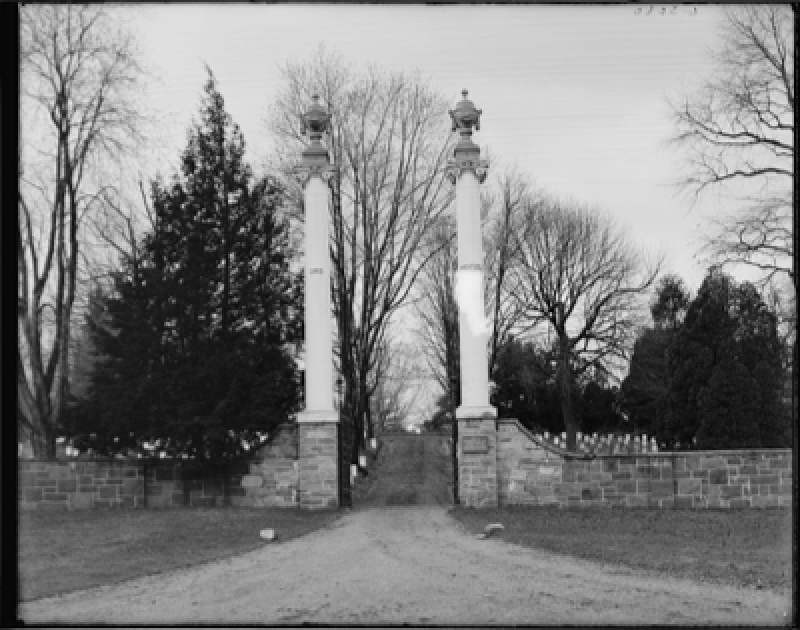
Ord and Weitzel Gate – Arlington National Cemetery

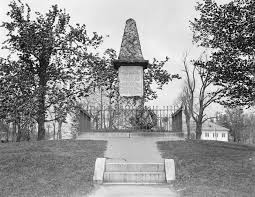
Ord-Weitzel Gate c. 1900-1920

The gate, located at the north entrance to Arlington National Cemetery (ANC), is dedicated to Union Civil War Major Generals Edward Ord and Godfrey Weitzel. Exiting the ANC, the gate provides access to the the U.S. Marine Corps War Memorial and Netherlands Carillon.

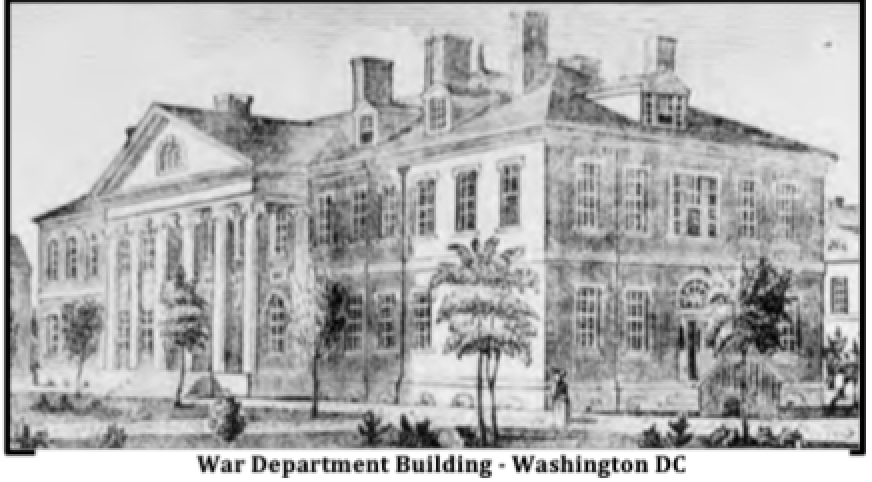
Originally completed in 1879, it was constructed from two 35-foot high sandstone Doric columns salvaged from the demolition of the United States War Department Building (now the site of the Eisenhower Executive Office Building). The gate was initially not dedicated to anyone. In 1971, the gate was dismantled and the columns, marble pediments, and iron gates put into storage. The gate was restored and re-positioned in 2022 (photo at end – ANC Blog: Ceremony for Reopening of Historic Ord and Weitzel Gate)

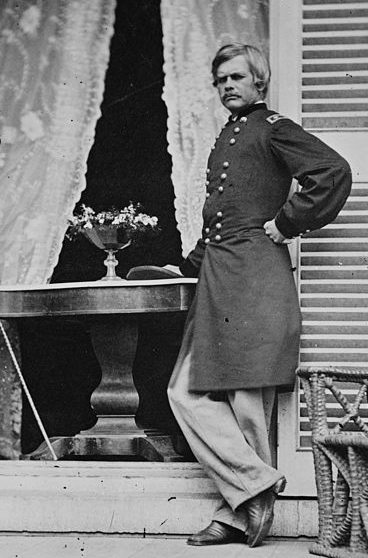
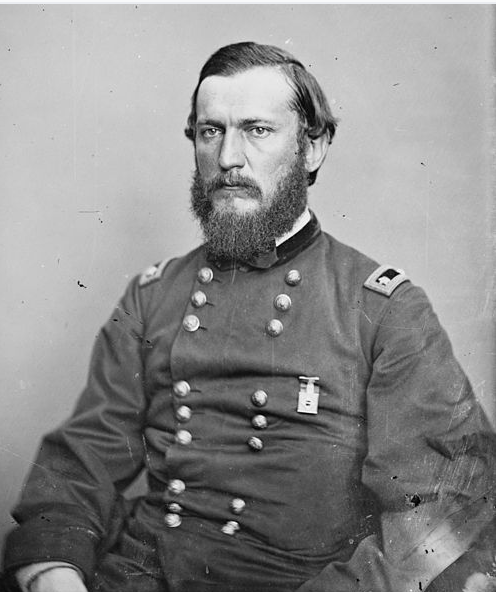
General Ord (photo left) – “He returned to service in January of 1865, and took command of the Army of the James during the Appomattox Campaign.  His men served a crucial role in the Union breakthrough at Petersburg. At the end of the campaign, Ord ordered a forced march which relieved General Philip Sheridan and his men, and helped force Robert E. Lee to surrender.” Edward O.C. Ord – American Battlefield Trust.

General Weitzel (photo right) – “It was not the short, bearded general from Galena, Ill. (U.S. Grant), who seized the Confederate capital; instead, it was a tall young officer, measuring 6′ 4″ and hailing from Winzeln, Germany, Godfrey Weitzel, who bravely led the all-black 25th Army Corps of Union troops into the Confederate capitol of Richmond on April 3, 1865.”

“The bright young engineer was promoted to full major general at age 29 and given command of an entire Army Corps, the 25th Corps. This corps was unique in that it was comprised solely of black troops, the only such corps in the Union Army and the very last corps formed during the war.” The Engineer Who Captured Richmond – The Society of American Military Engineers

Sources:

Photographs – Ord and Weitzel – From Wikipedia

Detroit Publishing Co., Publisher. The Ord-Weitzel Gate, Arlington, Va. United States Arlington National Cemetery Virginia, None. [Between 1900 and 1920] Photograph.

US Army Center of Military History, Secretaries of War and Secretaries of the Army (p.11)

Copyright © 2025. All Rights Reserved by David R. French. Questions, Comments and Corrections are Appreciated.


“Noise! You’ll have noise enough before long! The regulars are coming out!”

On April 19, 1775, the first armed conflict of the American Revolutionary War took place on the village green in Lexington, Massachusetts. I picture the tension in those early morning hours—Paul Revere, William Dawes, and Samuel Prescott had just alerted the local militia, and two of my 5th great-grandfathers, Joseph Simonds and Joel Viles, stood among the seventy-seven men of Captain John Parker’s Company. Together, they faced roughly 800 British soldiers at dawn, prepared to resist. The Midnight Ride of Paul Revere and Some Other Guys.

As the standoff unfolded, a shot suddenly rang out—its origin remains a mystery—and the British troops opened fire. Eight colonists were killed, and several others wounded, marking the beginning of open revolution. I feel immense pride knowing that my ancestors were there, part of that “shot heard round the world.”

Joshua Simonds, another of my relatives, recounted a striking moment: when the British arrived in front of the meeting house, Joshua was in the upper gallery with an open cask of powder. He cocked his gun, placed the muzzle close to the cask, and determined he would “touch it off” if the troops entered the gallery—a remarkable act of resolve and defiance. Joshua Simonds – Boston 1775 Blog.

Reflecting on the spirit of those times, I’m reminded of James Madison’s warning, “Accumulation of all powers…in the same hands…may justly be pronounced the very definition of tyranny.” And Thomas Paine’s words echo: “In absolute governments the King is law, so in free countries the law ought to be king.”

For my blog’s header, I gratefully feature the painting “Lexington Green 19th of April 1775” by Don Troiani, whose American Revolution and Civil War works capture these historic moments so powerfully.

Copyright © 2025. All Rights Reserved by David R. French


The Spencer Shops

My paternal grandparents were master craftspeople, running the premier woodworking shop in Hartford, Connecticut during the 17th and 18th centuries. Their handiwork produced exquisite furniture that stands as a testament to their artistry. Below I’ve included brief biographies of these gifted ancestors along with links to view some of the beautiful chairs attributed to their Spencer and Spencer-King workshops. Take a moment to admire the elegant lines and intricate details of their designs, passed down through generations of dedicated artisans. Their legacy of fine craftsmanship lives on in these striking pieces. The first chair noted, sold by Sotheby’s at auction, carried an estimate of $10-15,000!

Thomas Spencer (1607-1687) – My 9th great-grandfather

Thomas Spencer was one of four brothers who emigrated to the Massachusetts Bay Colony from England arriving in 1633, first living in Cambridge, Massachusetts and then moving to Hartford, Connecticut in 1636.  Thomas served in the Pequot War alongside Nicholas Disbrowe and later both of them had a long association as fellow woodworkers.

Nicholas Disbrowe (1612-1683) – My 9th great-grandfather

Nicholas Disbrowe (Disborough/Desborough) was a carpenter/joiner/cabinetmaker from Essex, England and was an original founder of Hartford, Connecticut.  Nicholas was one of the earliest known American furniture makers and is famous for the Hartford Chest. “Disbrowe was no ordinary carver and his designs are distinguished by undulating bands of carved tulips flowing from stiles to rails without breaking, Disbrowe’s designs were carefully worked out to fit the individual piece and no two pieces were identical.”

Obadiah Spencer Jr. (1666-1741) – My 7th great-grandfather

Obadiah, a joiner and a turner, was the grandson of Thomas Spencer.  It is believed that Obadiah may have been trained as a turner by his paternal grandfather, Thomas, and as a joiner by his maternal grandfather, Nicholas Disbrowe. His uncle, Gerard Spencer (1650-1712), was also a skilled carpenter. 

Obadiah’s father was Obadiah Spencer Sr. (1638-1712) and mother Mary Disbrowe (1641-1709), the daughter of Nicholas.

“Obadiah’s shop produced fashionable turned chairs with shaped and carved crest rail and other decorative options in imitation of the sophisticated banister-back and cane-back seating furniture made in Boston.” (source: Sotheby’s). These chairs are products of the Deerfield, Connecticut turning tradition related to the Spencer-King workshops. of Hartford, Connecticut, was the grandson of Thomas Spencer (1607-1687), Hartford’s leading turner during the seventeenth century, and the principal leading joiner.”

Chair #1 Circa 1750 – Sotheby’s

Important William and Mary Black-Painted Carved and Turned Maple Bannister-Back Armchair, Attributed to the Spencer Family Shop, Hartford area, Connecticut.”

Description: It is a rare example of William and Mary seating furniture from the Connecticut River Valley with a fan and rosette carved crest rail and spool shaped finials. The armchair is attributed to the Spencer family workshop of Hartford since it displays distinctive characteristics associated with that shop. These include the placement of the banisters with the rounded side against the sitter’s back, the shaped rail below that terminates in carved volutes, and the turned rails between the arm supports and the seat rails. 

Five Colleges and Historic Deerfield Museum Consortium

Chair #2 Circa 1790-1820

Description: One of a pair of slat-back side chairs supported by turned posts surmounted with the spool finial characteristic of Deerfield area craftsmanship, and fit with the original, woven split ash seat.

Chair #3 Circa 1740

Description: Bannister-back side chair, painted black, attributed to the Spencer family workshop of Hartford, Connecticut. The chair has a solid arched crest rail; four turned banisters with the round side facing forward; flattened arch-shaped bottom rail; ball finials over similarly turned back stiles; trapezoidal rush seat; block-and-vase turned front posts ending in small modified Spanish feet; high front stretcher with vase-and-ring turnings in the center and three similarly-turned side and back stretchers; and plain back legs that are slightly flared near the floor.

Chair #4 – Circa 1740

Description: Attributed to the Spencer family workshop.  Bannister-back armchair with rush seat, covered overall with black and gold paint. The armchair has a solid arched crest rail; four turned banisters with the round side facing forward; shaped bottom rail; gilded ball finials on a vase shape over the two turned side rails; two plain arms ending in scrolled handhold; rush seat; turned front posts ending in small peg feet; high front stretcher with two turned ball in the center; and three turned side and back stretchers. The chair was originally painted red and later repainted black and gold, which was possibly added to compete with the fancy chairs being manufactured in the nineteenth century by Hitchcock and others.

Note: The Five Colleges and Historic Deerfield Museum Consortium is an amazing database of objects from the collections of seven museums in the Pioneer Valley of Massachusetts: the Mead Art Museum at Amherst College, Hampshire College Art Gallery, Historic Deerfield, Mount Holyoke College Art Museum, Joseph Allen Skinner Museum of Mount Holyoke College, the Smith College Museum of Art, and the University Museum of Contemporary Art at the University of Massachusetts, Amherst.

Copyright © 2022. All Rights Reserved by David R. French. Questions, Comments and Corrections are Appreciated

Getting Away with Murder – A Case of Influence

My mother’s “Aunt Kittie,” Catherine Ruth Grace was born in 9 November 1889 in New Britain, Connecticut to William J. Grace and Mary Courtney Grace. Her siblings were: Joseph, Edward and Raymond (my grandfather). Catherine married Arthur Pearce Fourette in 1913 and they had two children together, Helen (b.1915) and Ruth (b. 1916), it does not appear they lived together after the birth of the children.

Helen died in her first year of life and Ruth died in 1923, at the age of six (cause unknown). The 1920 census shows Catherine working as a clerk at Travelers Insurance Company and living with her mother, younger brother (Raymond) and daughter Ruth.

This post centers on a tragic incident involving Thomas F. Griffith, an elected constable and political leader in Middlesex County (Hartford, CT), that resulted in the death of Catherine’s daughter Helen. The details of the incident are supported and illustrated by court records and newspaper stories.

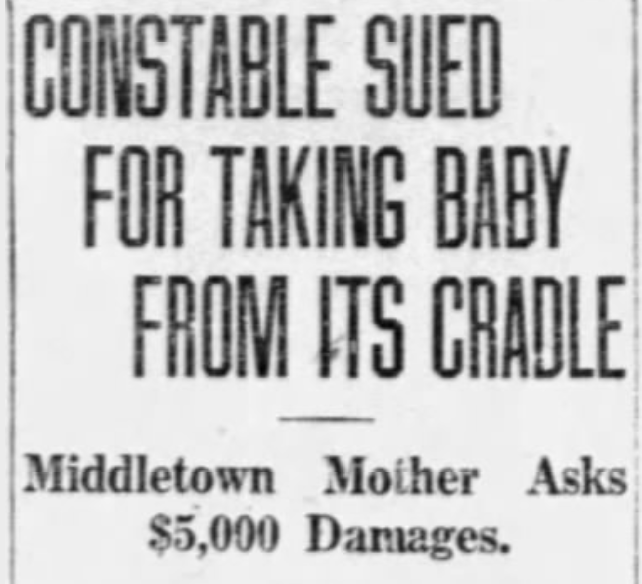
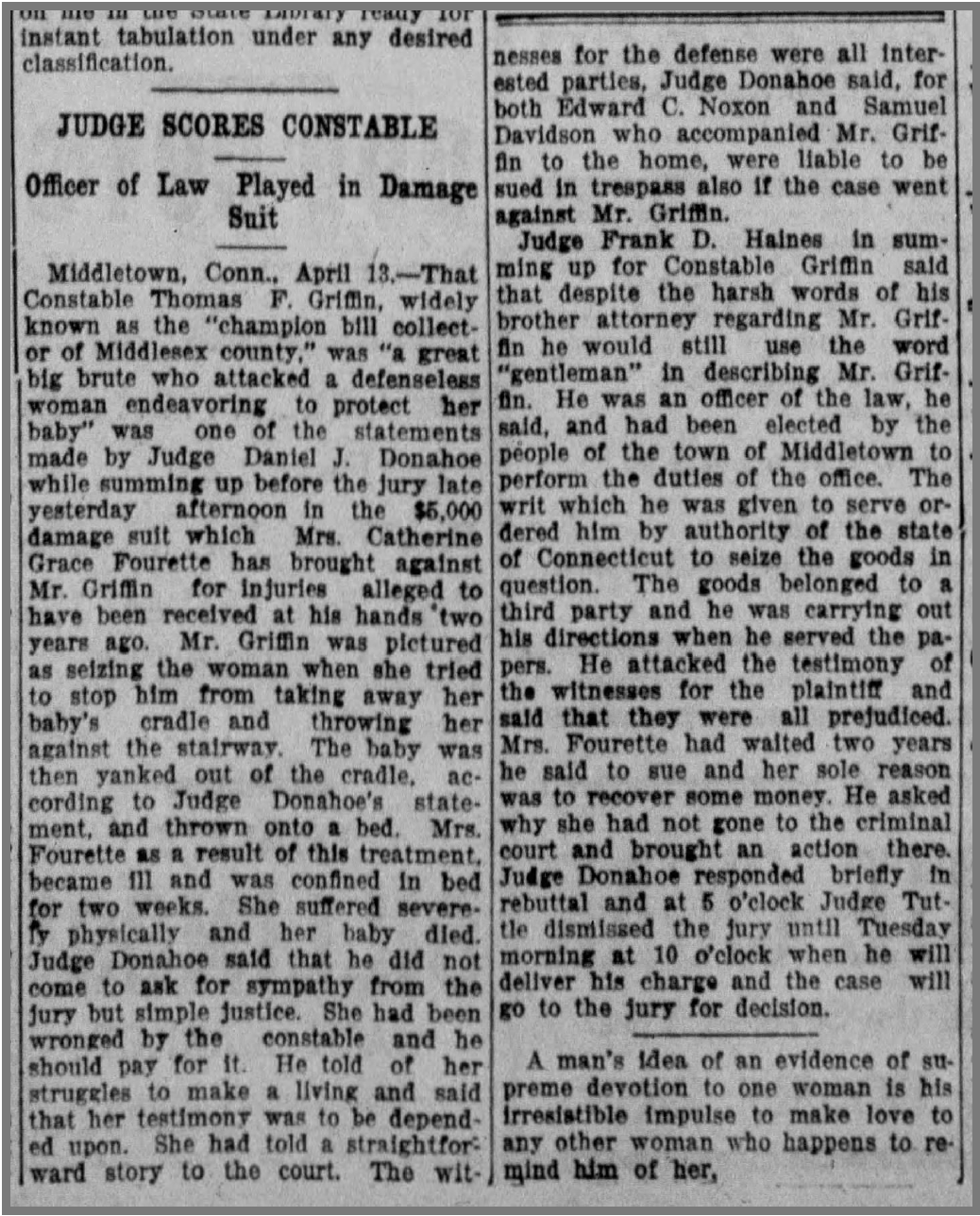
The Crime – On 13 March 1915, Thomas Griffin, an elected constable for Middletown, went to apartment of Catherine Fourette to serve court papers on her husband, Arthur, for the return of certain household furniture. Arthur was not living in the apartment at the time. According to news articles and court records, Griffin forced his way into the residence and in the process assaulted both Catherine and her infant, Helen. It is assumed that the injuries to mother and daughter led to the death of Helen. The actions of that day are described in an the below article “Judge Scores Constable” – The Journal (Meriden, Connecticut) · 13 Apr 1917.

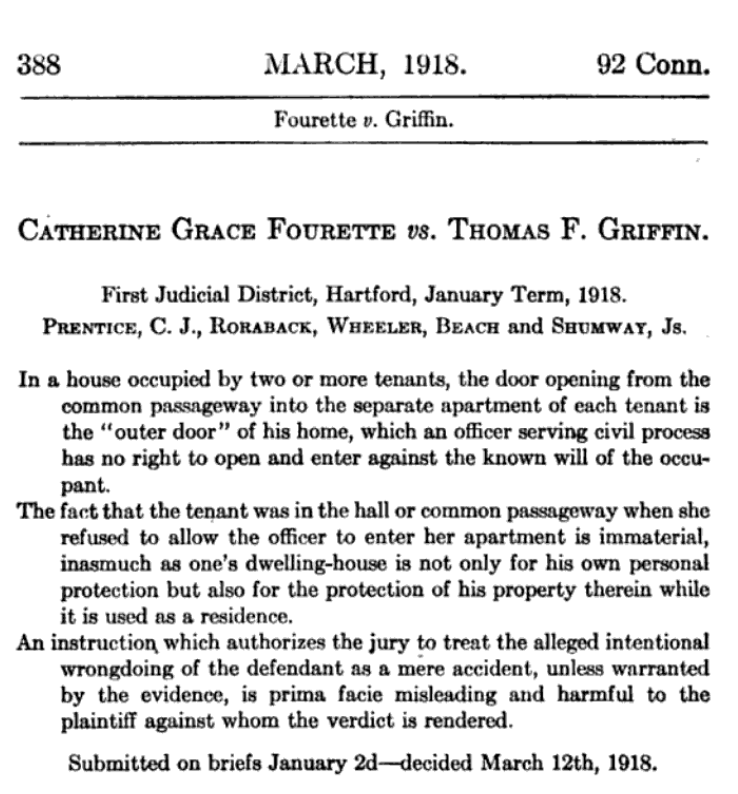
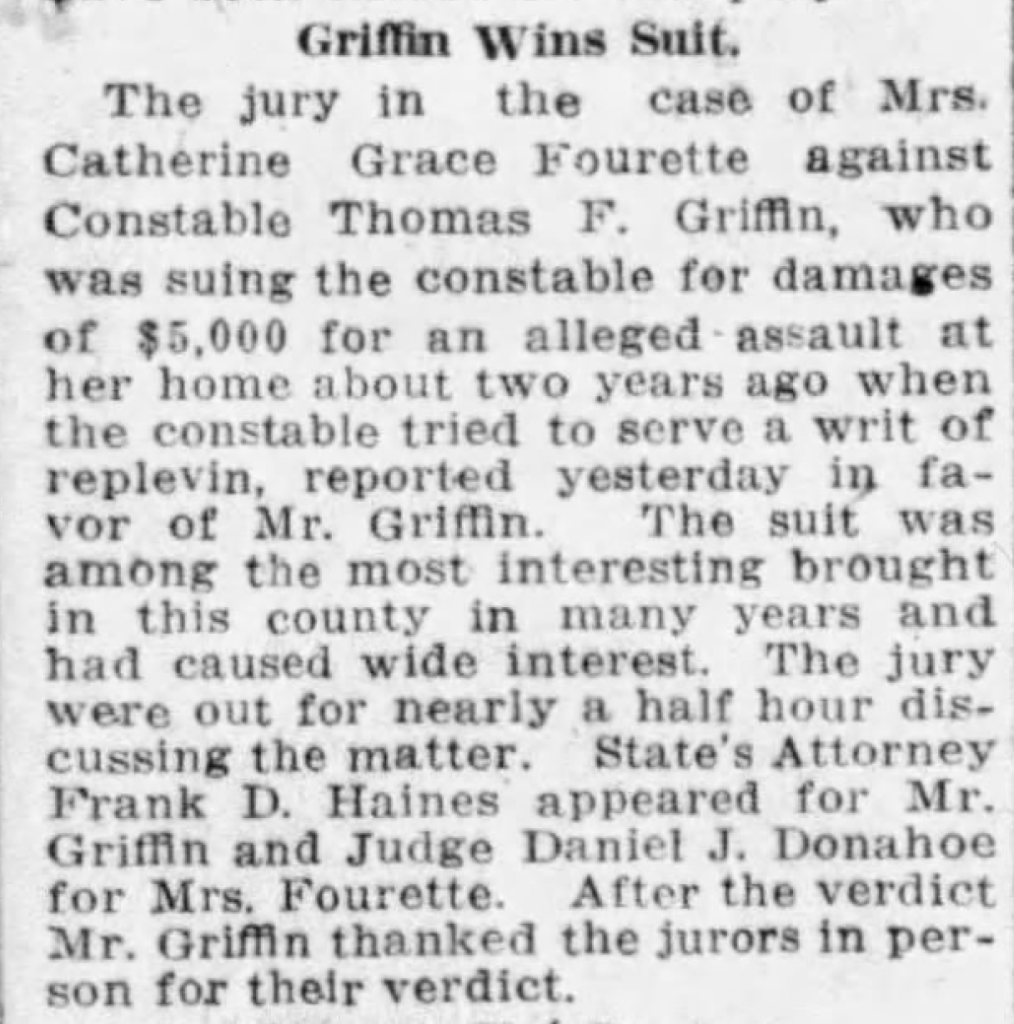
The Case – Almost two years the death of Helen and with no criminal action taken against Griffin, Catherine filed a civil suit alleging trespass and assault and seeking $5,000 in damages. After a trial, the jury found in favor of Griffin after a very short deliberation. This verdict was successfully appealed by Catherine’s attorney, Daniel J. Donahoe, and a new trial was ordered based on a biased statement by the judge to the jury that Griffin’s breaking of the door (into the apartment) was “accidental and unintentional.” The appeal, Fourette v. Griffin, provides very interesting reading.

Sadly, this is were the story ends. I have been unable to find record of a second trial or the case being settled out of court. However, this case set precedent by viewing a shared entrance/passageway in a house, with multiple apartments, as being protected against unreasonable search and seizure, an officer had no right to enter the property. Below are quick vignettes on Thomas F. Griffin and Catherine’s attorney, Daniel J. Donahoe.

“A great big brute who attacked a defenseless woman endeavoring to protect her baby.” Daniel J. Donahoe

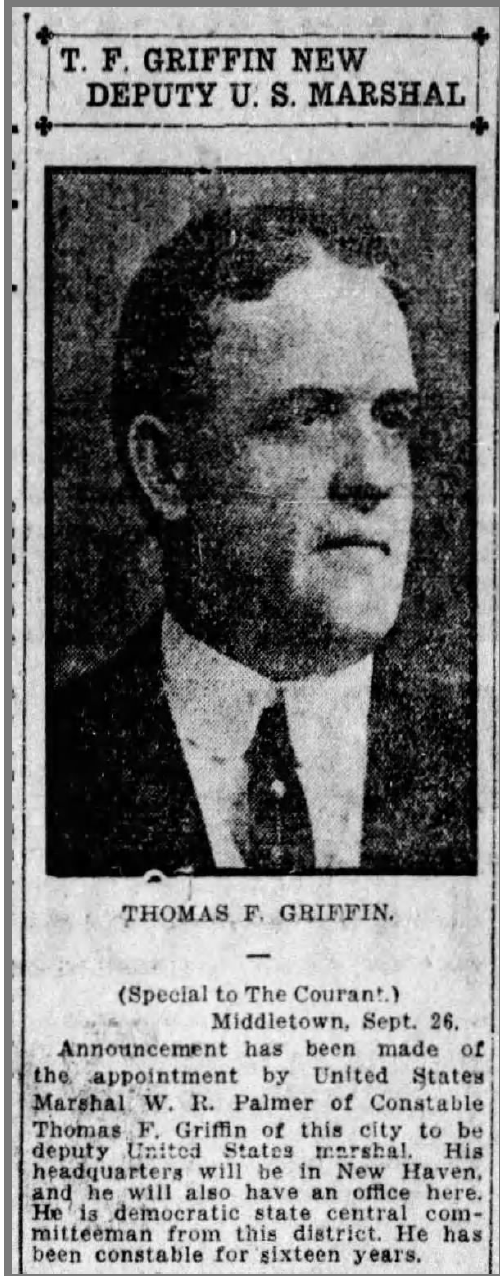
According to his obituary, Thomas F. Griffin (1870 – 1933) served as the elected town constable of Middletown, CT. for 27 years, was the Democratic town chairman and was also a member of the Democratic state committee. In 1920, he was appointed by President Woodrow Wilson to serve as a Deputy U.S. Marshall (article).

“Possessed of an indomitable will and ambition”

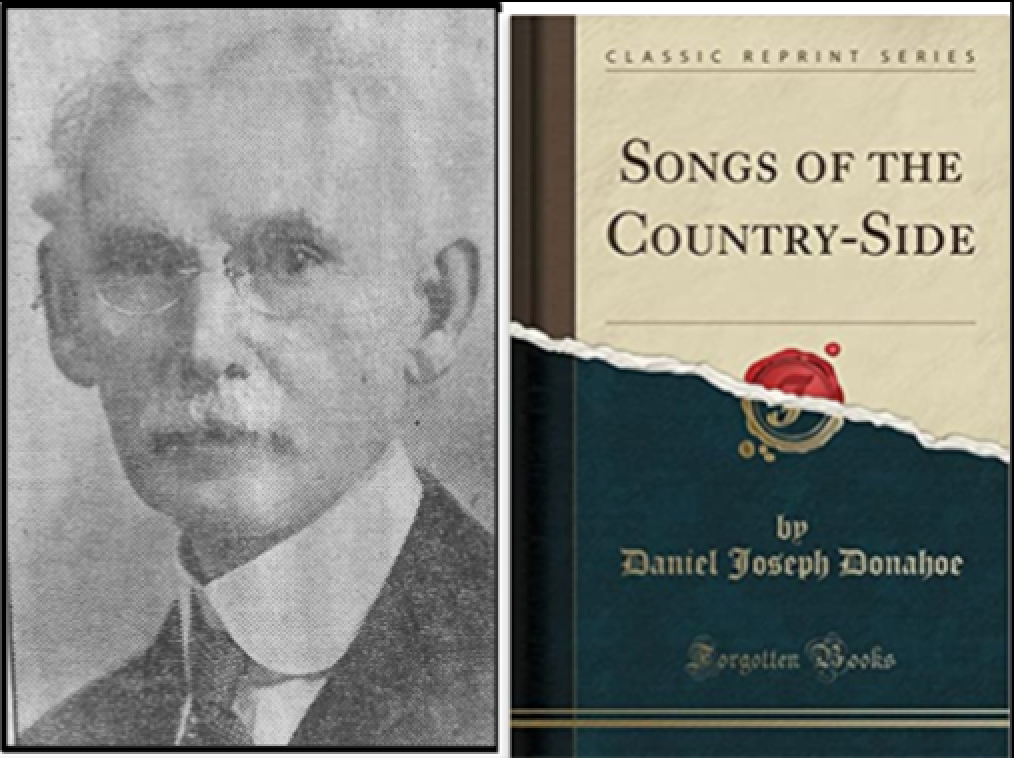
Catherine’s attorney, Daniel Joseph Donahoe (1853–1930), was very distinguished and respected. Donahue served as an Associate Judge (1887-1903) and Judge (1913-15) for the Middletown City Court. He was also the first lawyer to hold the office Public Defender for the Superior Court of Middlesex County. Donahoe was also a published poet. In 1914, Donahoe argued before the CT. Supreme Court on behalf of the plaintiff in ELIZABETH BROWN vs. THOMAS BROWN we held that a married woman could recover damages from her husband for an assault committed upon her by him.

Copyright © 2022. All Rights Reserved by David R. FrenchQuestions, Comments and Corrections are Appreciated


What to Make of It?

This story begins 25 years after the U.S. Civil War. The subject of this post, William “Willis” Craig, lived In the small farming community in Longview in East Texas. Willis was born enslaved in Georgia in 1856 and moved to Longview with his parents Lewis and Easter Craig.

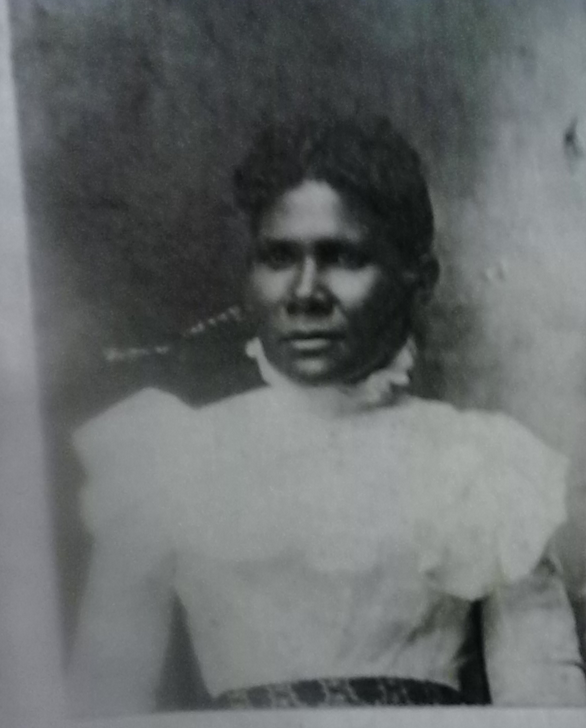
The 1880 Census for Longview, Texas notes that Willis (24) is working as a farm laborer and living with his 16 year-old bride Anna (Richardson) and their 1 year-old son, Devread. Anna just happened to be the daughter of his next door neighbor, Weakly and Sarah (Bryant) Richardson. (Photo R: Anna 1897)

Here is where the story takes an interesting turn.

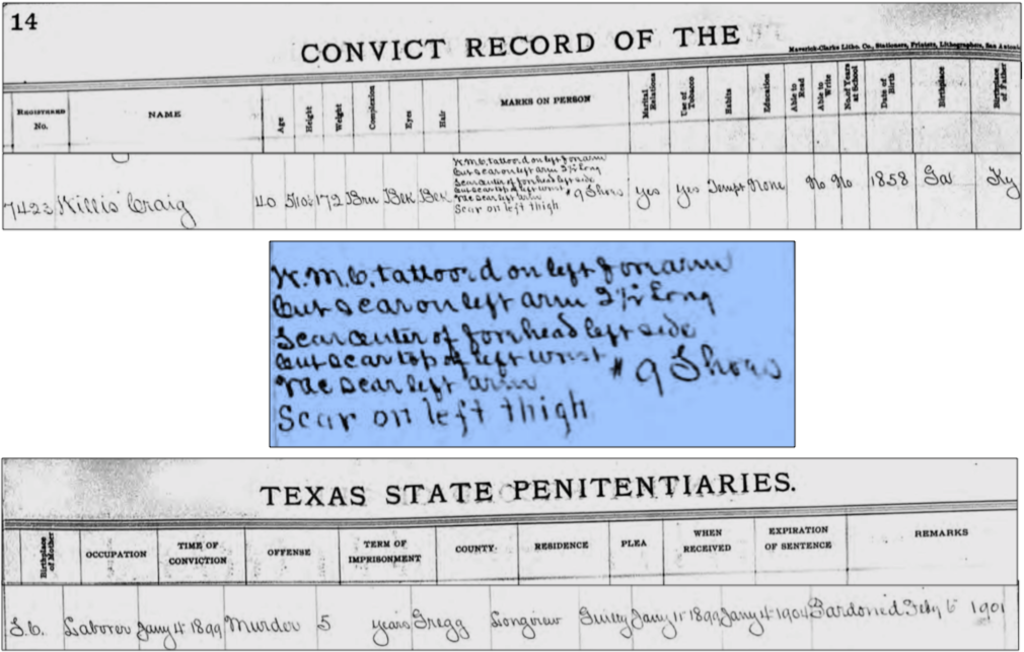
In the 1900 Census for Rusk, Texas, Willis is a recorded as a prisoner in the East Texas Penitentiary. Below is his “convict record” listing his age, weight, and distinguishing marks (in blue below) and term of sentence. The record notes that in January 1899, Willis was convicted of murder and sentenced to five years. However, Willis was pardoned in February 1901. No additional public records were found regarding the murder conviction and pardon.

Why was Willis pardoned after serving only one year of a 5 year sentence?

In the 1900 Census, Anna is living with Elderville, Rusk County, Texas with six of her children whose ages ranged from 2 to 18 years-old. (Children: Lucy, Louis, Joseph, Ulysses, Addie and Sarah)

In the 1910 Census for Depew, Oklahoma (300 miles north of Longview, TX), Willis and Anna are together with their children Sara, Addison, Ulysses, Joseph and Fannie Mae. Also living with them are the children of eldest daughter, Ida Dixon, whose names were Arthur, Eva, Essie and Ermon. There is no record of where Ida and Frank Dixon where living in 1910.

Note: Willis’ wife Anna died on 18 Aug 1912. After her death, Willis is shown in the 1920/30/40 Census’ living with his daughter Ida Wiggins in Depew.

In the 1920 Census for Depew, Oklahoma, Ida (34) and her husband Matthew (46) are living with their children Rebie (Wiggins) and Arthur, Eva, Essie and Ermon (Dixon). Also in the home was Ida’s father, Willis, and her sister Fannie Mae.

Here is the second turn in the the life of Willis Craig.

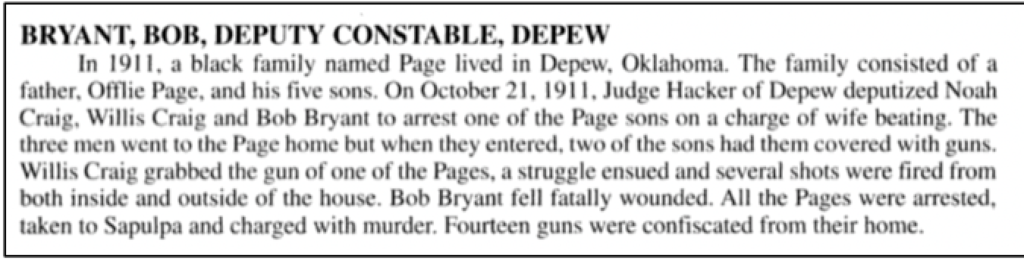
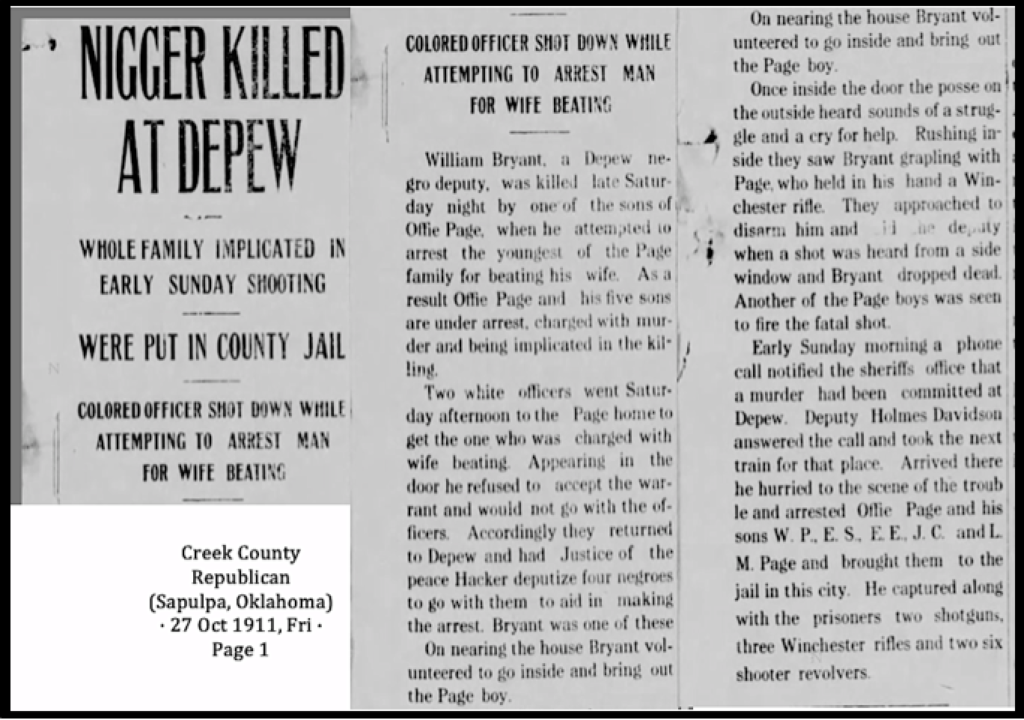
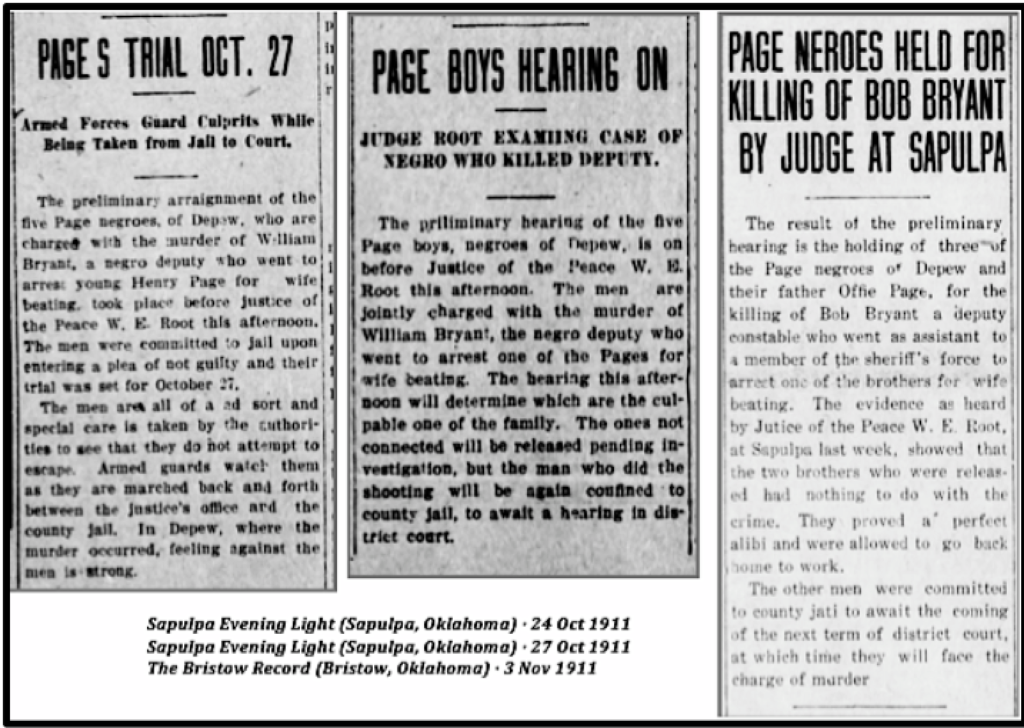
On Saturday, October 21, 1911 in Depew, Oklahoma, Willis and his brother Noah became witness to the death of William Bryant during an attempt to arrest of Henry Page who was accused of beating his wife. As reported in the newspapers, white deputies attempted to arrest Page and when unsuccessful, had four “Negroes” deputized by the Justice of the Peace. Willis and Page were deputized along with Bryant. Bryant apparently agreed to “go in and bring the Page boy out” and died when he was shot by one of the “Page boys” while Willis was struggling with Henry Page. It is interesting that that shots were fired from “inside and outside” the house, which seems to indicate that the white deputies outside were also engaged in the shooting.

Bob Bryant and the story of his death are memorialized by the Oklahoma Peace Officers Memorial. The news articles gave his name as William Bryant?

News articles (below) reporting the incident illustrate the nature of racism in 1900’s Oklahoma in their description of the murder. Sadly, I have been unable to uncover a record of the outcome of the case.


An Early Account of Lowell, MA by J.B. French

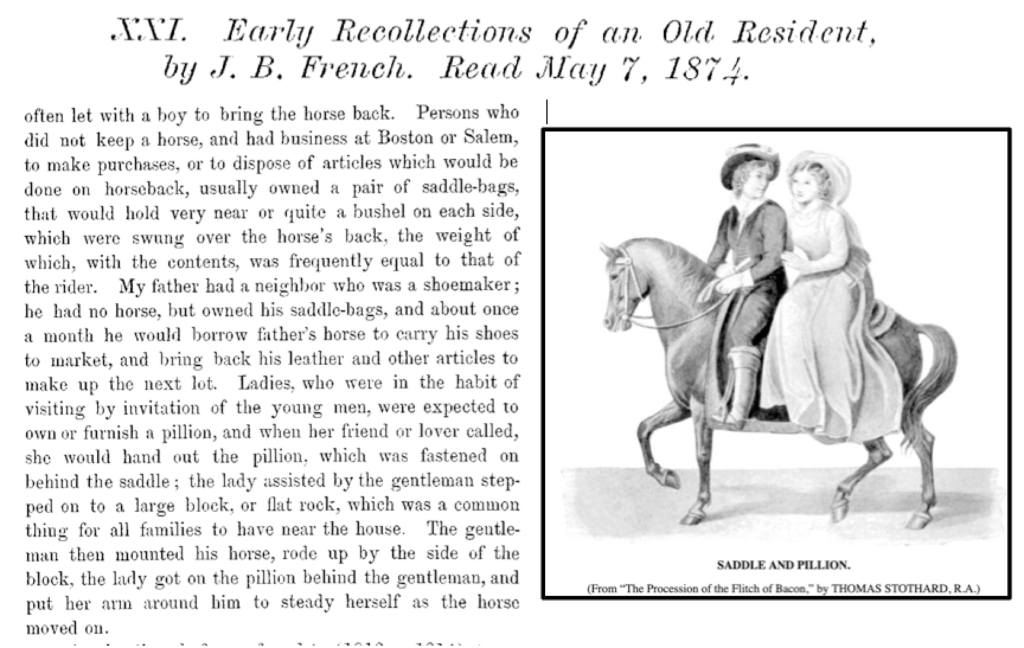
Below is an excerpt from a story told by Josiah Bowers (J.B.) French (my 3rd great grand uncle) from a collection of stories about the history of Lowell, Massachusetts in a book titled, “Contributions of the Old Residents Historical Association – Lowell, MA 1877. The Association was formed in December of 1868 by prominent (male only) members of the local community who were residents at the time of the city’s incorporation in 1836 and who had continuously lived in Lowell since that time and were at least 45 years of age. His recollections on early transportation in Lowell/Billerica/Boston includes a reference to his father, my 4th great grandfather, Luther French ( 1767-1846) and mentions the use of a pillion that was used when courting on horseback. That was a new term for me and sounds both romantic and perhaps uncomfortable! ( I added the illustration, it was not part of J.B.’s story).

I previously posted a story about the interesting and successful life led by Josiah in “The Brothers French.”

Copyright © 2022. All Rights Reserved by David R. French

Questions, Comments and Corrections are Appreciated


Yes, I am Posthumous (Sikes)

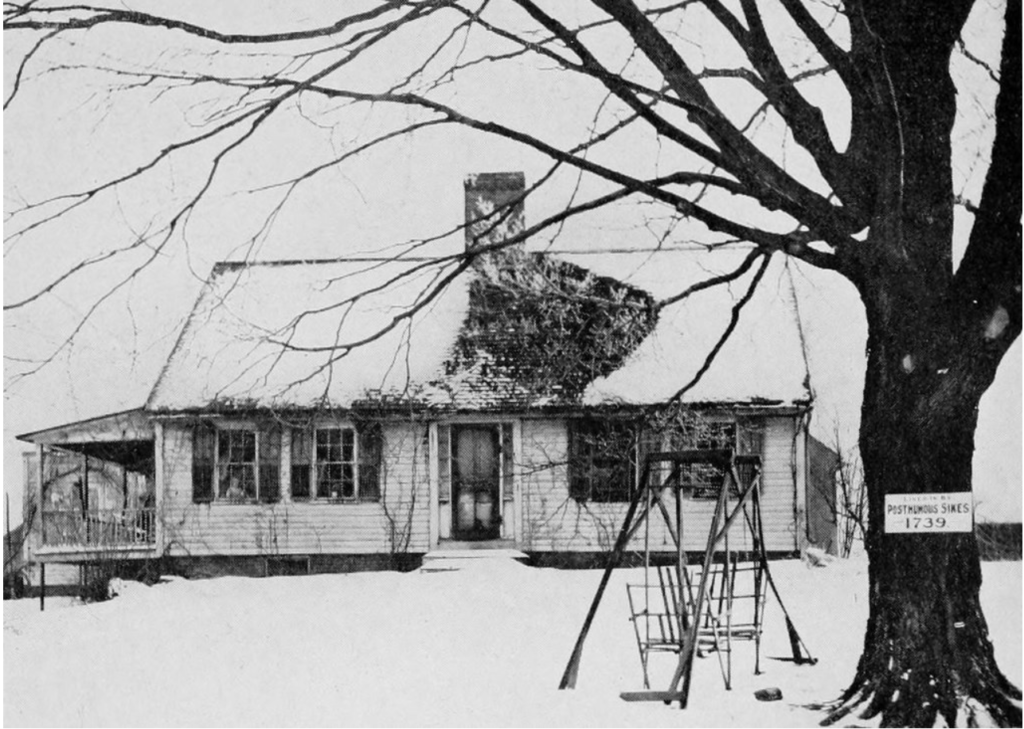
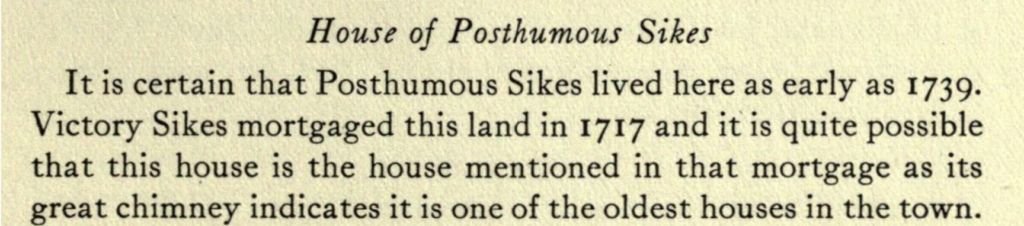
Perhaps the most unusual name in my family tree (other than Bygod/Beget Eggleston) is Posthumous Sikes, the grandson of my 7th great-grandfather Victory Sikes (1649-1708). Posthumous, a farmer in Suffield, CT., is my 1st cousin 7x removed.

According to a post entitled, Posthumous Sikes House, Suffield Connecticut, “The early Puritan settlers of New England would often give their children seemingly unconventional names, often preferring “Increase,” “Thankful,” and “Deliverance” to more Catholic-sounding names like Mary, James, and Peter. In the case of “Posthumous,” it was often given to a child born after the death of his father, and for Posthumous Sikes, he was born in 1711, seven months after his father Jonathan died. Posthumous married Rachel Adams around the same time that he built this house, and they had four children: Amos, Stephen, Shadrack, and Gideon. Posthumous died in 1756, and his son Shadrack later owned the property. The house appears to have remained in the Sikes family until at least the mid-1800s.”

Lost New England – July 9, 2015 by Derek Strahan

If it is not already on your frequent reading list, the Lost New England site is a great blog focusing on New England history.

Copyright © 2022. All Rights Reserved by David R. French

Questions, Comments and Corrections are Appreciated


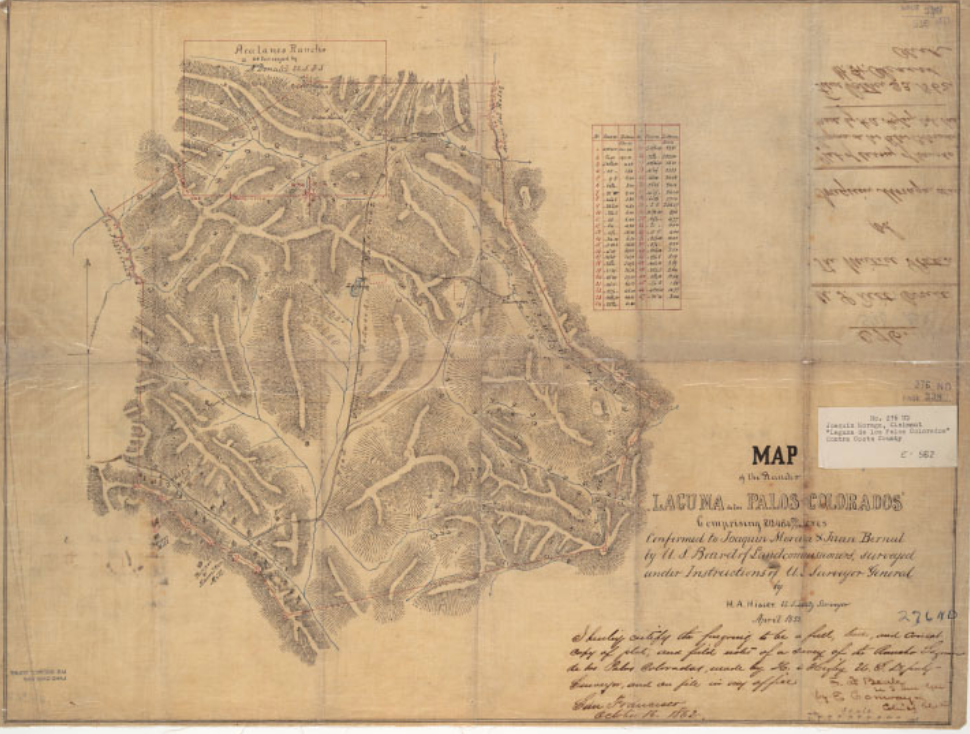
Moraga History – Rancho Laguna de los Palos Colorados

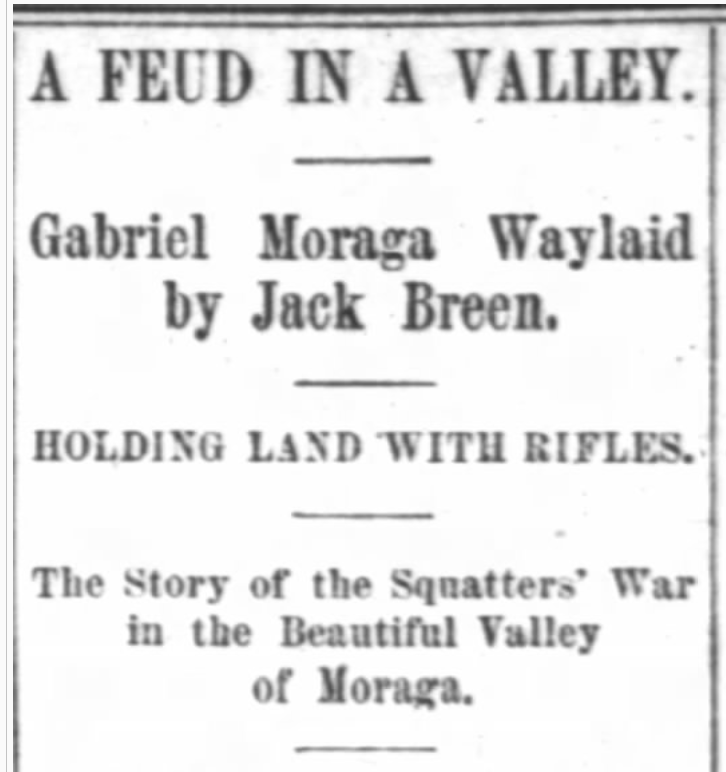
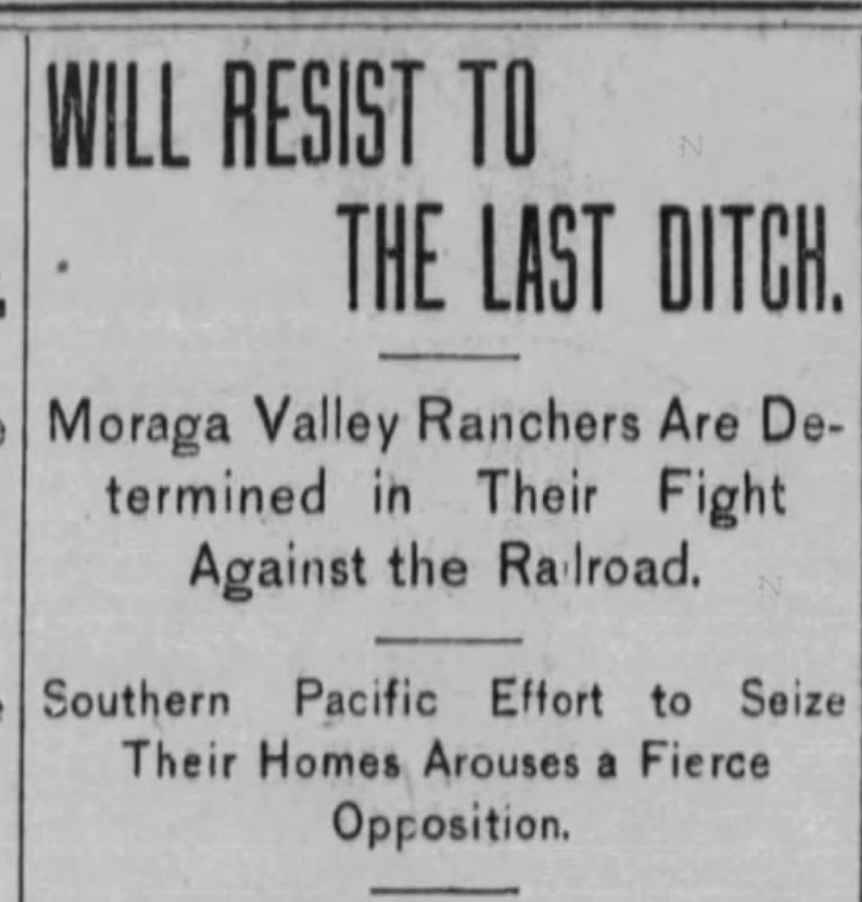
In the 1970’s, I lived in the small, suburban town of Moraga, California attending Donald Rheem Elementary, Joaquin Moraga Intermediate, and Campolindo High School. While there may have been times where I failed to listen to my teachers, I am certain there was never any mention of the history of Moraga, beyond it being a Mexican land grant (Rancho Laguna de los Palos Colorados) made to Joaquin Moraga. Below are two articles that provide a small glimpse into the history of Moraga and explore tales of a squatters war and of ranchers resisting a railroad expansion.

Copyright © 2022. All Rights Reserved by David R. French

Questions, Comments and Corrections are Appreciated